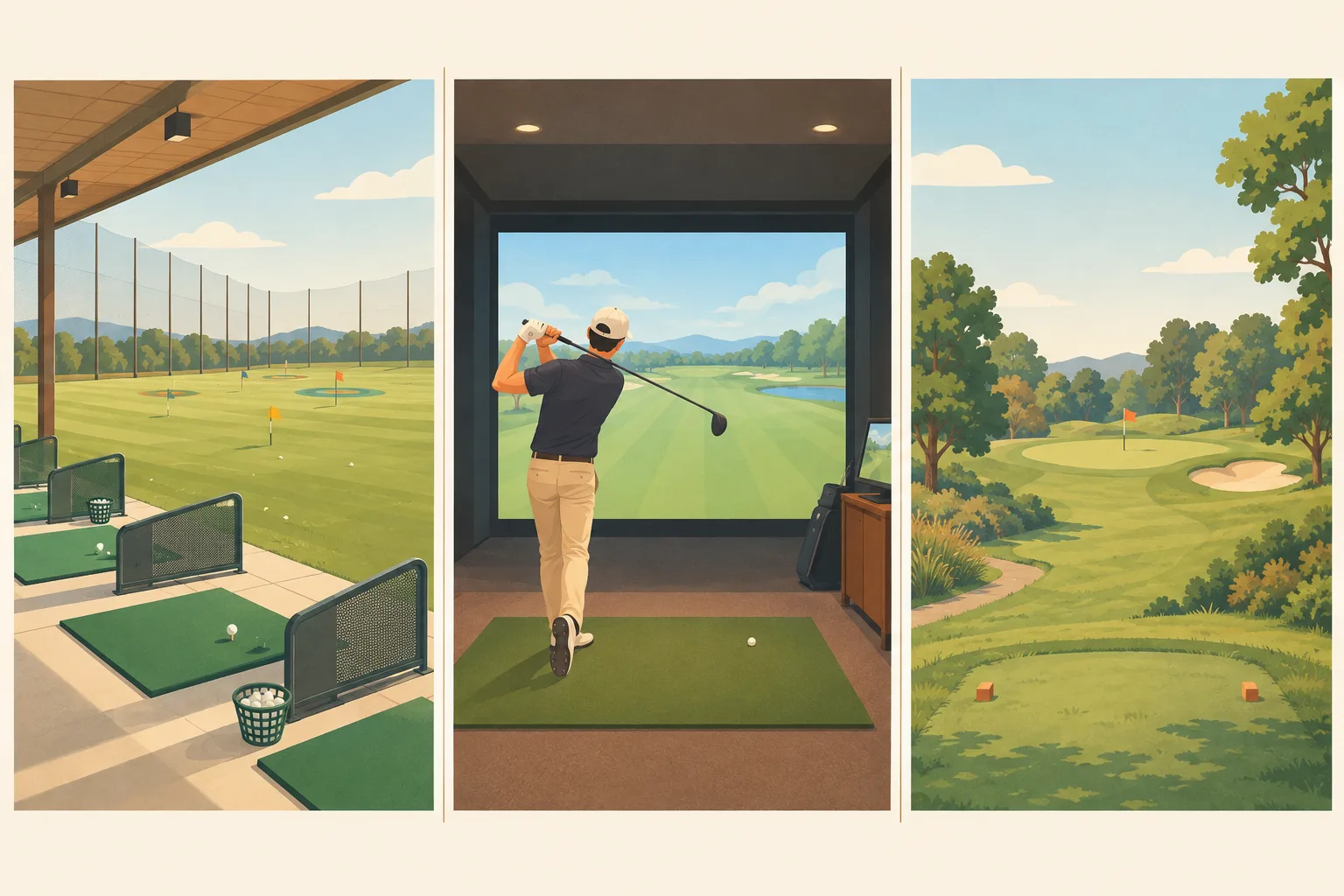
Most people in Korea hit their first golf balls in one of three places: a netted outdoor driving range, an indoor screen-golf bay where a simulator turns each shot into a virtual round, or a par-3 course made up of short holes. The Korea Golf Association's 2023 Korea Golf Index estimates that about 6.24 million people aged 20 to 69 (16.9%) used at least one golf course, range or indoor screen in a year. This is a research comparison based on Korea's sports-facilities law, official pages of facilities run by public corporations, Korea Consumer Agency findings, the R&A Rules of Golf and manufacturers' descriptions, all checked on October 14, 2026. I have not played at or evaluated any of these places. Fees are what individual facilities posted that day, as examples rather than national averages. The first image is an AI-generated illustration made with ChatGPT.
The law treats them as different facilities
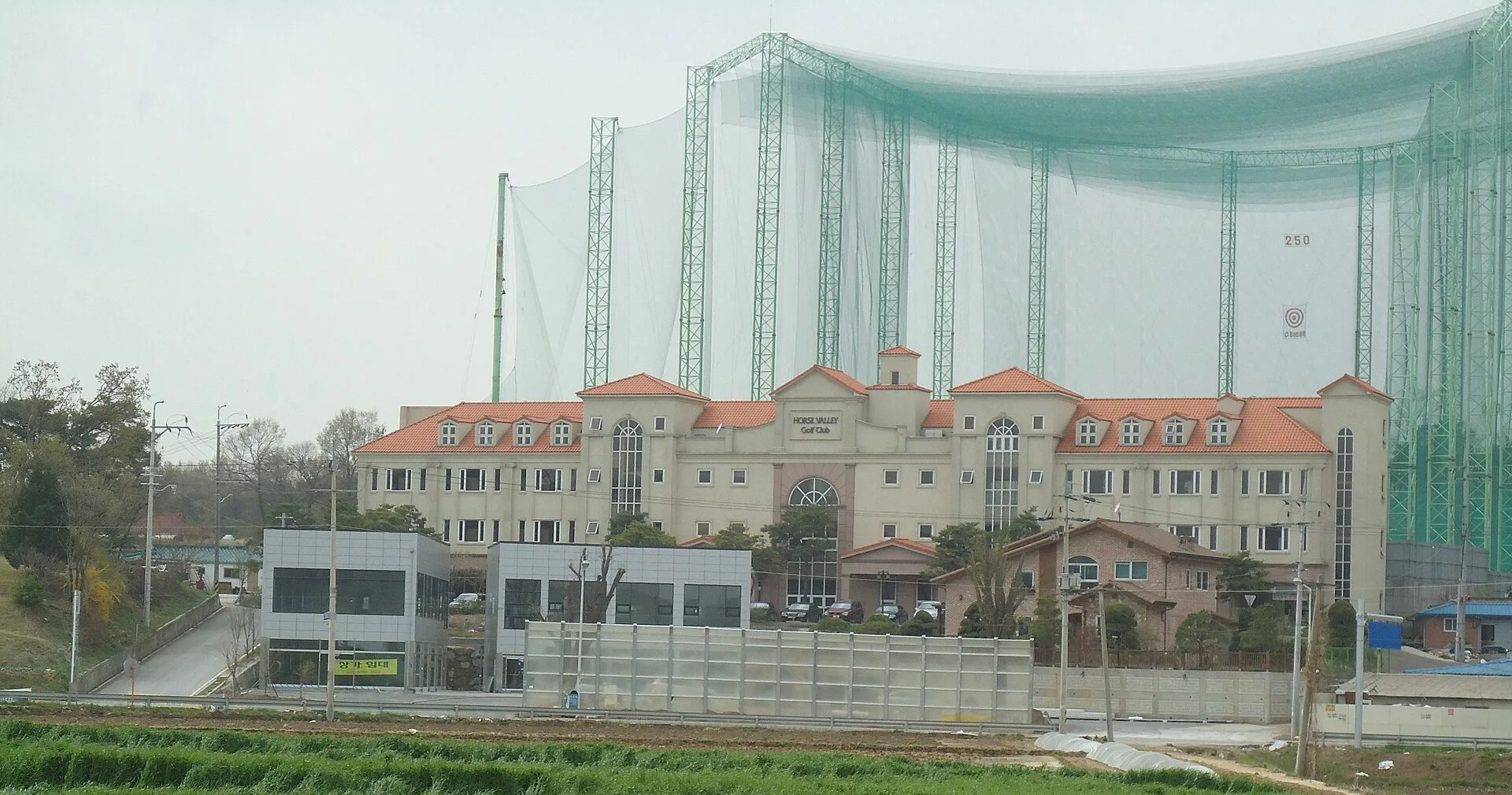
Korea's Installation and Use of Sports Facilities Act makes golf courses a registered business, while driving ranges and 'virtual-experience' facilities — the category screen golf has belonged to since September 2019 — only need to be reported. The facility standards differ too. A range must space hitting bays at least 2.5 metres apart, keep 1.5 metres between bays and the walkway behind, and install nets against stray balls. A screen-golf bay needs at least 3 metres to the screen, 2.8 metres to the ceiling and 1.5 metres to the waiting area. At the end of 2023 Korea had 7,335 driving-range businesses and 533 golf courses, plus 6,741 virtual-experience businesses covering golf and baseball together.
'Par-3' is not a category in the law. A golf course of either membership type needs only three holes to meet the standard, while a driving range may add up to two holes outdoors, or a pitching course of up to 18 holes, each no more than 100 metres wide or long. So one par-3 may legally be a golf course and another an extension of a range. Driving ranges and screen-golf venues are also classed as small sports businesses exempt from compulsory liability insurance, so if you are concerned about cover for injuries, ask the facility before you play.
Driving range: lots of balls to build the basics
A range lets you repeat the same movement many times in a short session. Bukak Golf Range in Seoul, run by the Seongbuk-gu Urban Management Corporation, has 53 bays on two floors, a 280-metre target area, automatic tee-up at every bay, and putting and bunker practice areas. It charges by time rather than by ball: KRW 12,000 for 40 minutes before 3 p.m. on weekdays, and KRW 12,000 for 35 minutes after 3 p.m. and at weekends. Gwangju's Sangmu Golf Range has 98 bays at KRW 13,000 for 40 minutes, with lessons listed at KRW 250,000 to 300,000 a month. Indoors, Seoul's public Jamsil range charges adults KRW 6,000 for a day visit on weekdays and KRW 7,800 on Saturdays and holidays.
The advantage is watching where each ball goes while you work through one club at length. The law requires at least one qualified instructor at ranges with 20 to 50 bays and two above 50. The drawbacks are the weather and the lack of slopes or course strategy to practise. Safety matters, too: of 30 range injury cases the Korea Consumer Agency collected between 2002 and April 2004, 19 (63.3%) involved being struck by a club swung back in the next bay, and more than half the injured were hurt in the face. Check your neighbour's swing before stepping into or out of a bay.
Screen golf: less tied to weather and daylight
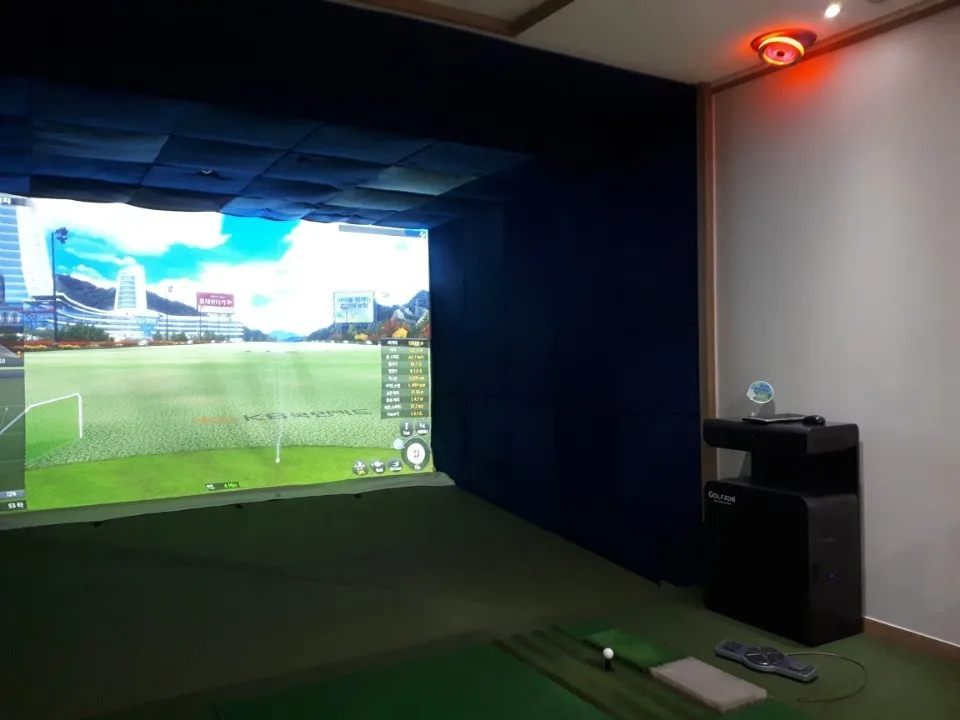
In screen golf, sensors read the speed and direction of a ball hit from an indoor mat and continue its flight on a virtual course. GOLFZON Park, GOLFZON's franchise brand, says its venue system analyses ball and club movement with an AI spin sensor and overhead and side sensors, shows club-face angle and path on a floor screen, and projects a hole onto the floor for putts of 4 metres or less. Its GDR range system offers modes such as a driving range, distance drills, an 18-hole practice round without putting and a nine-hole course practice. These are the manufacturer's claims; I have not tested their accuracy.
In a February 2025 survey of 1,500 users of GOLFZON Park, SG Golf and Friends Screen, the Korea Consumer Agency recorded overall satisfaction of 3.74 out of 5. Some 13.5% reported a complaint or harm; poor cleanliness and indoor air quality each accounted for 40.1%, and games halted by software errors for 37.6%. The 'supplementary services' factor, which covers the quality and hygiene of free rental equipment along with company events, scored lowest, at 3.60, and the law requires screen-golf venues to keep rented clubs and shoes hygienic. I found no official benchmark price, as fees vary by venue. In the golf association's index, 48.0% of indoor-screen users said a visit usually lasts about two hours.
The drawbacks are that results on screen may not match what happens on real grass, and that conditions vary between venues. When the consumer agency inspected 20 screen-golf venues in Seoul and Gyeonggi in 2012, four had locked emergency exits and seven had ceilings damaged by clubs because the bays were too cramped. The survey is old and things may have changed, but at an unfamiliar venue, check the space around the bay and the ventilation first.
Par-3 course: a short round on real grass
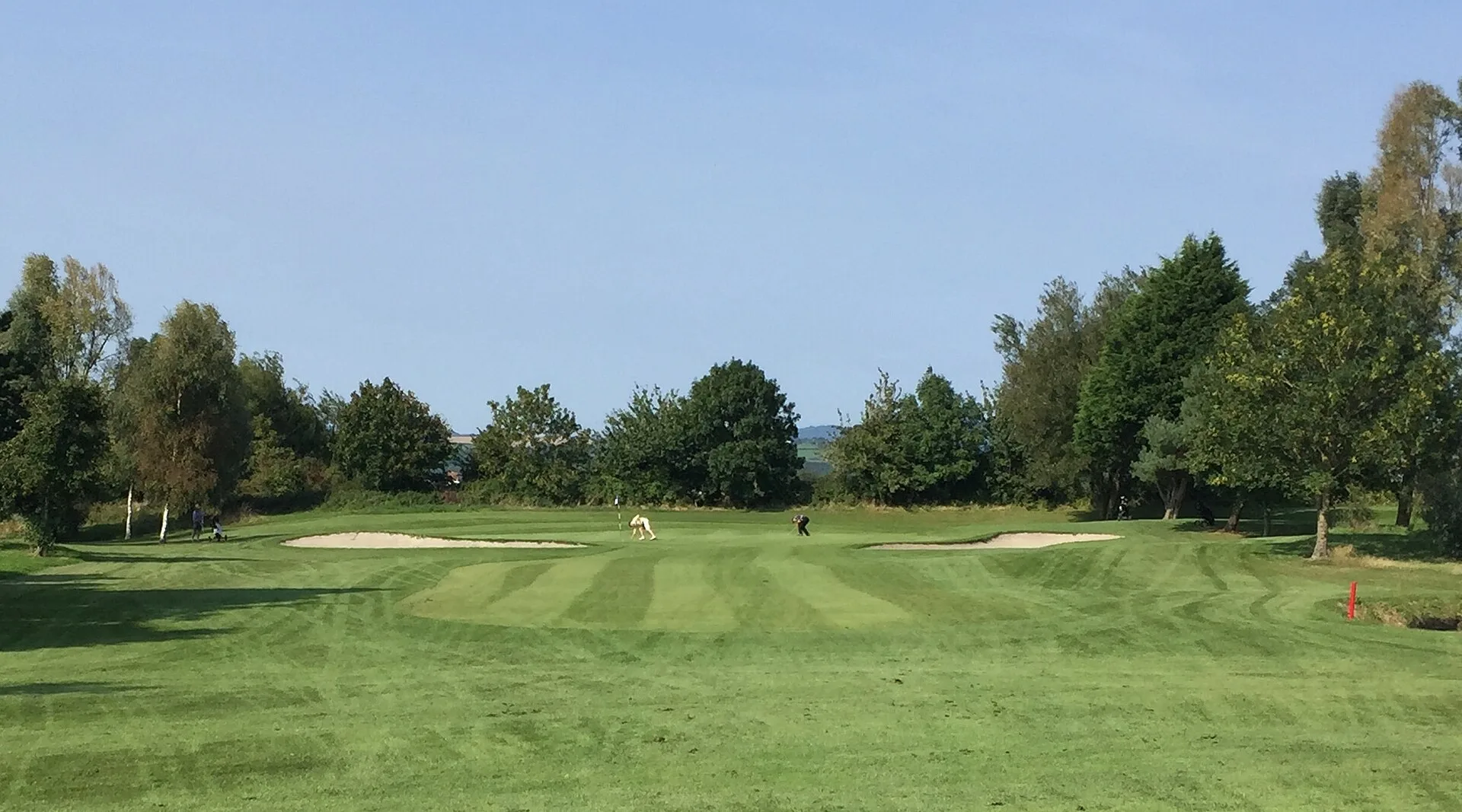
On a par-3 course every hole is a par three. The par-3 at Hwasan Sports Park in Suwon, run by the city's urban development corporation, has nine holes totalling 710 metres, from 55 to 100 metres each, with three hazards and 11 bunkers. It costs KRW 15,000 on weekdays and KRW 20,000 at weekends and on holidays, takes groups of two to four on a first-come basis, and does not accept reservations. The natural-grass par-3 at Incheon's Songdo Sports Park has nine holes over 712 metres (55 to 108 metres each); in the March–November high season it charges KRW 15,000 on weekdays and KRW 20,000 at weekends, with bookings opening at 9 a.m. one week ahead. Neither fee table says whether the price is per person.
Read the local rules carefully. Hwasan asks players to finish nine holes within an hour, play one ball each and wear rubber-spiked golf shoes. Songdo bans drivers and fairway woods, including utility woods, sets a rule of 'one club per person (bring a putter)', and also requires golf shoes. The Rules of Golf allow up to 14 clubs in a round, but public par-3s set stricter rules for safety and pace. Hitting from grass and putting on a real green is hard to replicate at a range or on a screen, but you need enough of the basics to keep up with the pace first.
Etiquette and safety before your first visit
Rule 1.2a of the R&A Rules of Golf asks players to look out for others' safety, shout 'Fore' at once if a ball might hit someone, and protect the course by repairing divots, smoothing bunkers and fixing ball marks. Rule 5.6b recommends making each stroke within 40 seconds of being able to play without interference. The R&A's Spirit of the Game guidance adds that you should check no one is nearby even before a practice swing, and wait until the group ahead is out of range. On a short par-3 course these principles translate directly into pace and safety.
At ranges and screen bays, mind the distance to the next bay; on a course, watch the group ahead and the carts. When the consumer agency analysed 87 golf-course injury cases from 2018 to 2021, 44 (50.6%) involved golf carts, and it urged players to get on and off only after a cart has fully stopped and to hold the safety handle. As a beginner, read the facility rules and ask staff or an instructor about the basic routes first.
Costs and kit: what to rent and what to bring
You don't need to buy a full set of clubs at the start, but each place expects different kit. Both public par-3s require golf shoes, Songdo also asks you to bring a putter, and neither official page mentions rentals. Rental clubs and shoes are common enough at screen-golf venues that both the law and the consumer agency's survey cover them, though the survey factor that includes them scored lowest. Ranges mostly charge by time, with lessons paid separately.
In the golf association's 2023 index, monthly spending averaged KRW 458,000 for course users, KRW 229,000 for range users and KRW 176,000 for indoor-screen users, and users visited ranges 18.1 times a year, screens 14.5 times and courses 6.8 times. These are averages for people who already play, so a beginner's budget may look different. For my first month I would stick to pay-by-time range or screen sessions and note what I spend in money and time.
Our three picks
- Repeating the swing to build basicsDriving range
Hit many balls in a short time and watch direction and distance. Public ranges post examples of about KRW 12,000–13,000 for 40 minutes; mind the next bay.
- Less tied to weather and daylightScreen golf
Practise modes and virtual rounds help you learn how a course flows. Equipment and cleanliness vary by venue, so check first.
- A short round on real grassPar-3 course
Nine short holes in about an hour. Check the shoe and club rules and how bookings work first.
Side by side
| Question | Driving range | Screen golf | Par-3 course |
|---|---|---|---|
| Legal category | Driving range (reported) | Virtual-experience facility (reported) | Golf course (registered, 3+ holes) or a range's short course |
| Posted fee examples (Oct 14) | Bukak KRW 12,000 for 40 min (weekdays before 3 p.m.); Sangmu KRW 13,000 for 40 min | No official benchmark found | Hwasan and Songdo nine holes KRW 15,000 weekdays, 20,000 weekends |
| What you mainly practise | Repeating the swing, ball direction and distance | Course flow, practice modes (manufacturer's description) | Shots from grass, putting, pace of play |
| Weather | Matters (outdoors) | Barely matters (indoors) | Matters (outdoors) |
| Standards and safety | Bays 2.5 m apart, safety nets | 3 m to the screen, 2.8 m to the ceiling | Wait until the group ahead is out of range; shout 'Fore' |
| Kit | Check the facility's notice | Rentals common (hygiene required by law) | Golf shoes required (Songdo: putter too) |
| Time examples | 40- or 35-minute blocks (Bukak) | About two hours most common (association index) | Nine holes within an hour (Hwasan rule) |
| Not verified here | Lesson quality, crowding | Venue fees, equipment condition | Whether fees are per person; each facility's legal category |
Where I would start
I would begin by repeating the basic swing at an outdoor range, mixing in screen golf when the weather is bad or I want a feel for a course. Once I was making reasonable contact, my first goal would be playing nine holes at a public par-3 within the hour. Wherever you go, read the fee unit, kit requirements and safety rules first, and make a habit of watching the person beside you and the group ahead.


