Renting a hanbok, Korea’s traditional dress, is a popular thing for visitors to do — but where you wear it shapes the day. At Gyeongbokgung you get a palace backdrop and free entry in hanbok, within fixed opening hours. Bukchon and Insadong are made for strolling between alleys and tea houses, but Bukchon is a residential area, and part of it has legal visiting hours. Jeonju Hanok Village means a KTX trip from Seoul, but you can spend a whole day in hanbok in a village of about 700 traditional houses. This guide compares the three on the palace hanbok rule, opening hours and visiting limits, what is on in November 2026 and how to get there. It is a research guide, not a review: the facts come from the Korea Heritage Service’s Royal Palaces and Tombs Center, the Jongno-gu district office, VisitSeoul (the Seoul Tourism Organization) and Jeonju city, checked on 30 October 2026 (US Central time; the morning of 31 October in Korea). I did not rent or wear a hanbok for it, I do not recommend particular rental shops, and I do not rank the three areas.
Free palace entry in hanbok: what counts as hanbok
Start with the obvious question: does wearing hanbok really get you into the palaces for free? It does. The Royal Palaces and Tombs Center of the Korea Heritage Service, which runs the four main Seoul palaces (Gyeongbokgung, Changdeokgung, Deoksugung and Changgyeonggung), Jongmyo Shrine and the Joseon royal tombs, lists “people wearing hanbok” among those admitted free. Its hanbok guideline says the aim is to popularise hanbok and take it global, so the rule applies to Koreans and foreigners alike.
The guideline is specific about what counts. Both traditional hanbok and modern everyday hanbok (saenghwal hanbok) qualify, but you need a top and a bottom: a jeogori (the short jacket) with a skirt or trousers. A durumagi (the long overcoat) worn on its own does not count. The jeogori has to keep its wrap-over collar, though the ribbon ties (goreum) can be missing. Trousers count if they follow the traditional sapok cut, even with a zip waist or no ankle ties. Skirts may be wrap-around or not, with no restriction on style; with a separate waist skirt, the jeogori must reach the waist. What does not count: a jeogori over jeans, a T-shirt over a hanbok skirt or trousers, a T-shirt-style everyday hanbok top, or a one-piece hanbok dress worn without a jeogori. The guideline asks for hanbok that suits the dignity of a palace and bans excessive exposure. I found no rule on which gender’s hanbok you wear.
The Secret Garden (Huwon) of Changdeokgung is a separate case. It has its own ticket (5,000 won for adults) on top of the palace ticket, and the fee page lists only children aged 6 and under and Korean people of national merit and Korean disabled visitors as free there. Hanbok wearers are not on that list.
Autumn 2026 has a twist. A Royal Palaces and Tombs Center notice says that during the Korea Grand Festival, from Thursday 29 October to Sunday 15 November 2026, the four palaces, Jongmyo and the royal tombs are free for everyone, except special tours of the Secret Garden and closing days. In that window hanbok is about photos and atmosphere, not the ticket. From 16 November, expect the usual fees and the hanbok rule to apply again. Foreign visitors aged 18 and under or 65 and over enter free anyway.
Around Gyeongbokgung: palace backdrops, within opening hours
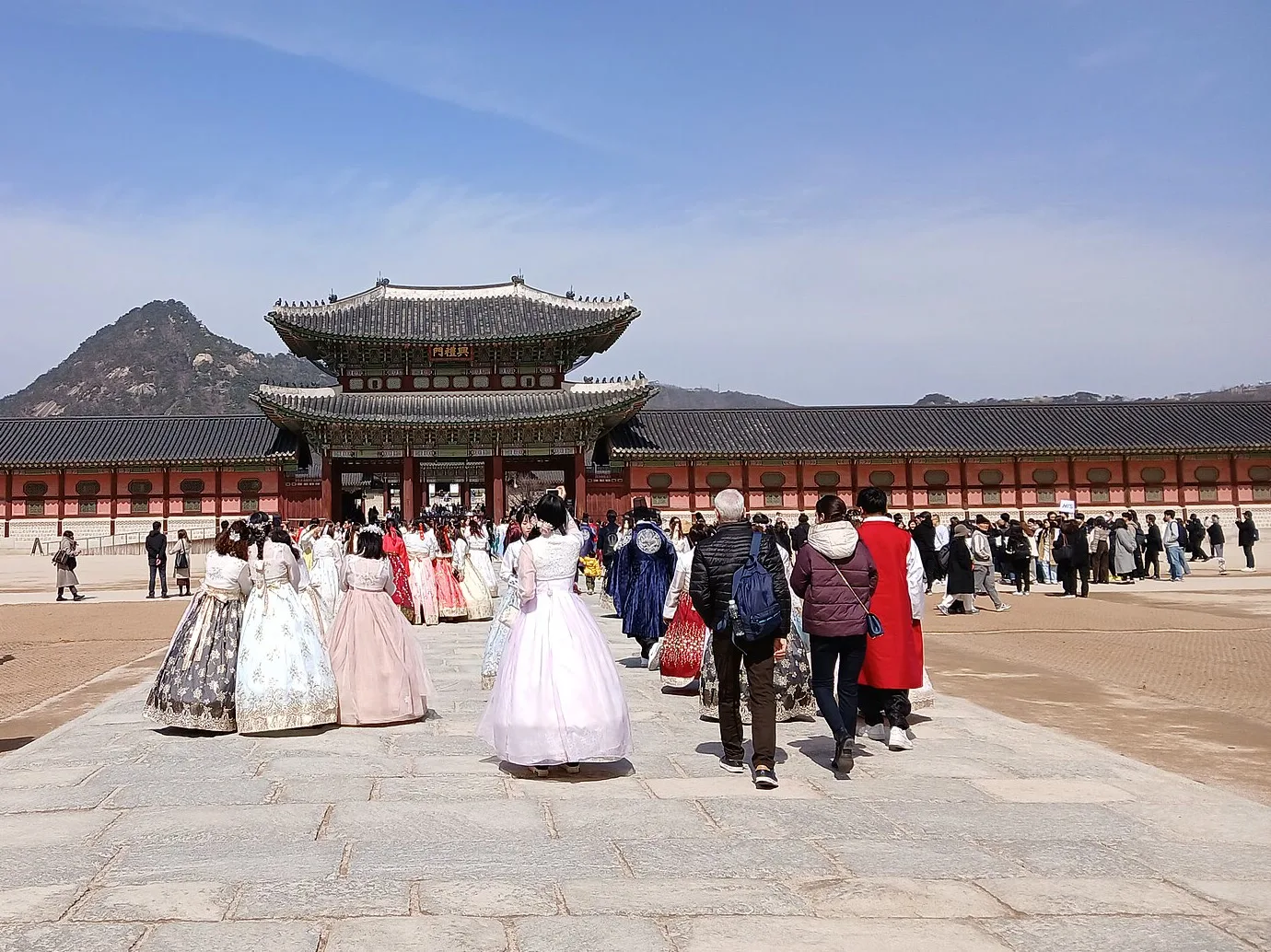
Gyeongbokgung is the classic backdrop for hanbok photos. VisitSeoul, the Seoul Tourism Organization’s official guide, notes that many hanbok rental shops sit in the traditional districts of Insadong, Bukchon and Samcheong-dong, and that the streets fill with visitors in hanbok every weekend. Adult admission to Gyeongbokgung is 3,000 won (for foreigners aged 19 to 64), and the palace closes every Tuesday. Hours change with the season: 09:00–17:00 from November to February (last entry 16:00), 09:00–18:00 in March–May and September–October (last entry 17:00), and 09:00–18:30 in June–August (last entry 17:30). In November, plan to be inside before 4 p.m.
The palace’s set-piece events run on a timetable too. The royal guard-changing ceremony takes place at 10:00 and 14:00 every day except closing days and lasts about 20 minutes. A guard patrol ceremony runs at 15:00 on weekends and public holidays from 1 March to 29 November (not in June–August): inside Gyeongbokgung on Saturdays, and on Insadong’s culture street on Sundays and holidays. Between 29 October and 15 November 2026, Gyeongbokgung’s regular guided tours are 30 minutes shorter than usual.
Know the photo rules. Under the palace visitor rules, souvenir photos by visitors are treated as already permitted. Souvenir shoots that use special non-everyday costumes or props — the rules cite character costumes, mascot suits and inflatable air suits — need a filming permit, as does commercial filming for films, dramas or adverts, and staff may restrict photography in crowded areas. Hanbok is not among the examples, but check in advance if you plan to bring large props or professional gear.
The palace office lists three subway exits for Gyeongbokgung: Gyeongbokgung Station (line 3) exit 5, Anguk Station (line 3) exit 1 and Gwanghwamun Station (line 5) exit 2. If you want to stay in hanbok after Gyeongbokgung closes, Deoksugung is open 09:00–21:00 all year except Mondays (last entry 20:00) and costs 1,000 won. Changdeokgung (3,000 won) opens 09:00–17:30 from November to January (last entry 16:30). For several palaces, an integrated palace pass (6,000 won) covers the four palaces and Jongmyo, but not the Secret Garden.
Bukchon and Insadong: a short alley walk, timed carefully
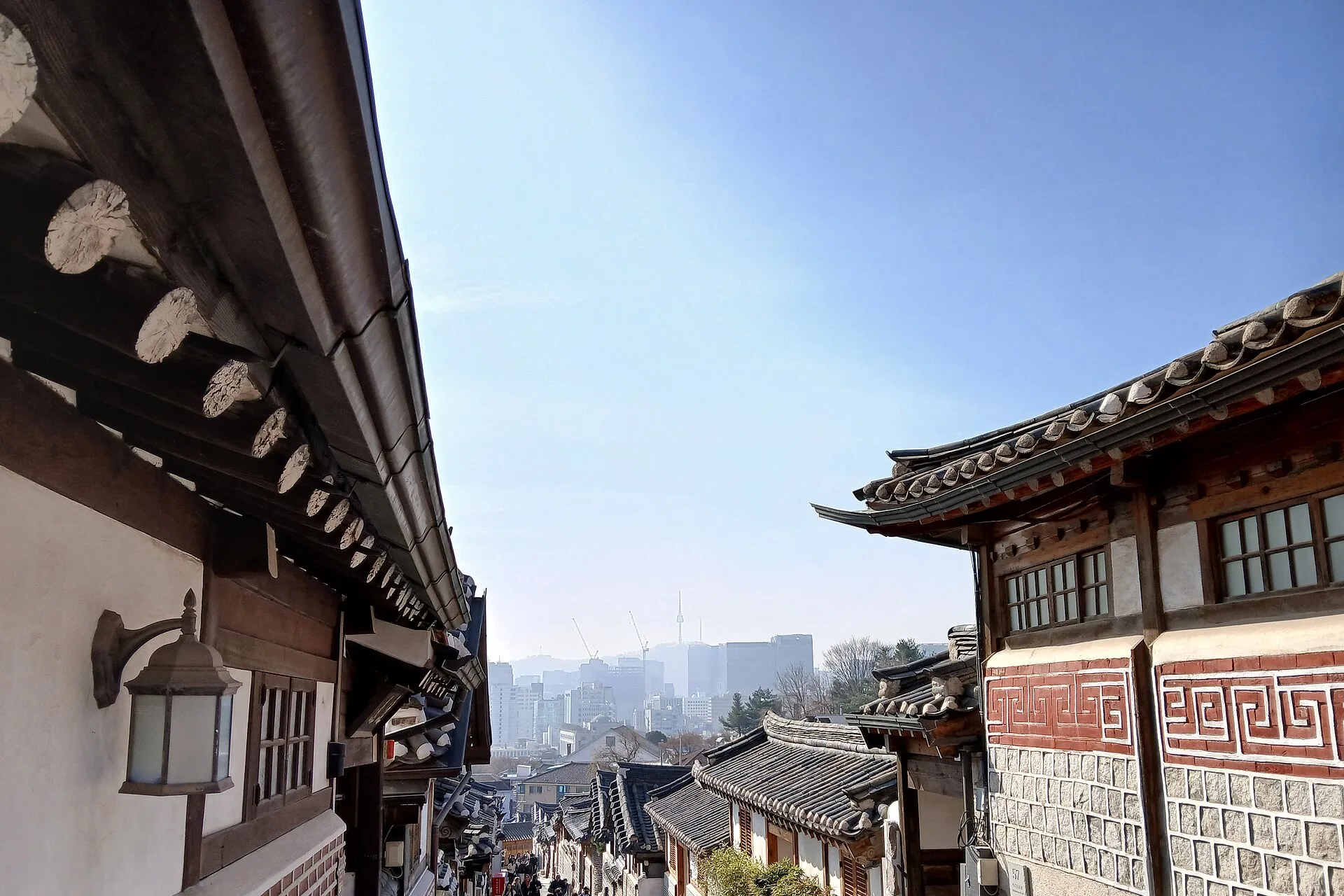
Bukchon Hanok Village is easy to pair with Gyeongbokgung. VisitSeoul describes it as the area you reach by walking from Anguk Station towards Bugaksan Mountain, where hanok appear between low-rise buildings. It was a residential area for the elite in the Joseon era, and around the 1930s a developer, Jeong Se-gwon, bought land and built clusters of small and medium-sized hanok, the origin of today’s village. But Bukchon is a neighbourhood before it is a sight. Jongno-gu, the district office, stresses that “Bukchon is an area where residents actually live” and runs a campaign asking visitors to walk quietly; VisitSeoul also asks for a quiet, respectful visit.
Timing matters most. Bukchon is a special management area under the Tourism Promotion Act. Since 1 November 2024, tourists have been barred from the “red zone” around Bukchon-ro 11-gil (about 34,000 square metres) from 17:00 to 10:00 the next morning; after a grace period the rule has been enforced since 1 March 2025, with a 100,000-won fine. Jongno-gu’s Bukchon page (updated 11 August 2026) also shows a box for a roughly 100-metre stretch of Bukchon-ro 11-gil, in a dense hanok residential area where visitors concentrate: visiting hours Monday to Saturday 10:00–17:00, and Sunday marked as an “alley rest day”. The special-area page does not mention Sundays, so I could not confirm whether both describe the same rule. To be safe, walk Bukchon in hanbok between 10:00 and 17:00, Monday to Saturday. Groups should also know that since 1 January 2026 charter buses are banned at all times on about 2.3 km of Bukchon-ro, Bukchon-ro 5-gil and Changdeokgung 1-gil.
Insadong feels different. VisitSeoul describes streets lined with traditional shops selling antique furniture, paintings, folk art and crafts, with wooden tea houses, small galleries and vendors selling traditional snacks. Ssamzie-gil, a shopping complex opened in 2004, has about 70 shops along a spiral walkway. On Sundays and public holidays at 15:00 (until 29 November), the guard patrol ceremony mentioned above takes place on Insadong’s culture street. Because Bukchon’s red zone covers the Bukchon-ro 11-gil area, an afternoon of tea houses and craft shops in hanbok is less time-bound in Insadong.
For a rainy or cold day, there is an indoor option nearby: from 29 October to 18 November, Jongno-gu’s “2026 Beautiful Jongno Museum Outing” runs special exhibitions and hands-on programmes at 13 private museums (two of them partner venues), including the Gahoe Minhwa Museum, Bukchon Museum and Bukchon Asian Art Museum.
Jeonju Hanok Village: a whole day in hanbok
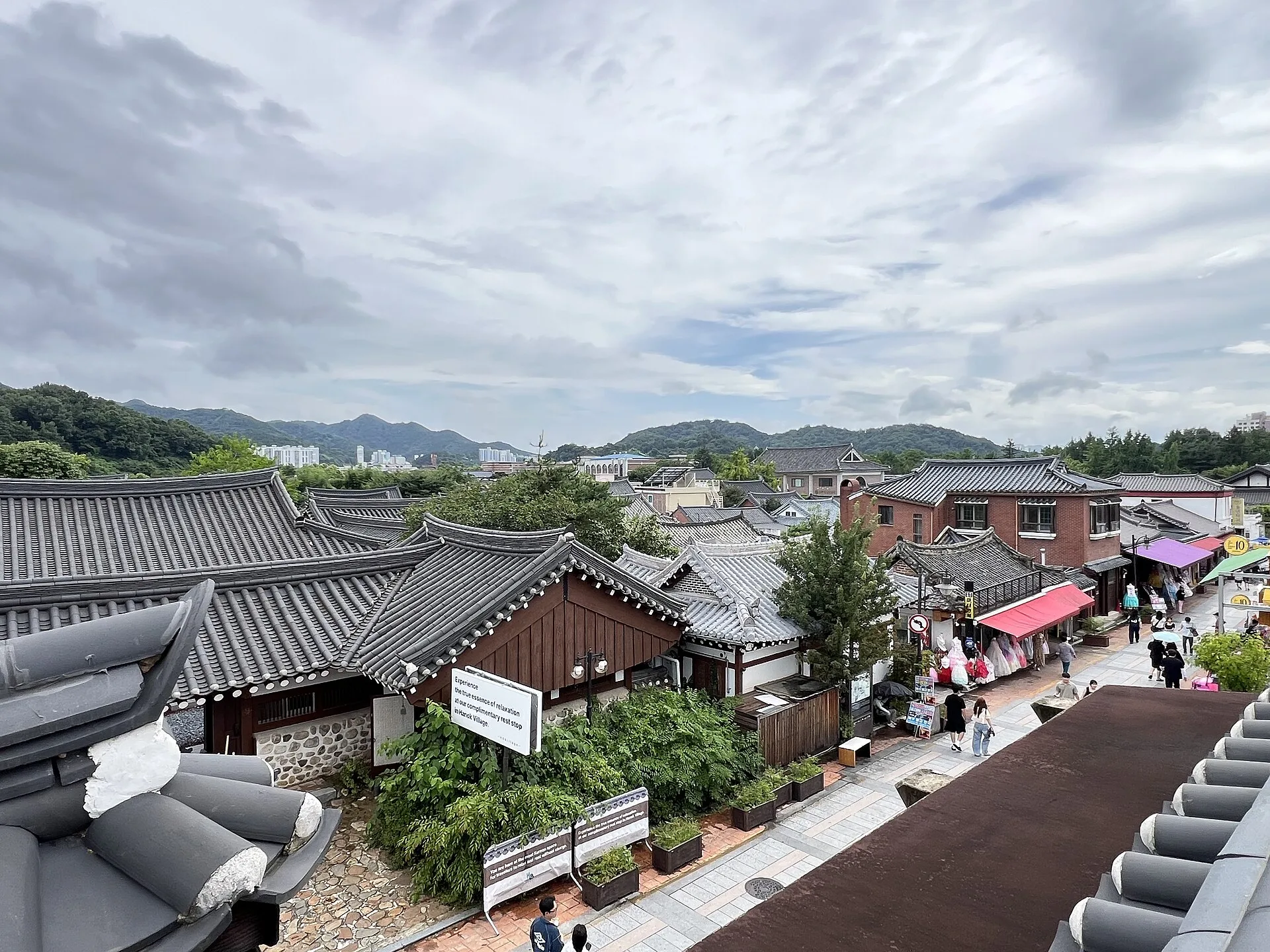
Jeonju Hanok Village works on a different scale. Jeonju city describes it as a cluster of about 700 hanok in Pungnam-dong — the largest traditional hanok village in Korea and the only urban hanok cluster in the country. Its official fact sheet lists 298,260 square metres, 947 buildings (735 hanok and 212 others) and 575 businesses: 203 places to stay, 183 food and drink outlets and 189 other shops and rental businesses. The whole district became a no-smoking zone in 2016.
Gyeonggijeon is the obvious stop in hanbok. It was built in 1410 to enshrine the portrait of King Taejo, founder of the Joseon dynasty, and its setting has made it a filming location for historical dramas and films. It opens 09:00–19:00 in March–May and September–October, 09:00–20:00 in June–August and 09:00–18:00 from November to February. Tickets cost 3,000 won for adults, 2,000 won for teenagers and soldiers and 1,000 won for children, and entry is free on the last Wednesday of each month (Culture Day). Hanbok wearers are not on its free list, so unlike the Seoul palaces, do not expect free entry for your outfit. Jeondong Cathedral, built between 1907 and 1914 on a martyrdom site, and Jeonju Hyanggyo, the old Confucian school, which is free to enter (10:00–18:00), are in the same village.
There is an evening option too. Gyeonggijeon’s “Starlight” night programme runs on Friday nights from June to November 2026; from September to November there are two entries, at 19:30 and 20:30, and it costs 10,000 won per person, booked through Ticketlink.
Jeonju’s tourism site puts the KTX ride from Seoul at about 1 hour 40 minutes and notes that Jeonju-bound KTX trains run much more often from Yongsan Station than from Seoul Station. From Jeonju Station, city buses such as the 112, 79 and 508 reach the village in about 25 minutes; from the express bus terminal, the 79, 999 and 1994 take about 15 minutes. The Jeonbuk Tour Pass’s hanok-village pass (4,200–8,000 won) includes Gyeonggijeon admission. On a day trip from Seoul, the KTX alone takes more than three hours there and back, so you may get fewer hours in hanbok than in Seoul.
Before you rent: timetable, season and a complete outfit
VisitSeoul says hanbok rental shops are plentiful in Insadong, Bukchon and Samcheong-dong, and the Jeonju Hanok Village site has its own hanbok-experience section; the real decisions are when and how far you will walk. Rental periods, return times and deposits vary by shop, and the official pages I checked set no standard for them. Ask the shop first, then match its terms to the timetable above. In November, the last entry to Gyeongbokgung is 4 p.m., Bukchon’s red zone closes to tourists at 5 p.m., Deoksugung admits visitors until 8 p.m. (except Mondays), and Gyeonggijeon closes at 6 p.m.
If you want the free palace entry, check the outfit when you choose it: a wrap-collar jeogori plus a skirt or trousers. T-shirt-style tops and one-piece dresses without a jeogori are not accepted. If it is cold and you add a durumagi overcoat, keep the full jeogori-and-skirt or jeogori-and-trousers set underneath, since an overcoat on its own does not count. Between 29 October and 15 November 2026 everyone enters the palaces free, so the rule does not matter in that window.
Take all the photos you like, but mind where you are. Souvenir photos at the palaces need no permit; Bukchon’s alleys, however, are people’s homes, and what Jongno-gu asks is that you walk quietly. This is a research guide: I did not rent or wear a hanbok for it, so it does not cover what to wear for the weather or how crowded each place gets. Check the weather and each site’s latest notices before you go.
Related on Rank Three: for which palace to see first, read Which Seoul palace first? Gyeongbokgung, Changdeokgung or Deoksugung; to spend a night in a hanok, see Bukchon vs Jeonju vs Gyeongju: where to try a hanok stay in Korea?; and for a day trip that includes Suwon’s Hwaseong Haenggung, free in hanbok, see Suwon Hwaseong vs DMZ tour vs Nami Island: which day trip from Seoul?.
Our three picks
- Around Gyeongbokgung: palace backdrops, within opening hoursAround Gyeongbokgung
Pick it for palace photos in hanbok. The right outfit gets you in free instead of paying 3,000 won (and everyone enters free from 29 October to 15 November 2026), and the palace is next to Gyeongbokgung Station on line 3. In November the last entry is 4 p.m. and it closes on Tuesdays, so start in the morning; to stay in hanbok into the evening, carry on to Deoksugung, open until 9 p.m. except on Mondays.
- Bukchon and Insadong: a short alley walk, timed carefullyBukchon and Insadong
Pick them for a short alley walk, tea houses and craft shops. Tourists may enter Bukchon’s red zone around Bukchon-ro 11-gil only from 10:00 to 17:00, with a 100,000-won fine otherwise, and one 100-metre stretch is listed as resting on Sundays, so go between Monday and Saturday and keep your voice down. Insadong lies outside the red zone and is less time-bound.
- Jeonju Hanok Village: a whole day in hanbokJeonju Hanok Village
Pick it to spend a whole day in hanbok. The village of about 700 hanok includes Gyeonggijeon, Jeondong Cathedral and the Hyanggyo, and Gyeonggijeon’s Starlight night programme runs on Friday nights until November. The KTX takes about 1 hour 40 minutes each way from Seoul, and Gyeonggijeon’s free-entry list does not include hanbok wearers.
Side by side
| What to check | Around Gyeongbokgung | Bukchon and Insadong | Jeonju Hanok Village |
|---|---|---|---|
| Where you walk in hanbok | Gyeongbokgung’s courtyards and halls; Deoksugung in the evening (closed Mondays) | Bukchon’s hanok alleys; Insadong’s streets and Ssamzie-gil | A village of about 700 hanok, with Gyeonggijeon, Jeondong Cathedral and the Hyanggyo |
| Admission (official pages) | Gyeongbokgung 3,000 won; Deoksugung 1,000 won; integrated pass 6,000 won | No admission listed for the alleys (museums are separate) | No admission listed for the village; Gyeonggijeon 3,000 won |
| Hanbok perk | Free entry (wrap-collar jeogori plus skirt or trousers); not for the Secret Garden | None | Hanbok wearers not on Gyeonggijeon’s free list |
| November hours and limits | Gyeongbokgung 09:00–17:00 (last entry 16:00), closed Tuesdays | Red zone open to tourists 10:00–17:00 (100,000-won fine); a 100 m stretch is marked as resting on Sundays (campaign notice) | Gyeonggijeon 09:00–18:00 (Nov–Feb) |
| Autumn 2026 (official) | 29 Oct–15 Nov: palaces and Jongmyo free for all (not Secret Garden special tours); guided tours 30 min shorter | Jongno museum outing at 13 private museums (29 Oct–18 Nov) | Gyeonggijeon Starlight on Friday nights until November (10,000 won) |
| Timed events | Guard-changing ceremony 10:00 and 14:00 (about 20 min); patrol ceremony Saturdays 15:00 (until 29 Nov) | Guard patrol ceremony on Insadong’s culture street, Sundays and holidays 15:00 (until 29 Nov) | Starlight entries 19:30 and 20:30 (Sep–Nov) |
| Getting there | Gyeongbokgung Stn (line 3) exit 5, Anguk Stn exit 1, Gwanghwamun Stn (line 5) exit 2 | Walk from Anguk Station towards Bugaksan (VisitSeoul) | KTX about 1 hr 40 min (more trains from Yongsan); bus about 25 min from Jeonju Station |
| Good to know | Special costumes and commercial shoots need a permit | Residents live here: walk quietly; charter buses banned on 2.3 km of roads | Whole village is a no-smoking zone; a day trip means long travel |
| Good for | Palace photos and free entry in hanbok | A short alley walk, tea houses and crafts | A full day in hanbok and a KTX trip |
Where I would start
For a first time in hanbok, I would start around Gyeongbokgung. The palace gives you an unmistakable backdrop, the right outfit gets you in free on normal days, and the subway is right there. In November the last entry is 4 p.m., so rent in the morning, see Gyeongbokgung first, and if you have time left, continue to Deoksugung, open until 9 p.m. except on Mondays, or to Insadong. Treat Bukchon as a short, quiet walk on a Monday-to-Saturday daytime visit. If you want a whole unhurried day in hanbok and do not mind the KTX there and back, Jeonju Hanok Village is the better fit. Wherever you go, rental periods and return terms vary by shop, so match them to the timetable above before you rent.


