A hanok is a traditional Korean house, and the Korea Tourism Organization names three places to stay in one: Bukchon in Seoul, Jeonju Hanok Village and Hwangnidan Street in Gyeongju. They are very different places to spend the night. Bukchon is a lived-in neighbourhood in the middle of Seoul with strict visitor rules; Jeonju’s hanok village is a whole district of about 700 hanok, one and a half to two and a half hours from Seoul by KTX; and in Gyeongju you sleep close to the tombs and palace sites of the Silla kingdom. This guide compares the areas, not individual guesthouses. It is a research piece, not a review of a stay: the facts come from Jongno District, the Seoul, Jeonju and Gyeongju city governments, the Korea Tourism Organization, the Korea Law Information Center, the Korea Heritage Service and KORAIL, all checked on 25 October 2026 (US Central time). No lodging is recommended, and the three areas are not ranked.
What a hanok stay involves
The Korea Tourism Organization’s guide to hanok accommodation is frank about the trade-offs. In many hanok you sleep on mats and blankets on the floor rather than in a bed, so if you want a bed, look for a room that has one; and because of the way hanok are built, some lack modern conveniences, so check the facilities before you book. On the other hand, many modern hanok stays now have beds and other amenities, and some run programmes such as tea ceremonies or cooking. Hanok are built of wood, so be especially careful with fire, and some are designated cultural heritage, so take care not to damage them.
Seoul’s Hanok Portal adds that a traditional hanok may lack modern toilets or showers because its original form is preserved. It asks guests to avoid loud noise that disturbs neighbours and to arrive before sunset, not to cook with fire or smoke without the owner’s consent, and it says all pets except guide dogs are prohibited. We found no official guidance on soundproofing. Room layouts, bathrooms and beds vary from place to place, so read each listing carefully.
Two official schemes are worth knowing. Under the Enforcement Decree of the Tourism Promotion Act, a hanok experience business (hanok-cheheomeop) is a tourist-use facility business that lets tourists use a hanok equipped for overnight stays or for traditional-culture experiences such as folk games and crafts. The national Korea Quality certification, run by the Korea Tourism Organization and valid for three years, can also be awarded to hanok experience businesses. Neither is a guarantee of quality; they only tell you that a place sits inside an official system.
Bukchon: a lived-in hanok neighbourhood in central Seoul
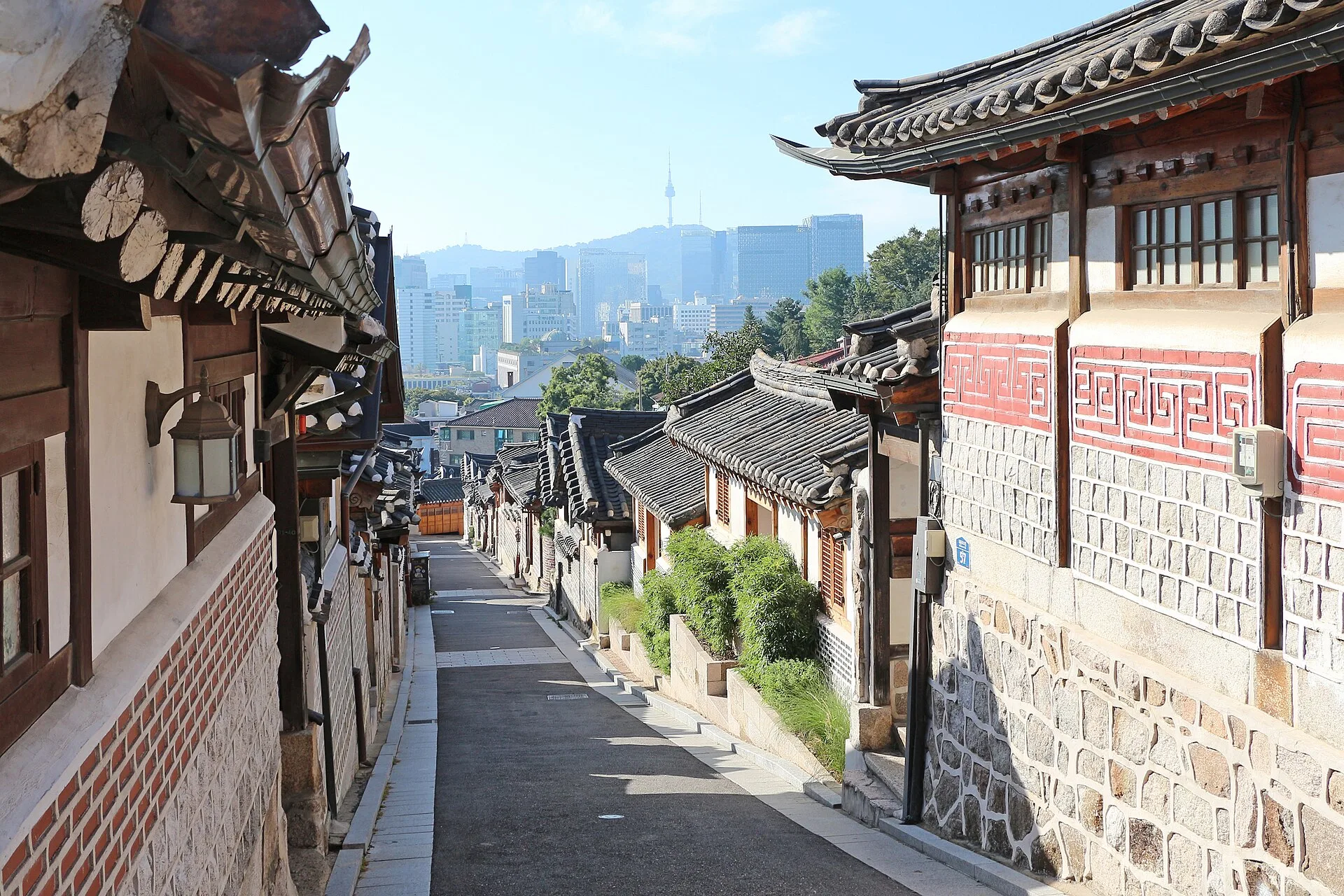
Bukchon lies between Gyeongbokgung, Changdeokgung and Jongmyo, and Seoul’s Hanok Portal calls it the city’s representative traditional residential area. From exit 3 of Anguk Station on subway Line 3, it is about five minutes’ walk towards Gyedong to the Bukchon Traditional Culture Center (37 Gyedong-gil), which works as an information point and opens 9:00–18:00 on weekdays and 9:00–17:00 at weekends. With two palaces on the doorstep, it is by far the easiest of the three to fit into a Seoul trip.
It is also a neighbourhood where people live, and the rules reflect that. On 1 July 2024 Jongno District made Bukchon Hanok Village Korea’s first ‘special management area’ under the Tourism Promotion Act. The busiest part, the Bukchon-ro 11-gil area (about 34,000 square metres), is the red zone: tourists may visit only between 10:00 and 17:00, and tourism visits are banned from 17:00 until 10:00 the next morning. A trial began on 1 November 2024, and since 1 March 2025 breaking the rule has meant a 100,000-won fine. It applies equally to foreign visitors, who are asked to pay on the spot or before leaving Korea; Jongno says dedicated ‘Bukchon security officers’ explain the rule and warn people first, then fine those who ignore it.
The exemptions matter if you are staying there. In February 2025 Jongno listed them as registered red-zone residents and their family and acquaintances, customers of shops in the red zone, merchants, lodging guests, people simply passing through without sightseeing, and non-tourism vehicles. So the rule does not stop guests reaching a guesthouse inside the zone. But Jongno added that even exempt people can be fined if ‘tourism activity’ is confirmed, and gave examples: taking photos or video, lingering to look around, and wandering the streets for sightseeing unrelated to using a shop. In other words, an evening photo walk down the alleys can earn a fine even if you are a guest.
Other parts of Bukchon are managed too. Bukchon-ro 5ga-gil and the Gyedong-gil area form an orange zone with intensive guidance, and Bukchon-ro 12-gil is a yellow zone under close monitoring; neither has visiting-hour limits. Chartered tour buses are banned at all times, weekends and holidays included, on about 2.3 km of roads including Bukchon-ro, with fines since 1 January 2026 of 300,000 won, rising to 400,000 and then 500,000 won for repeat offences. And things are still changing. According to Jongno, hanok experience businesses in the Bukchon hanok cluster grew from 47 in 2020 to 168 by June 2026 and have spread into residential alleys, bringing night-time noise and loss of privacy for residents. In June 2026 the district said it was reviewing ways to limit new registrations in Bukchon Zone 1, the Gahoe-dong 31 and 11 area where hanok are densest, with a final plan due after a committee review and an official notice. A study of the special management area runs from May to November 2026, so check Jongno’s latest notices before you go.
Seoul’s Hanok Portal asks visitors to keep to the visiting hours and not to photograph private spaces, such as the inside of a house through an open door or a front yard over a wall. That tension is Bukchon’s weak point as a place to stay: the red zone is already the busiest part of the village, and the evening rules are strict. If you picture strolling the lanes at night with a camera, Bukchon is the wrong choice.
Jeonju Hanok Village: a whole district of hanok
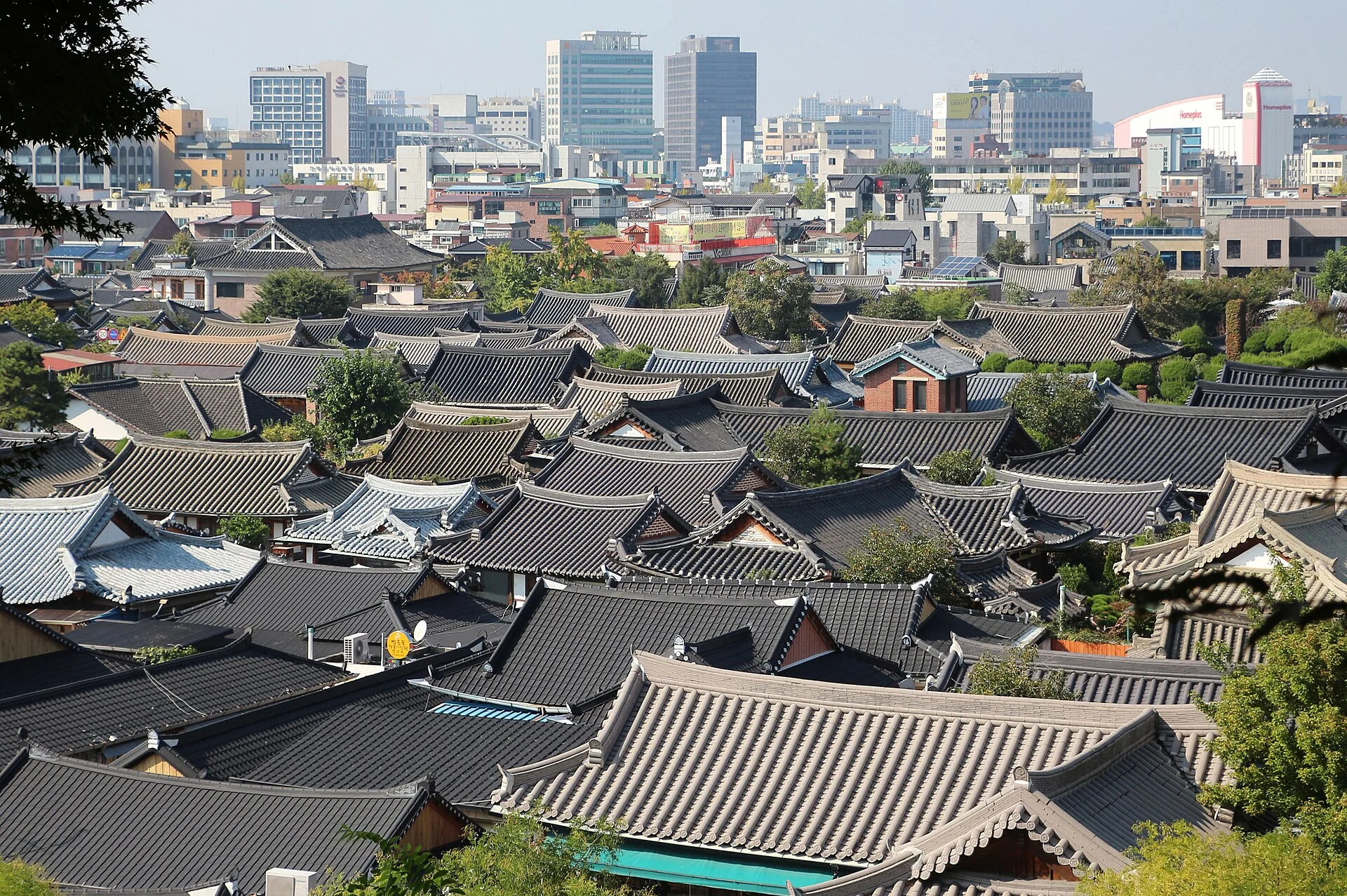
Jeonju Hanok Village covers 298,260 square metres of the Pungnam-dong and Gyo-dong area of Wansan District. The city describes its cluster of about 700 hanok as Korea’s largest traditional hanok village and the country’s only urban hanok cluster. The village is open around the clock all year, and the tourist information centre is at 99 Girin-daero. There is plenty of choice: the village website’s hanok-stay page says about 160 hanok experience businesses are concentrated there, while its status table lists 203 lodging businesses. Neither figure is dated, but either way the lodgings are spread across a whole district rather than a few lanes.
The sights are within walking distance. Gyeonggijeon, built in 1410 to enshrine the portrait of King Taejo, the founder of the Joseon dynasty, opens 09:00–19:00 from March to May and in September and October, 09:00–20:00 from June to August and 09:00–18:00 from November to February; tickets cost 3,000 won for adults, 2,000 won for teenagers and soldiers and 1,000 won for children, and entry is free on the last Wednesday of each month. Jeondong Cathedral can be visited free between 9:00 and 17:00 outside Mass times, Jeonju Hyanggyo, the old Confucian school, opens 10:00–18:00 free of charge, and Omokdae is the spot where Yi Seong-gye, later King Taejo, is said to have held a victory feast on his way back from defeating Japanese raiders.
From Seoul, take the KTX. KORAIL’s fare table effective 1 September 2026 puts a standard-class ticket from Yongsan to Jeonju at 31,600 won (31,000 won on the slower trains via Seodaejeon). By our count from KORAIL’s timetable effective 1 November, 19 trains a day run from Yongsan to Jeonju from Monday to Thursday and 24 from Friday to Sunday, taking 1 h 28 min to 2 h 29 min with a median of about 1 h 43 min. Since 1 September 2026 the former SRT trains have run as KTX-Sancheon, and KTX trains now also leave from Suseo: four a day go to Jeonju in 1 h 43–46 min (30,400 won). From Jeonju Station, the village website lists buses 112, 79, 508, 536, 542, 545, 546, 101, 119 and 999 to the Jeondong Cathedral (Hanok Village) stop, about 25 minutes, or a taxi for about 7,000–8,000 won; that page is undated. An express bus from Gangnam in southern Seoul takes about 2 h 40 min, according to the same undated page.
Jeonju’s drawbacks are its city-centre setting and the journey. The village sits in the middle of a city, so modern buildings rise behind the roofs, as the photo shows, and from Seoul you need one and a half to two and a half hours on the train plus a bus or taxi. We found no Bukchon-style visiting-hour rule for Jeonju, but homes and guesthouses share the same lanes, so keep your voice down at night.
Gyeongju: sleep in a hanok, walk to the Silla sites
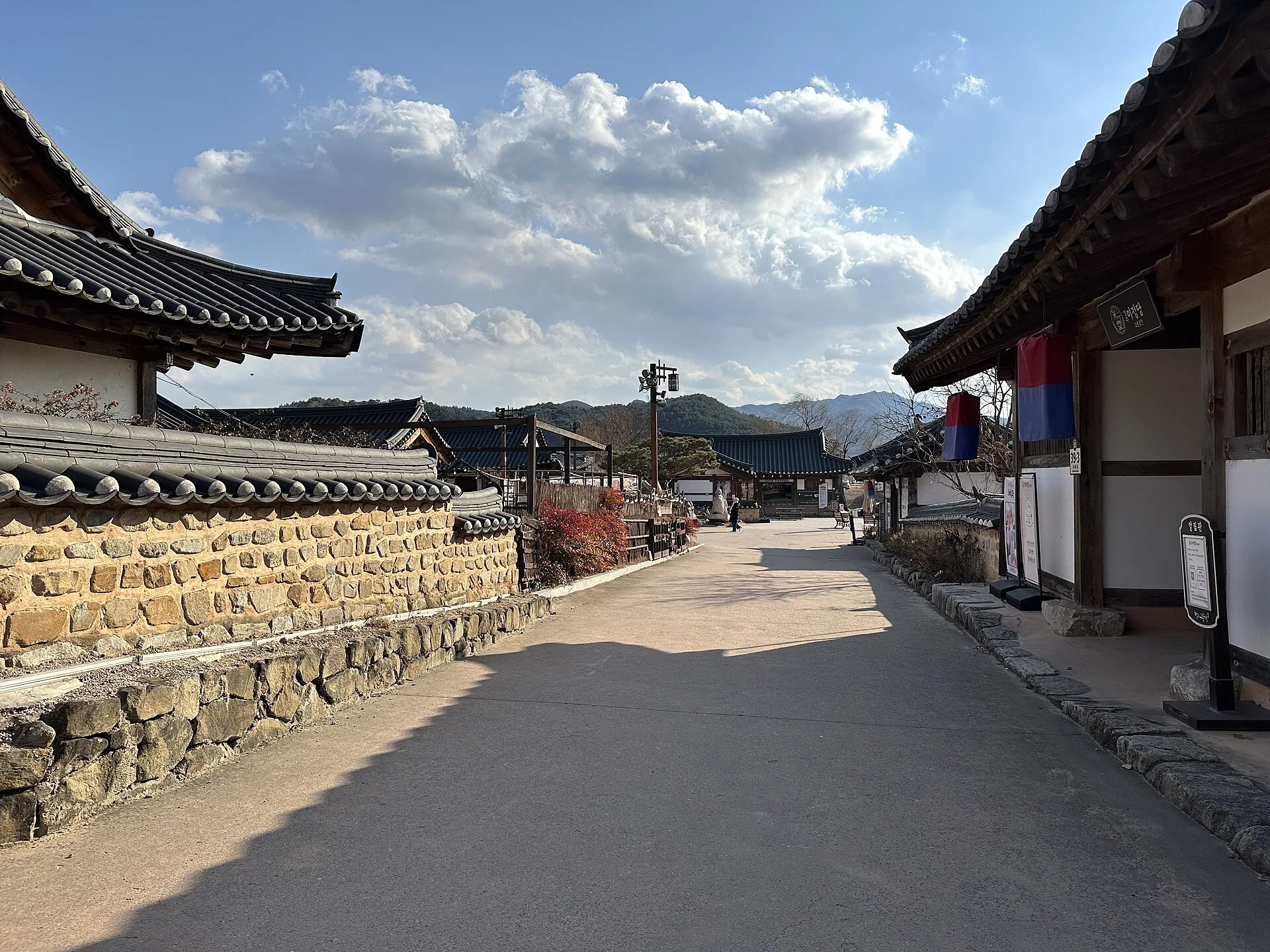
In Gyeongju, this guide looks at Hwangnidan-gil and the Gyochon Village area. The Korea Tourism Organization describes Hwangnidan Street as the city’s most visited area and one with many hanok accommodations. Gyeongju City defines Hwangnidan-gil as the Hwangnam-dong and Sajeong-dong area on both sides of the road from Naenam crossroads to Hwangnam Elementary School crossroads, known for cafés, small shops and restaurants. Gyochon Village (39-2 Gyochon-gil) stands on the site of Gukhak, the first national academy of the Silla kingdom, founded in 682, whose role passed to a Goryeo local school (hyanghak) and then a Joseon Confucian school (hyanggyo); the village is named after the hyanggyo. Many traditional hanok survive around the Choi family head house and the hyanggyo, close to Wolseong, Woljeonggyo Bridge, Cheomseongdae, Gyerim and the royal tombs.
Several of these sites belong to the Gyeongju Historic Areas, inscribed as World Heritage in December 2000. According to the Korea Heritage Service, the property has five districts (Namsan, Wolseong, Daereungwon, Hwangnyongsa and Sanseong); the Wolseong district includes Cheomseongdae and Gyerim, and the Daereungwon district covers the Hwangnam-ri tomb group among others. Gyeongju’s strength is the evening. Daereungwon opens 09:00–22:00 and is free, with only the Cheonmachong tomb inside charging 3,000 won for adults (ticket sales end at 21:30); Cheomseongdae opens 09:00–22:00 (to 21:00 in winter) and Woljeonggyo Bridge 09:00–22:00, both free; and Donggung Palace and Wolji Pond opens 09:00–22:00 (tickets until 21:30) for 3,000 won. Woljeonggyo itself, lost in the Joseon era, was rebuilt after about ten years of research and finished in April 2018. An evening walk among sites open late, then a night in a hanok, is Gyeongju’s particular appeal.
From Seoul, again take the KTX. KORAIL’s fare table puts a standard-class ticket at 44,500 won from Seoul Station on most trains (38,000 won on the slower trains via Suwon) and 42,900 won from Suseo on most trains. By our count from the timetable effective 1 November, KTX trains on the Gyeongbu line leave Seoul Station for Gyeongju 24 times a day from Monday to Thursday and 27 times from Friday to Sunday, taking 1 h 58 min to 2 h 53 min (median about 2 h 14 min); from Suseo there are 17 (Monday to Thursday) or 20 (Friday to Sunday), taking 1 h 51 min to 2 h 19 min; KTX-Eum trains from Cheongnyangni take 2 h 39 min to 2 h 56 min (9 a day, plus a 2 h 34 min train at weekends). Mind the station name: Singyeongju Station on the high-speed line was officially renamed Gyeongju Station on 28 December 2023. Gyeongju City estimates about 22 minutes by taxi from there to Gyochon (13.5 km, about 11,800 won) or about 50 minutes by bus (about 1,300 won), but the figures are undated. From the intercity bus terminal it is about 7 minutes by taxi or 23 minutes by bus.
Distance is Gyeongju’s weak point: it is the farthest of the three from Seoul, and the KTX station is 13.5 km from Gyochon. Hwangnidan-gil is also a busy street of cafés and shops, so if you want quiet nights, check exactly where a lodging sits on the map before you book.
How to choose, and how to be a good guest
Your itinerary decides it. If you only want one hanok night within a Seoul trip, Bukchon is the simplest: no train, and palaces next door. If you want a day or more in a hanok neighbourhood, choose Jeonju; if you want a hanok night plus evening walks among ancient sites, choose Gyeongju. Count the train fare too: a standard-class single usually costs 31,600 won from Yongsan to Jeonju and 44,500 won from Seoul to Gyeongju.
When you book, check three things. First, whether you get a bed or floor bedding, and whether the toilet and shower are in your room. Second, your arrival time: Seoul’s Hanok Portal asks guests to arrive before sunset, and in Bukchon’s red zone lodging guests are exempt from the evening ban, but stopping to photograph the alleys on the way in can still be fined. Third, whether the listing mentions an official scheme such as hanok experience business registration or Korea Quality certification.
While you stay, remember that neighbours live behind those walls. As Seoul’s Hanok Portal asks, keep the noise down and do not use fire or smoke without the owner’s consent; in a wooden house, fire safety matters everywhere.
Related on Rank Three: for a day in historic villages such as Yangdong near Gyeongju, see A village day in Korea: Hahoe, Yangdong or Naganeupseong?; if you would rather base yourself in an ordinary Seoul neighbourhood, Myeongdong vs Hongdae vs Gangnam: where to stay on a first trip to Seoul?; and to choose a palace near Bukchon, Which Seoul palace first? Gyeongbokgung, Changdeokgung or Deoksugung.
Our three picks
- Bukchon: a lived-in hanok neighbourhood in central SeoulBukchon (Seoul)
If you want one hanok night within a Seoul trip. It sits between Gyeongbokgung and Changdeokgung, about five minutes on foot from Anguk Station. Just remember that tourist visits to the red zone around Bukchon-ro 11-gil are banned from 17:00 to 10:00, and that even guests can be fined 100,000 won for photographing or lingering there in those hours.
- Jeonju Hanok Village: a whole district of hanokJeonju Hanok Village
If the hanok neighbourhood itself is the point. About 700 hanok, open around the clock, with Gyeonggijeon and Jeondong Cathedral on foot and plenty of hanok lodgings; one and a half to two and a half hours by KTX from Yongsan (31,600 won standard class).
- Gyeongju: sleep in a hanok, walk to the Silla sitesGyeongju (Hwangnidan-gil and Gyochon)
If you want a hanok night and Silla heritage together. Daereungwon, Woljeonggyo and Donggung and Wolji stay open until 22:00, and Cheomseongdae until 22:00 (21:00 in winter), so evening walks are easy. The KTX stop, Gyeongju Station (formerly Singyeongju), is 13.5 km from Gyochon, so allow for a taxi or bus.
Side by side
| What to check | Bukchon (Seoul) | Jeonju Hanok Village | Gyeongju (Hwangnidan-gil, Gyochon) |
|---|---|---|---|
| What kind of place | Traditional residential area between Gyeongbokgung, Changdeokgung and Jongmyo | About 700 hanok in one urban district | Hanok streets beside Silla sites (Hwangnam-dong, Sajeong-dong, Gyochon) |
| Hanok stays | 168 hanok experience businesses in the Bukchon hanok cluster (June 2026) | About 160 hanok experience businesses (village website, undated) | Many hanok accommodations around Hwangnidan Street (KTO) |
| Visitor rules | Red zone: tourist visits banned 17:00–10:00; 100,000-won fine; guests exempt, but not for “tourism activity” | No visiting-hour rule found; open 24 hours | No visiting-hour rule found |
| Evenings | No sightseeing in the red zone after 17:00 | Village open 24 hours; Gyeonggijeon to 18:00 (Nov–Feb) | Daereungwon, Woljeonggyo, Donggung and Wolji open to 22:00; Cheomseongdae to 22:00 (21:00 in winter) |
| Nearby sights and fees | Gyeongbokgung, Changdeokgung, Jongmyo | Gyeonggijeon 3,000 won; Jeondong Cathedral and Hyanggyo free | Daereungwon free (Cheonmachong 3,000 won); Donggung and Wolji 3,000 won |
| From Seoul | Subway Line 3 to Anguk | KTX from Yongsan: 31,000–31,600 won, 1 h 28 min–2 h 29 min (19–24 a day from 1 Nov, depending on the day) | KTX from Seoul Station: 38,000–44,500 won, 1 h 58 min–2 h 53 min (24–27 a day from 1 Nov, depending on the day) |
| Station to the hanok area | About 5 minutes on foot from Anguk exit 3 to the Bukchon Traditional Culture Center | Bus about 25 min or taxi 7,000–8,000 won from Jeonju Station (undated) | Taxi about 22 min (about 11,800 won) or bus about 50 min from Gyeongju Station to Gyochon (undated) |
| Watch out for | Crowds and strict evening rules; people live here | In the middle of a modern city; train plus bus or taxi from Seoul | Farthest from Seoul; station 13.5 km from Gyochon |
Where I would start
For a single hanok night within a Seoul trip, I would choose Bukchon: no train, and palaces next door. The red-zone rule does not stop guests reaching their lodging, but between 17:00 and 10:00 any tourism activity there, such as taking photos or lingering to look around, can still be fined. If I wanted to linger in a hanok neighbourhood for a day or two, I would go to Jeonju, and if I wanted hanok nights with evening walks among Silla tombs and palace sites, Gyeongju. Wherever you book, check the bed, the bathroom and whether the place sits inside an official scheme such as hanok experience business registration or Korea Quality certification, and remember that you are a guest in someone else’s neighbourhood.


