On a first trip to Jeju, the first question is often where to stay. The island is bigger than it looks, and your base decides how long you spend getting to the airport and how much you can see in a day. This guide compares three areas: Jeju City, with the airport and the old town; Seogwipo on the south coast, which really means either downtown Seogwipo or the Jungmun resort area; and Aewol on the west coast. It looks at how to get there from the airport, journey times, fares, what is nearby, Hallasan trailheads and the weather. It is a research guide, not a review: we did not stay in these areas or ride these buses, and journey times are timetable or official-guide figures. The facts come from Jeju Province, the Jeju Bus Information System, Korea Airports Corporation’s Jeju Airport pages, Visit Jeju (the Jeju Tourism Organization’s portal), Hallasan National Park and the Korea Meteorological Administration’s Jeju office, checked on 31 October 2026 (US Central time; 1 November in Korea). It covers areas only, not hotels or other businesses.
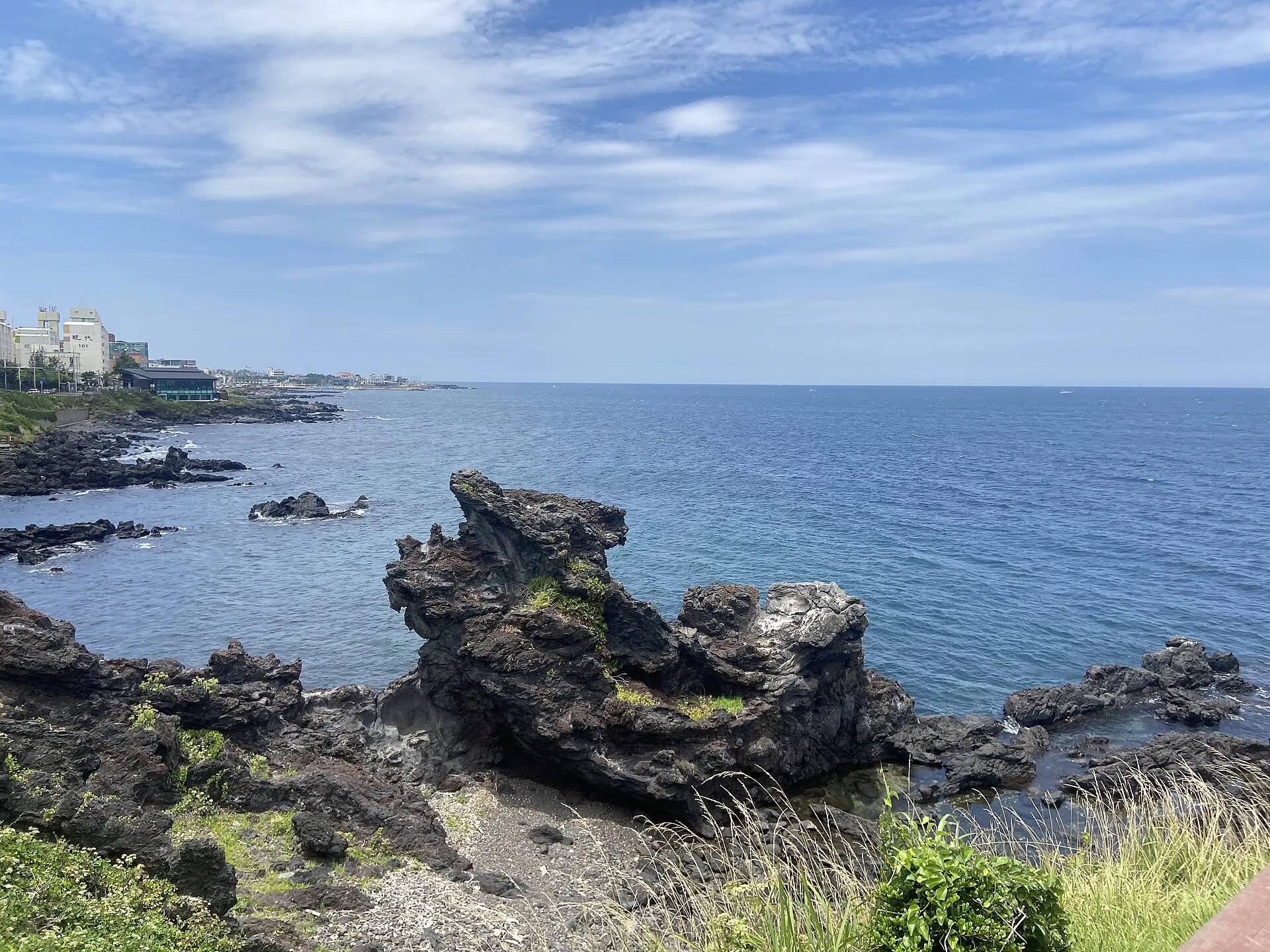
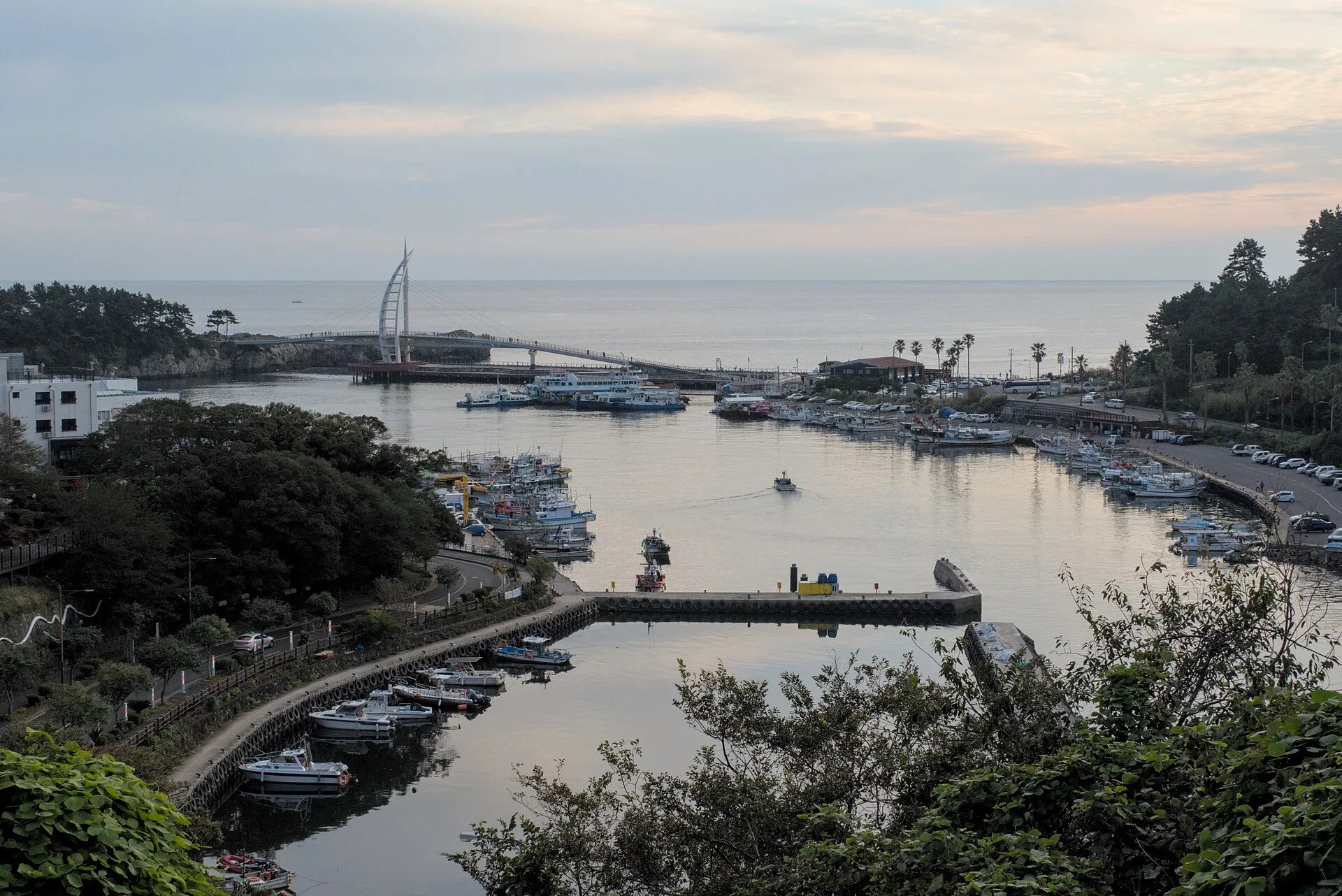
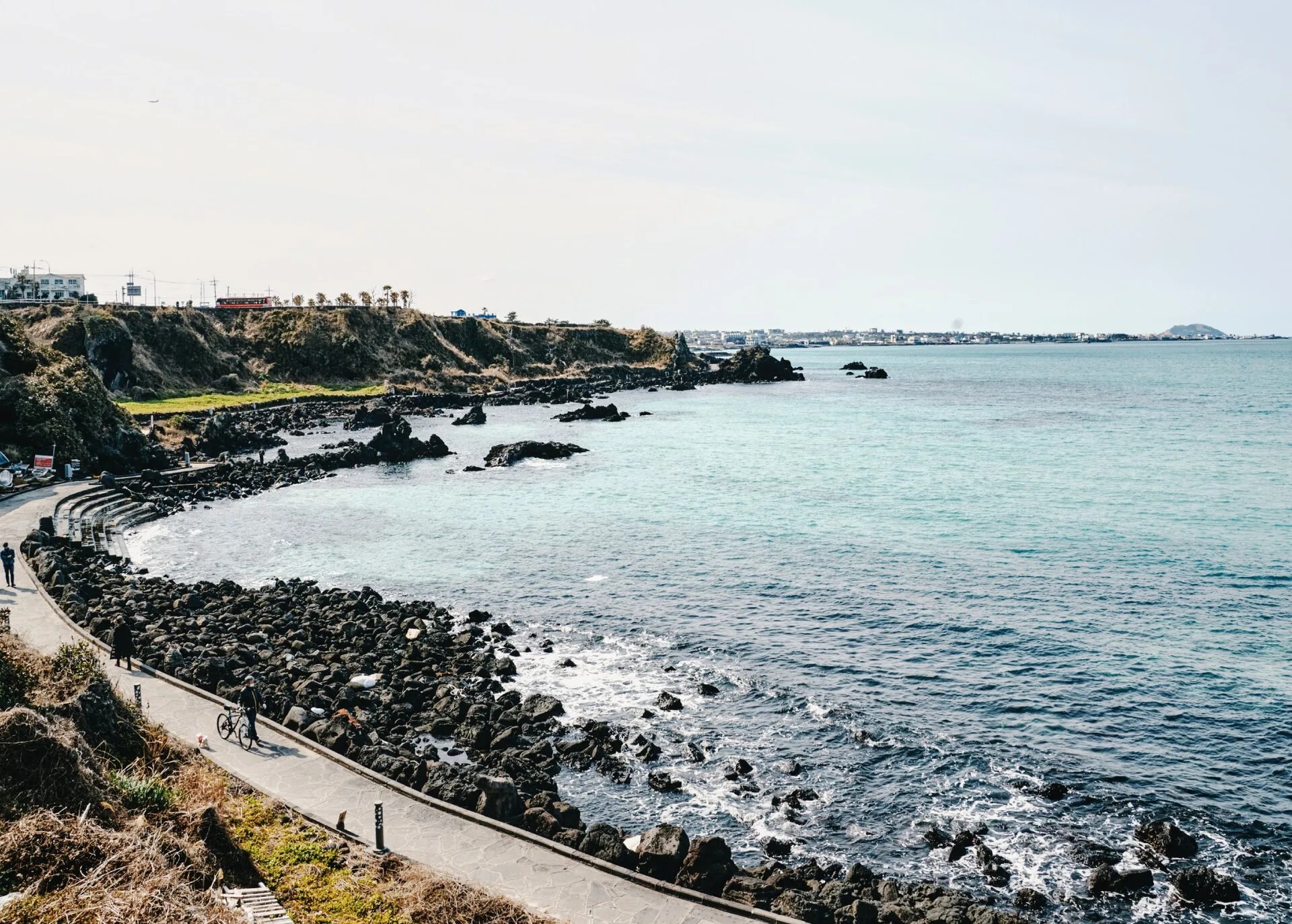
First, the map: two cities and two Seogwipos
Jeju Special Self-Governing Province has just two administrative cities: Jeju-si (Jeju City) and Seogwipo-si. Jeju International Airport is in Jeju City, at 2 Gonghang-ro. Aewol is a town (eup) within Jeju City on the coast west of the airport. Hallim, home to Hyeopjae Beach, is a separate town, so when a listing says “near Aewol”, check the town name on the map.
Seogwipo is the confusing one. Seogwipo-si covers the whole southern half of the island, from Daejeong and Andeok to Namwon, Pyoseon and Seongsan, plus twelve urban districts. If you are thinking of staying “in Seogwipo”, decide between two places: downtown Seogwipo, with Cheonjiyeon Falls and the Maeil Olle Market, or the Jungmun Tourist Complex further west. Visit Jeju, the official tourism portal, files downtown Seogwipo and Jungmun as separate sub-regions of Seogwipo-si, and the Jungmun resort area, which spans Jungmun-dong, Saekdal-dong and Daepo-dong, has been developed since 1978.
Bus fares follow one set of rules across the island. Regular buses cost a flat 1,150 won for an adult with a transport card (1,200 won in cash), however far you go. Express buses, numbered in the 100s, charge by distance: 2,000 won by card when you board, covering the first 20 km, with the rest settled when you tap off, up to 3,000 won. The airport limousines charge by section: route 600 costs 1,300–5,500 won and route 800 1,300–5,000 won. Nationwide cards such as T-money and Cashbee work, as do credit cards with a post-paid transit function. Tap off and board another bus within 40 minutes and you get up to two discounted transfers, free if the next fare is the same or lower; between express and limousine buses, though, the discount is only 1,150 won for an adult.
Do not count on cash. The airport’s route data mark the express buses, the 800-series limousines and nearly all city buses leaving the airport “no cash since July 2024” (the 600 and 601 carry no such note), while the bus information system’s fare table still lists cash fares: 1,200 won on regular buses and the maximum fare on express buses. The two disagree, but a transport card works either way.
At the airport, ordinary city and intercity buses stop right outside Gate 2; the limousine stand is about 10 m to the right of Gate 5; taxis wait across the crosswalk from Gate 3. Express 182 and limousine 800 leave from the “express bus (Pyeonghwa-ro)” stop at Gate 4, and express 181 from Gate 1.
Jeju City: right by the airport, easy without a car
Jeju City’s great advantage is that the airport is right next to it. The express 102 and 182 timetables put Jeju Bus Terminal 7–10 minutes from the airport. City buses cost 1,150 won by card and leave from Gate 2 (towards Yongdam and City Hall) and Gate 5 (towards Nohyeong and Yeon-dong); route 315, for example, heads for the international pier and 365 for City Hall and Jeju National University. You can also move around at night: Jeju City has late-night buses in the 3000 series, and route 3001 loops between the airport, Nohyeong and Jungang-ro. If you land late on the first night or fly out early on the last morning, that matters.
The sights are close together, too. Visit Jeju calls Dongmun Traditional Market, which took shape in 1945, the largest and oldest market on Jeju. Jeju Mokgwana, the Joseon-era government office, stands next to Gwandeokjeong, built in 1448, which Visit Jeju describes as the oldest surviving building on the island. Yongduam Rock is on the coast north-east of the airport. Sanjicheon Stream, which runs from Dongmun Market to Jeju Port, is the start of Jeju Olle Route 18, while Route 17 (17.9 km, six to seven hours) passes Yongduam and Gwandeokjeong and finishes near Dongmun Market.
Hallasan is within reach as well. According to the national park, the Seongpanak trailhead is about 30 minutes from Jeju Bus Terminal on bus 281, and Eorimok about 35 minutes on bus 240; both trailheads are on the Jeju City side of the mountain.
The drawback is the distance to the south. On the express 182 timetable, the airport is about 55 minutes from Jungmun, 70 minutes from Seogwipo Bus Terminal and 90 minutes from Seogwipo’s central rotary, so several days of waterfalls and south-coast Olle walks mean several round trips. And this is a city with an airport and a bus terminal; if you pictured a seaside retreat, it may disappoint. That last point is our reading of the timetables and the map, not an official statement.
Seogwipo: waterfalls and the south coast, downtown or Jungmun
From the airport, limousines 600 and 800 and expresses 181 and 182 run to Seogwipo. Limousine 600 leaves from the Gate 5 stand and runs past the Jungmun resort hotels, the International Convention Center, Daepo, Gangjeong, the World Cup Stadium and the Seogwipo port area to the Seogwipo KAL Hotel (the 601 goes only as far as the Convention Center). The adult fare is 4,500 won to the Jungmun stops and 5,500 won to the KAL Hotel. On the timetable in force since 1 August 2024, the 06:30 departure from the airport reaches the Convention Center at 07:41 and the KAL Hotel at 08:13: about 71 minutes and about 1 hour 43 minutes. The first departure on the timetable, at 06:00, is a 601 that goes only to the Convention Center; the first 600 to the KAL Hotel leaves at 06:30 and the last at 22:20.
For downtown Seogwipo without the Jungmun detour there is limousine 800, which starts at Jeju Bus Terminal, calls at the airport (Gate 4) and runs to Seogwipo Bus Terminal for up to 5,000 won. Express 182 leaves Gate 4 and follows Pyeonghwa-ro via Jungmun to Seogwipo, while the 181 runs the same loop the other way round, starting on the 5.16 road. On the 182 timetable it is about 55 minutes from the airport to Jungmun (the post office stop), 70 to Seogwipo Bus Terminal and 90 to the central rotary, with a bus every 30–60 minutes, for 2,000–3,000 won by card. Coming back the 5.16-road way, the 182 takes about 75 minutes from the central rotary to the airport. From Jeju Bus Terminal (not the airport), regular trunk buses 281 (5.16 road) and 282 (Pyeonghwa-ro, via the Jungmun post office) also link the two cities at the flat 1,150-won fare. The 600 and 182 times here follow the bus information system’s timetables dated 1 August 2024.
Downtown Seogwipo is good for walking. Cheonjiyeon Falls drops 22 m into a 20 m-deep pool and is open 09:00–22:00 (last entry 21:20), so you can see it after dark. Jeongbangpokpo Falls, which Visit Jeju calls the only waterfall in Korea that falls straight into the sea, is open 09:00–17:50 (last entry 17:30; hours shift with sunset) and costs 2,000 won for adults. Visit Jeju calls the Seogwipo Maeil Olle Market the city’s largest and oldest permanent market; Lee Jung-seop Street was laid out around the thatched house where the painter lived as a wartime refugee, next to the Lee Jung-seop Art Museum; and Oedolgae is a 20 m sea stack with paths around it. Jeju Olle Route 6 (Soesokkak to the Olle Travel Center, 11 km, four to five hours) runs through downtown, and Route 7 (the travel center to Wolpyeong, 17.7 km, five to six hours) passes Oedolgae.
Jungmun feels different. Jungmun Saekdal Beach, Cheonjeyeon Falls and the convention center are inside the resort complex, and Visit Jeju says the beach’s frequent, relatively high waves make it popular with surfers. Nearby, the Daepo coast columnar joints stand 30–40 m high along about 1 km of shore and are Natural Monument No. 443; Jeju Olle Route 8, from Wolpyeong to Daepyeong port, passes the columns, and its A route also takes in the beach.
The southern trailheads of Hallasan are close. The park puts the Donnaeko trailhead about 25 minutes from Seogwipo (city bus 611 or 612 to Chunghon Cemetery Square, then about a 20-minute walk), Yeongsil about 30 minutes from the Jungmun rotary on bus 240, and Seongpanak about 40 minutes from Seogwipo.
The weather differs a little. On the Korea Meteorological Administration’s 1991–2020 normals, the annual mean temperature is 16.9°C at the Seogwipo station and 16.2°C at the Jeju station; in December the means are 9.4°C and 8.3°C, and the average daily highs 13.1°C and 11.0°C. In December, Seogwipo is about a degree milder on average, but it does get snow: in February 2025 the Seogwipo station logged nine snow days, its highest February count on record, against ten at the Jeju station. Seogwipo is also wetter, with 1,989.6 mm of rain a year on average against 1,502.3 mm in Jeju City.
The catch is distance from the airport. With a late arrival or an early flight you need to plan around the limousine’s first and last buses and a journey of more than an hour. Downtown and Jungmun are also some way apart, so decide which one you want first.
Aewol: the west coast and sunsets, served mainly by express 102
Aewol, a town within Jeju City, lies along the coast west of the airport. Express 102 leaves from stop ④ outside Gate 2 and follows the western coast road through Hagwi, Aewol High School, Aewol-ri and Hallim to Moseulpo (Unjin port). On its timetable, the 06:55 from the airport reaches Aewol at 07:30, and the 07:04 from Aewol reaches the airport at 07:39, about 35 minutes each way. Buses run every 25–55 minutes and cost from 2,000 won by card, depending on distance. The timetable file leaves its “effective date” blank, so check the bus information system before you travel.
Check local buses within Aewol before you rely on them. Regular routes 202-1 and 202-2 link Hallim, Aewol and the Sinjeju rotary but do not run at weekends or in school holidays; route 270 follows Aejo-ro between the Aewol Hanaro Mart and Jeju National University, and village buses 791 to 795 serve Aewol-eup villages such as Yusuam, Sogil, Nabeup and Geumseong, with 793 to 795 starting from the Aewol or Hagwi Hanaro Mart.
What you get is the sea on your doorstep. The Handam Coastal Trail runs about 1.2 km along the shore from Aewol port to Gwakji beach, and Visit Jeju recommends it for sunsets on the island’s west side. Gwakji Beach has a 350 m by 70 m stretch of sand, and the water averages 1.5 m deep. The Aewol Coastal Road runs about 9 km from Hagwi-ri to Aewol-ri with a bike path and walking sections, and is part of Jeju Olle Route 16; Visit Jeju notes plenty of restaurants, cafes and places to stay along it. Olle Route 15-B (Hallim port to Gonae port, 13.5 km, about five hours) also passes Gwakji Beach.
The drawback shows when you head for the south coast or Hallasan. We found no official travel time from Aewol to Jungmun or Seogwipo, and no official guidance on reaching a Hallasan trailhead from Aewol; the weather agency’s report has no Aewol station either. No official source says so, but judging by the bus frequencies and routes, Aewol suits travellers with a rental car best.
With or without a car, Hallasan, and splitting your stay
With a rental car, where you sleep matters less, although we found no official driving time or distance between Jeju City and Seogwipo. What the official pages do give is the road names: the 5.16 road (route 1131) links the two cities and the 1100 road (route 1139) links Jeju City with Jungmun. Taxis use one island-wide tariff: since 1 July 2024 a mid-size taxi starts at 4,300 won for the first 2 km, then adds 100 won every 126 m (or every 31 seconds at 15 km/h or less), with a 20% surcharge from 23:00 to 04:00, a long-distance rate (120 won per 126 m) on trips of 20 km or more, and a 1,000-won fee for calling a taxi through a call service. There is no official fare estimate from the airport to Seogwipo or Aewol.
If you want to reach the summit of Hallasan, book before you book a room. Only two trails go to the top, Seongpanak (9.6 km, four and a half hours to the summit) and Gwaneumsa (8.7 km, five hours), and both need a reservation. Bookings for the following month open at 09:00 on the first working day of each month, and a QR code for entry and exit is sent to your phone; a no-show without cancelling bars you from booking for three months, or a year the second time. Hikes are day trips only, and from November to February the earliest start is 06:00. Seongpanak is about 30 minutes from Jeju Bus Terminal and about 40 from Seogwipo on bus 281, so either base works. The non-summit trails, Eorimok (two hours to Witse-oreum), Yeongsil (an hour and a half) and Donnaeko (three and a half hours to the Nambyeok junction), need no booking.
Staying three nights or more without a car? Consider splitting your stay: the first and last nights in Jeju City near the airport, the nights in between in Seogwipo, so you ride the 600 limousine or the 182 express only once each way. That is our suggestion based on the timetables above, not official advice. Bus times change with the seasons and route reforms, so check the Jeju Bus Information System (bus.jeju.go.kr) before you set off.
Related on Rank Three: for more to see on the island, Three volcanic landscapes in Jeju: columns, an oreum and a beach; to choose a first Olle walk, Choose a Jeju Olle walk: the current Routes 6, 7 and 10; and if Busan is next, Haeundae vs Seomyeon vs Nampo-dong: where to stay on a first trip to Busan?.
Our three picks
- Jeju City: right by the airport, easy without a carJeju City
The default for a first visit without a car, or for two nights or fewer. On the express timetables Jeju Bus Terminal is 7–10 minutes from the airport, which helps with early flights; city buses cost 1,150 won, and late-night 3000-series buses (the 3001 leaves the airport 22:00–00:25) help with late arrivals. Dongmun Market, Gwandeokjeong and Yongduam Rock are close. The south is further: about 55 minutes to Jungmun and 70–90 to Seogwipo on express 182.
- Seogwipo: waterfalls and the south coast, downtown or JungmunSeogwipo (downtown or Jungmun)
When the south coast is the point of your trip: waterfalls, Olle Routes 6, 7 and 8, Jungmun’s beach. From the airport take limousine 600 (4,500 won, about 71 minutes to Jungmun) or express 182 (about 55 minutes to Jungmun). Cheonjiyeon Falls is open until 22:00, and on the weather agency’s normals December averages about a degree warmer than in Jeju City.
- Aewol: the west coast and sunsets, served mainly by express 102Aewol
For the west coast, sunsets and seaside walks, if you have a rental car or can work around express 102 (about 35 minutes from the airport). The Handam Coastal Trail (about 1.2 km), Gwakji Beach and the Aewol Coastal Road (about 9 km) are on hand, but check local buses in advance (202-1 and 202-2 do not run at weekends or in school holidays).
Side by side
| What to check | Jeju City | Seogwipo (downtown or Jungmun) | Aewol |
|---|---|---|---|
| Administrative area | Urban Jeju-si (the airport is at 2 Gonghang-ro, Jeju-si) | Seogwipo-si (as a base, split into downtown Seogwipo and the Jungmun Tourist Complex: Jungmun-, Saekdal- and Daepo-dong) | Aewol-eup, Jeju-si (Hallim is a separate town) |
| Airport bus | City buses from Gates 2 and 5, e.g. 315, 365 | Limousine 600 (Gate 5); express 182 and limousine 800 (Gate 4); express 181 (Gate 1) | Express 102 (stop ④, Gate 2) |
| Timetable journey time | Jeju Bus Terminal 7–10 min | 600: Convention Center about 71 min, KAL Hotel about 1 h 43 min / 182: Jungmun about 55 min, Seogwipo Bus Terminal about 70 min | Aewol about 35 min |
| Adult fare (card) | 1,150 won (fare table: 1,200 won cash; airport data: no cash) | 600: 4,500 won to Jungmun, 5,500 won to the KAL Hotel; 800 up to 5,000 won; express 2,000–3,000 won | Express from 2,000 won (max 3,000) |
| Nearby sights | Dongmun Traditional Market, Jeju Mokgwana and Gwandeokjeong, Yongduam Rock, Sanjicheon Stream | Downtown: Cheonjiyeon Falls (open to 22:00), Jeongbangpokpo Falls, Maeil Olle Market, Lee Jung-seop Street, Oedolgae / Jungmun: Saekdal Beach, Daepo columnar joints | Handam Coastal Trail (about 1.2 km), Gwakji Beach, Aewol Coastal Road (about 9 km) |
| Jeju Olle routes | Route 17 ends near Dongmun Market; Route 18 starts at Sanjicheon | Routes 6 and 7 (downtown, Oedolgae); Route 8 (Jungmun) | Route 16 (Aewol Coastal Road); Route 15-B (Gwakji) |
| Hallasan trailheads by bus | Seongpanak about 30 min (281); Eorimok about 35 min (240) | Donnaeko about 25 min; Seongpanak about 40 min; Yeongsil about 30 min from Jungmun (240) | No official guidance found |
| Weather (KMA normals, 1991–2020) | Jeju station: 16.2°C a year, 8.3°C in December, 1,502.3 mm of rain | Seogwipo station: 16.9°C a year, 9.4°C in December, 1,989.6 mm of rain | No station figures |
| Drawbacks | About 55–90 minutes by bus to the south coast (182 timetable) | Far from the airport; downtown and Jungmun are apart | Mainly one airport route, express 102 (every 25–55 min); 202-1 and 202-2 do not run at weekends or in school holidays |
| Good for (our view) | A first trip without a car, short stays, late arrivals or early flights | Waterfalls, Olle walks and beaches in the south; slightly milder in December | Rental-car trips, west-coast sunsets and seaside walks |
So, where should you stay?
For a first trip to Jeju, Jeju City is our default. The airport and the bus terminal are 7–10 minutes apart on the timetables, which helps with an early flight home; city buses cost 1,150 won, and the 3000-series night buses help if you land late. If the trip is really about the southern waterfalls, the Olle walks and Jungmun’s beach, stay in Seogwipo; limousine 600 or express 182 takes about an hour to Jungmun and about 70–105 minutes to downtown Seogwipo, so first decide between downtown and Jungmun. Aewol fits best when you want the west coast and its sunsets and have a rental car. For three nights or more without a car, consider splitting your stay between Jeju City and Seogwipo. Timetables change, so check the Jeju Bus Information System before you go.


