Gimpo Airport is much closer to central Seoul than Incheon: it sits inside the city, in Gangseo-gu, and handles flights to Japan, China and Taiwan as well as domestic routes such as Jeju and Busan. After you land there are three ways into town: the subway or AREX (Airport Railroad) from Gimpo Airport Station beneath the airport, a bus, or a taxi. This guide compares them on where you board, where they go, fares, hours, luggage and whether the Climate Card works. It is a research guide, not a timed journey: the facts come from Korea Airports Corporation’s Gimpo pages, AREX, Seoul Metro, Seoul Metro Line 9, the Seoul Metropolitan Government, VisitKorea and Visit Seoul, checked on 30 October 2026 (US Central time; the morning of 31 October in Korea). Fares and times are the operators’ own figures.
Before you land: where Gimpo is and what is different
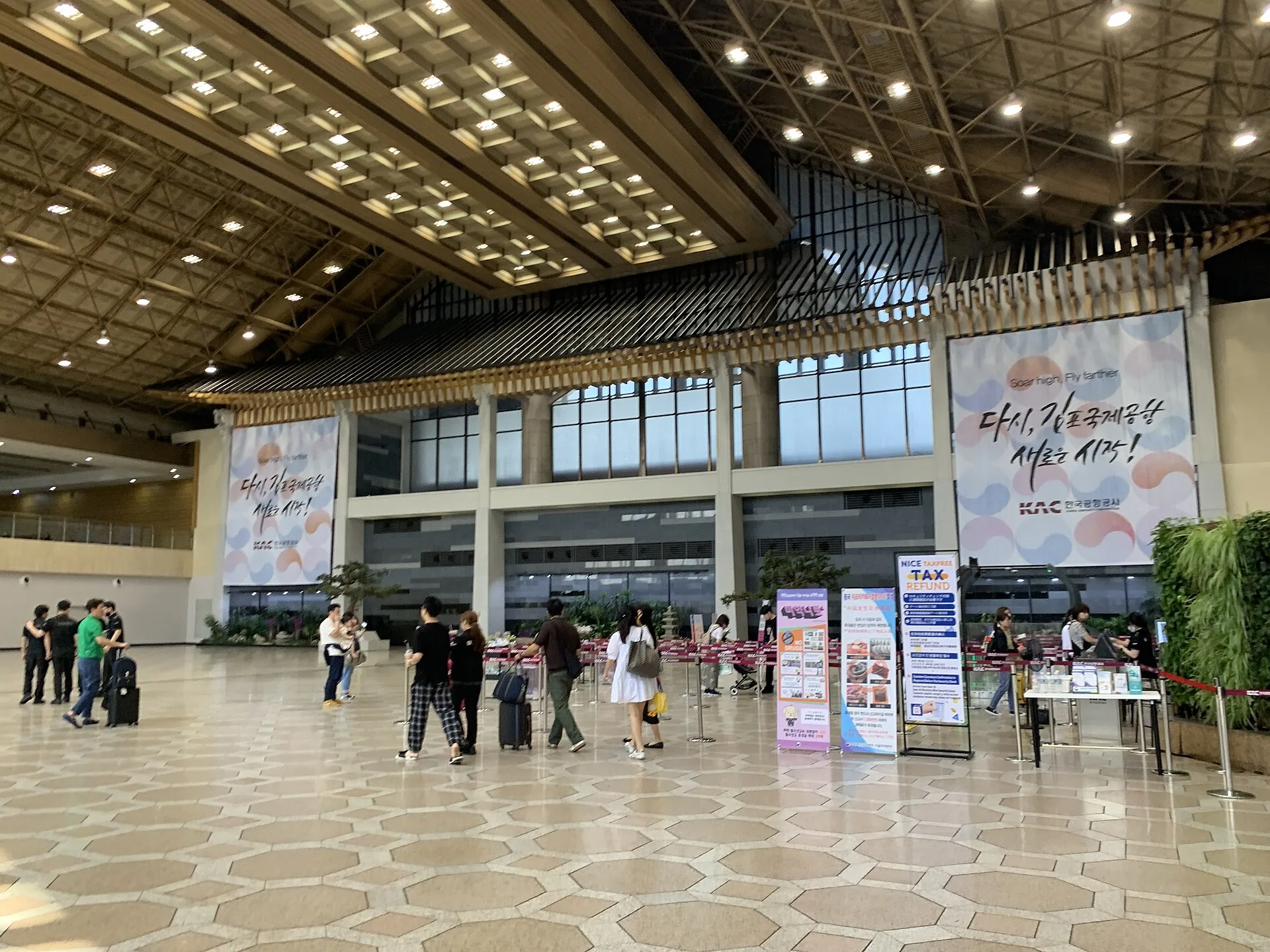
Gimpo International Airport sits at 112 Haneul-gil in Gangseo-gu — inside the city of Seoul, which is the biggest difference from Incheon. It has separate international and domestic terminals, and the airport lists bus stops and taxi stands for each terminal separately, so check which one you land at. In the airport’s own flight schedule for 31 October 2026, international destinations are Tokyo Haneda, Osaka Kansai, Nagoya Chubu, Beijing Capital and Daxing, Shanghai Hongqiao, Taipei Songshan and Kaohsiung; domestic flights go to Jeju, Gimhae (Busan), Gwangju, Yeosu, Ulsan and Sacheon.
A free shuttle links the terminals. One loop that also serves the cargo terminal runs 06:00–23:00; a passenger-terminal loop runs 08:00–23:00 every 12–15 minutes. Board at stop 5, to the right after 1F Gate 1 of the international terminal, or at stop 8, to the left after 1F Gate 4 of the domestic terminal. There is a tourist information centre on 1F of the international terminal, but its hours differ between VisitKorea (10:00–19:00) and Visit Seoul (09:00–18:00).
There are three ways into the city: the subway or AREX (Airport Railroad) from Gimpo Airport Station beneath the airport, a bus from outside the terminal, or a taxi. Unlike Incheon, Gimpo has almost no limousine buses that go straight to central tourist areas, and that changes the choice quite a bit.
Subway and AREX: pick the line by destination
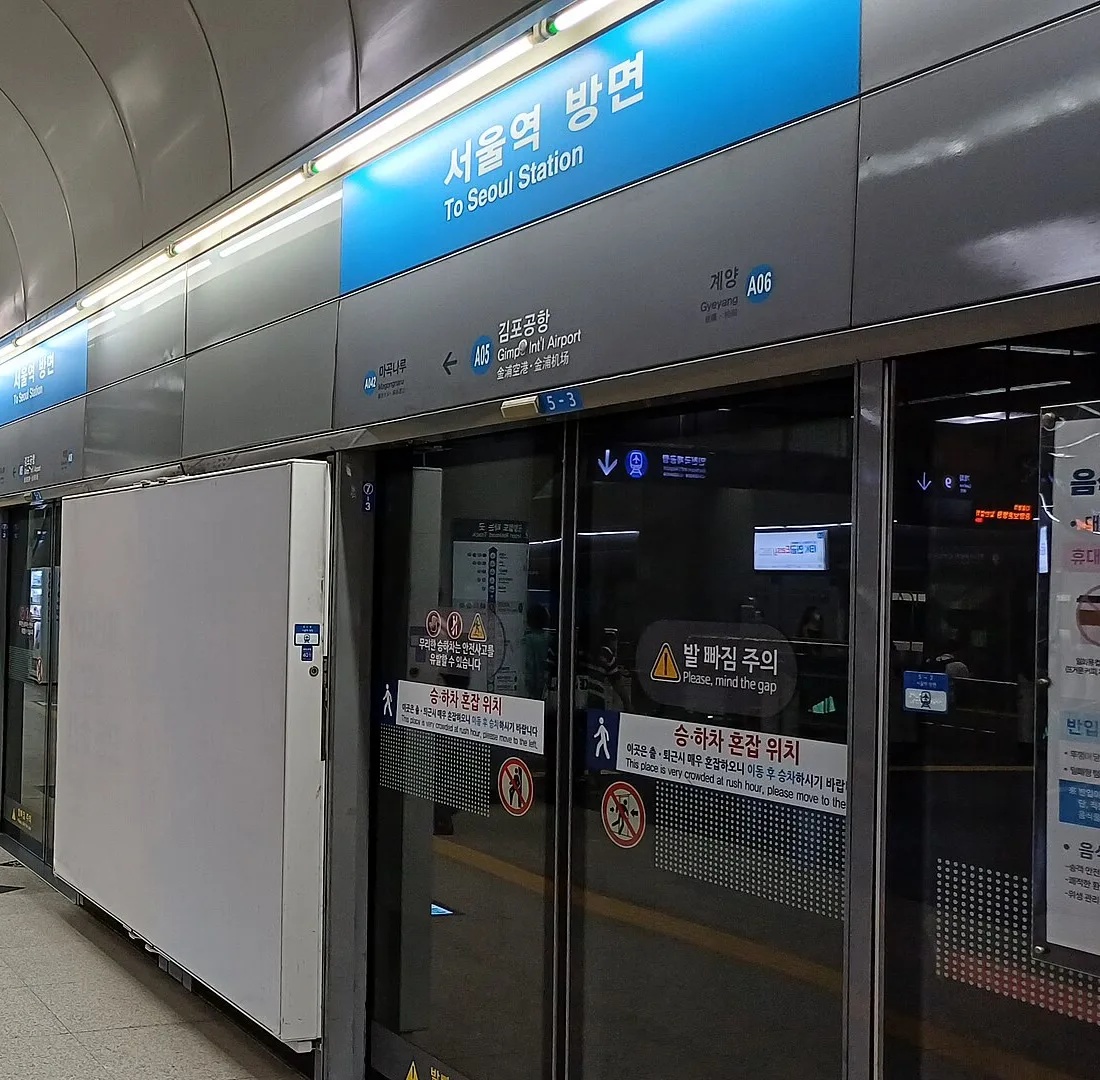
Gimpo Airport Station lies underground in the middle of the airport and brings together Line 5, Line 9, AREX, the Gimpo Goldline and the Seohae Line. AREX says every floor of its Gimpo station is served by escalators and lifts, with wheelchair gates and dedicated lifts. VisitKorea puts the AREX all-stop train at about 23 minutes to Seoul Station and says Lines 5 and 9, the Goldline and the Seohae Line reach central Seoul and nearby areas within about an hour.
AREX all-stop trains run Seoul Station – Gongdeok – Hongik Univ. – Digital Media City – Magongnaru – Gimpo Airport and on to Incheon Airport. The non-stop Express runs only between Seoul Station and Incheon Airport and does not stop at Gimpo, so take the all-stop train. Adult fares by transport card from Gimpo Airport are 1,750 won to Seoul Station or Gongdeok, 1,650 won to Hongik Univ. or Digital Media City and 1,550 won to Magongnaru. On weekdays the first Seoul-bound train leaves at 05:42 and the timetable runs past midnight; the last train to Seoul Station leaves at 00:16 and the 00:34 ends at Digital Media City, so check the platform display. On 14 October AREX warned that a union work-to-rule action may delay some trains and asked passengers to allow extra time.
For Yeouido or Gangnam, Line 9 is the easy option. It runs local and express trains one for one, and Gimpo Airport is an express stop. Express stops include Yeouido, Express Bus Terminal, Sinnonhyeon, Seonjeongneung, Sports Complex and Olympic Park. On weekdays the first express towards VHS Medical Center leaves Gimpo at 05:30 and the last at 23:28.
For Gwanghwamun or Jongno, Line 5 gets you there without changing. It runs via Yeouido, Gongdeok and Seodaemun to Gwanghwamun, with Jongno 3-ga next. I found no official journey time. The first weekday train towards Hanam Geomdansan leaves at 05:34. The Gimpo Goldline heads into Gimpo city (Gochon, Pungmu and beyond), not towards central Seoul.
A quick note on fares: the Seoul subway base fare is 1,550 won by transport card or 1,650 won with a single-journey ticket for the first 10 km, plus 100 won for every 5 km from 10 to 50 km. Transport-card trips started by 06:30 get 20% off the base fare (early-bird discount). Single-journey tickets carry a 500-won deposit, refunded at the deposit refund machine after you exit.
Buses: only three limousines, and the 601 for the old centre
Buses are where Gimpo surprises people who know Incheon. The airport’s current route data lists just three limousine routes, 6003, 6014 and 6101, and none of them goes to Myeong-dong or Gangnam. The 6003 calls at international 1F stop 6 and domestic stop 4, then heads through Songjeong, Magok and Balsan to Mokdong, Guro and Daerim stations; it costs 8,000 won and leaves the international terminal from 06:21 to 23:59. The 6014 runs from the same stops via Hwagok and Gaebong to Gwangmyeong (La Casa Hotel) for 8,000 won, 07:01–23:46 from the international terminal. The 6101 calls at international 1F stop 6 and domestic stop 5, then goes to Surak Terminal, Nowon Station and Changdong Station for 9,000 won, but since 1 March 2026 it runs only five times a day (08:35, 12:05, 15:00, 18:20 and 21:00 from the international terminal).
For the old city centre there is city bus 601, which runs via Magok, Deungchon, Mapo-gu Office, Yonsei University, Gyeongbokgung, Anguk Station (for Insadong), Hyehwa, Jongno and Gwanghwamun for 1,500 won. It comes every 6–10 minutes; the first bus from the airport towards Gwanghwamun leaves at 04:00 and the last at 22:50. Board at stop 4, by Gate 3 on 1F of the international terminal, or at city-bound stop 6, by Gate 6 of the domestic terminal. Routes 605 (Daebang, Noryangjin), 651 (Gaebong, Gwanak), 6629 (Hwagok, Yeongdeungpo) and 6632 (Deungchon, Dangsan) use the same stops.
Pay by transport card. Visit Seoul (as of June 2026) says Seoul buses do not take cash, while VisitKorea says some routes do, so do not rely on cash. On city buses, tap your card when you get on and when you get off; a transfer within 30 minutes of getting off (one hour between 21:00 and 07:00) gets the transfer discount, though distance charges still apply on longer trips. The 6101 accepts transport cards, and tickets are sold at the domestic limousine counter or kiosk.
Think about luggage, too. I found no official luggage rule for the Gimpo limousines; Visit Seoul’s “two bags, 28 inches or under” rule is for Incheon’s limousines. The 601 is an ordinary city bus, so with two or more large suitcases I would not take the bus.
Taxis: for heavy luggage or a late arrival
According to VisitKorea, the taxi stands are by Exit 3 on 1F of the international terminal and in front of Exit 6 of the domestic terminal. There are regular, deluxe, large (jumbo) and International Taxis with foreign-language service, and you can pay by cash, credit card or transport card. The airport says booked taxis pick up 20 metres to the left of Door 1 on 2F of the international terminal, or opposite Doors 4–6 on 1F of the domestic terminal.
Since 1 February 2023, a regular Seoul taxi costs 4,800 won for the first 1.6 km, then 100 won per 131 metres, plus 100 won per 30 seconds while moving below 15.72 km/h. A late-night surcharge adds 20% from 22:00 to 23:00 and from 02:00 to 04:00, and 40% from 23:00 to 02:00. Deluxe and large taxis start at 7,000 won for 3 km, then 200 won per 151 metres or 36 seconds, with 20% added from 22:00 to 04:00.
The airport’s own fare estimates (undated) are: Myeong-dong (Lotte Hotel Seoul) about 50 minutes, 20,000 won (deluxe 36,000); Seoul City Hall about 60 minutes, 22,000 won; Hongik University about 40 minutes, 15,000 won; Samcheong-dong about 60 minutes, 23,000 won; Gangnam Station about 60 minutes, 28,000 won; Dongdaemun Station about 70 minutes, 26,000 won. The English page adds that these are minimum fares without congestion, may differ from the actual fare, and that passengers pay any road tolls. With no date on the table, treat them as a rough guide.
If language is a worry, Seoul runs an International Taxi service for foreign visitors. You book by phone (1644-2255), website or app; fares are a zone flat fare between Seoul and Incheon Airport, a charter fare, or the meter plus 20%. But the desk at Gimpo’s international terminal has been closed since April 2020, the operator asks for bookings at least 24 hours ahead, and I found no flat-fare table for trips from Gimpo. VisitKorea also lists k.ride, Kakao Mobility’s app for foreign visitors that accepts overseas cards, and Uber Taxi as ways to call a cab, noting that call services may add a fee.
Visit Seoul pairs regular and deluxe taxis with one to three passengers and two standard suitcases, and large taxis or call vans with four to eight passengers and three or more pieces of luggage. With lots of luggage or three people, a taxi is the easy choice; with four or more, think about a large taxi.
Transport cards, the Climate Card and how to choose
Visit Seoul notes that T-money works on the subway, buses and taxis and is sold at the airports. It suggests the Climate Card for light-luggage travel within Seoul, and “taxi plus T-money” when you have a large suitcase or shopping bags.
From 1 October 2026 the Climate Card short-term pass covers Seoul only: subway travel within Seoul (including getting off at Incheon Airport T1 or T2) and Seoul-licensed city and village buses. Wide-area and airport buses, subway lines outside Seoul, the Sinbundang Line and GTX are excluded, and areas such as Gimpo are no longer covered. So it works on the 601 but not on the limousines or the Gimpo Goldline. Seoul’s answer says “subway within Seoul” without naming AREX. If you board inside the area and exit outside it, you pay the full fare at the exit. Passes cost 5,000 won for one day, 8,000 for two, 10,000 for three, 15,000 for five and 20,000 for seven, and start on the day you load them.
The simplest way to choose is by where you are staying. Near Seoul Station or Hongdae, take AREX; for Yeouido or Gangnam (Express Bus Terminal, Sinnonhyeon), the Line 9 express; for Gwanghwamun or Jongno, Line 5 or the 601 bus. If you are going to Mokdong, Guro, Daerim, Gwangmyeong, Nowon or Changdong, a limousine is worth a look. With heavy luggage, three or more people, or after the trains stop, take a taxi. This is desk research, not a timed journey, so check each operator’s latest timetable and notices before you travel.
Related on Rank Three: to choose a transport card, see T-money vs WOWPASS vs Climate Card: which transit card for Korea?; to call a cab by app, Kakao T vs Uber Taxi vs TADA: calling a taxi in Seoul; and if you fly home from Incheon, Getting to Incheon Airport: rail, airport bus or taxi.
Our three picks
- Subway and AREX: pick the line by destinationSubway and AREX
My first pick for most visitors. The station is under the middle of the airport: AREX for Seoul Station or Hongdae (about 23 minutes and 1,750 won to Seoul Station), the Line 9 express for Yeouido or Gangnam, and Line 5 for Gwanghwamun or Jongno, all without changing. The AREX Express does not stop at Gimpo, so take the all-stop train.
- Buses: only three limousines, and the 601 for the old centreBus (601 or limousine)
Take city bus 601 (1,500 won, every 6–10 minutes) if you are staying near Gyeongbokgung, Insadong or Gwanghwamun and want to avoid stairs and changes. The only limousines are the 6003 (Mokdong, Guro, Daerim), 6014 (Gwangmyeong) and 6101 (Nowon, Changdong; five a day), useful only if you are staying there. Pay by transport card.
- Taxis: for heavy luggage or a late arrivalTaxi
Suits heavy luggage, three people or a late arrival. Stands are by Exit 3 on 1F of the international terminal and in front of Exit 6 of the domestic terminal. The airport estimates about 20,000 won to Myeong-dong and 15,000 won to Hongik University (minimum, no congestion, undated), with a surcharge from 22:00 to 04:00.
Side by side
| What to check | Subway and AREX | Bus (city bus or limousine) | Taxi |
|---|---|---|---|
| Where to board | Gimpo Airport Station, underground in the middle of the airport (Lines 5 and 9, AREX, Goldline, Seohae Line) | 601 and other city buses: international 1F stop 4, domestic city-bound stop 6 / limousines: international 1F stop 6, domestic stops 4–5 | By Exit 3 on 1F of the international terminal; in front of Exit 6 of the domestic terminal |
| Main destinations | Seoul Station and Hongik Univ. (AREX); Yeouido, Express Bus Terminal, Sinnonhyeon (Line 9 express); Gwanghwamun, Jongno 3-ga (Line 5) | 601: Gyeongbokgung, Anguk (Insadong), Jongno, Gwanghwamun / limousines: Mokdong, Guro, Daerim (6003), Gwangmyeong (6014), Nowon, Changdong (6101) | Anywhere in Seoul, door to door |
| Adult fare | AREX 1,550–1,750 won by transport card (Seoul Station 1,750); Lines 5 and 9 by distance (1,550 won up to 10 km); subway single ticket from 1,650 won plus a 500-won deposit | City bus 1,500 won; limousine 8,000–9,000 won | Base 4,800 won (1.6 km); airport estimates: Myeong-dong 20,000, Hongik Univ. 15,000, Gangnam Stn 28,000 |
| Travel time (official figures) | AREX to Seoul Station about 23 min; subway to central Seoul within about an hour (VisitKorea) | No official journey times (601 every 6–10 min) | Airport estimates: Hongik Univ. 40 min, Myeong-dong 50, Gangnam Stn 60 (no congestion) |
| Hours (weekdays) | AREX to Seoul Station from 05:42; Line 9 express 05:30–23:28; Line 5 first train 05:34 | 601 04:00–22:50; 6003 06:21–23:59; 6101 five runs a day | No published hours (regular taxis +20–40% from 22:00 to 04:00) |
| Climate Card (from 1 Oct 2026) | Subway within Seoul (AREX not named separately); not the Gimpo Goldline | Seoul city buses such as the 601; not limousines | Not applicable |
| Luggage | Lifts and escalators on every floor of the AREX Gimpo station | No official luggage rule found for Gimpo limousines; the 601 is a regular city bus | Regular/deluxe: 1–3 people, 2 suitcases; large: 4–8 people, 3+ pieces (Visit Seoul) |
| Good to know | AREX Express skips Gimpo; work-to-rule may delay some trains (notice of 14 Oct) | Cash rules conflict between guides; carry a transport card | International Taxi desk at Gimpo closed; book 24 hours ahead |
| Good for | Light luggage and a hotel near a station | Gwanghwamun, Gyeongbokgung, Insadong, or a hotel on a limousine route | Heavy luggage, three people or a late arrival |
My pick
For most visitors I would start with the subway. The station is under the middle of the airport, and AREX (Seoul Station, Hongdae), the Line 9 express (Yeouido, Gangnam) and Line 5 (Gwanghwamun, Jongno) get you to the main areas without changing. AREX costs 1,550 to 1,750 won by transport card; Line 9 and Line 5 fares depend on distance. If you are staying near Gyeongbokgung, Insadong or Gwanghwamun and want to avoid stairs and transfers, look at city bus 601. Consider a limousine only if you are staying in Mokdong, Guro, Daerim, Gwangmyeong, Nowon or Changdong. With heavy luggage, three people or a late arrival, a taxi is the easy option: the airport estimates about 20,000 won to Myeong-dong and 15,000 won to Hongik University without traffic, plus a late-night surcharge from 22:00 to 04:00.

