After the flights, the next big decision for a first trip to Seoul is which neighbourhood to sleep in. Ask a search engine and the same three names keep appearing side by side; Google’s own suggestions include “myeongdong or hongdae to stay” and “gangnam or myeongdong”. This guide compares those three bases: Myeongdong, Hongdae and Gangnam. All three are busy and all three are on subway Line 2, but the trip from the airport with your luggage, the distance to the palaces and the mood after dark are quite different. It compares neighbourhoods, not hotels, so there are no hotel names or prices. The facts come from official sources, including VisitSeoul, the Korea Tourism Organization, the Jung-gu, Mapo-gu, Gangnam-gu and Seocho-gu district offices, Seoul Metro, the Airport Railroad (AREX), Incheon International Airport, Korea Airports Corporation and the Seoul city government, checked on 19 October 2026 (20 October in Korea). It is a research piece, not a stay report. Journey times appear in minutes only where an official source gives them; otherwise they are station counts from official line maps.
Start with the airport: the luggage run is the biggest difference
Two kinds of Airport Railroad (AREX) train run from Incheon Airport into Seoul. The express runs non-stop between Terminals 1 and 2 and Seoul Station; AREX gives 43 minutes from Seoul Station to Terminal 1 and 51 minutes to Terminal 2. It needs its own ticket, 13,000 won for an adult. The all-stop train takes 59 minutes from Seoul Station to Terminal 1 (some trains 2 to 6 minutes longer) and 66 minutes to Terminal 2, calling at Gongdeok, Hongik Univ., Digital Media City, Magongnaru, Gimpo Airport and more.
That difference splits the three areas. Hongik Univ. Station, the Hongdae stop, is served by the all-stop train, so it is 10 stops from Terminal 1 with no change of train (a count from the official line map), but the express does not stop there. For Myeongdong you ride to Seoul Station and take Line 4 two stops, past Hoehyeon. Seoul Station also has a City Airport Terminal on basement level 2: holders of an express ticket can check in, drop bags and clear departure immigration there for international flights leaving Incheon the same day. Check-in runs from 05:20 to 19:00 (last acceptance 18:50) and closes three hours before departure for Terminal 1 flights (3 hours 20 minutes for Terminal 2), and only some airlines and routes are eligible. AREX does not reach Gangnam at all: you change to Line 2 at Hongik Univ. and ride 17 more stops, or change to Line 9 at Magongnaru or Gimpo Airport for Sinnonhyeon.
With heavy bags, compare the airport limousine buses as well. According to Incheon Airport’s bus listings, route 6015 runs via Gongdeok, Namdaemun Market and Euljiro and ends at Myeongdong Station; route 6002 stops at Hapjeong and Hongik Univ. stations; for Gangnam, route 6020 stops at Gangnam Station on Line 2 and route 6009 at the Sinnonhyeon and Gangnam stops. All four charge 17,000 won for an adult. If you land late, night bus N6701 passes Seoul Station and Euljiro 1(il)-ga Station and N6002 stops at Hongik Univ., but no night bus on the list stops at Gangnam Station.
Gimpo Airport changes the sums again. From Gimpo, the AREX all-stop train reaches Hongik Univ. in 3 stops and Seoul Station in 5. On Line 9, Gimpo Airport and Sinnonhyeon are both express stops, so the Gangnam side is one ride with no change as far as Sinnonhyeon, one stop north of Gangnam Station (23 stations on the all-stop service). And on the way back, check the destination board at Hongik Univ.: the timetable for airport-bound all-stop trains mixes Incheon Airport Terminal 2 services with trains that end at Geomam.
Myeongdong: central shopping streets near the palaces and Namsan
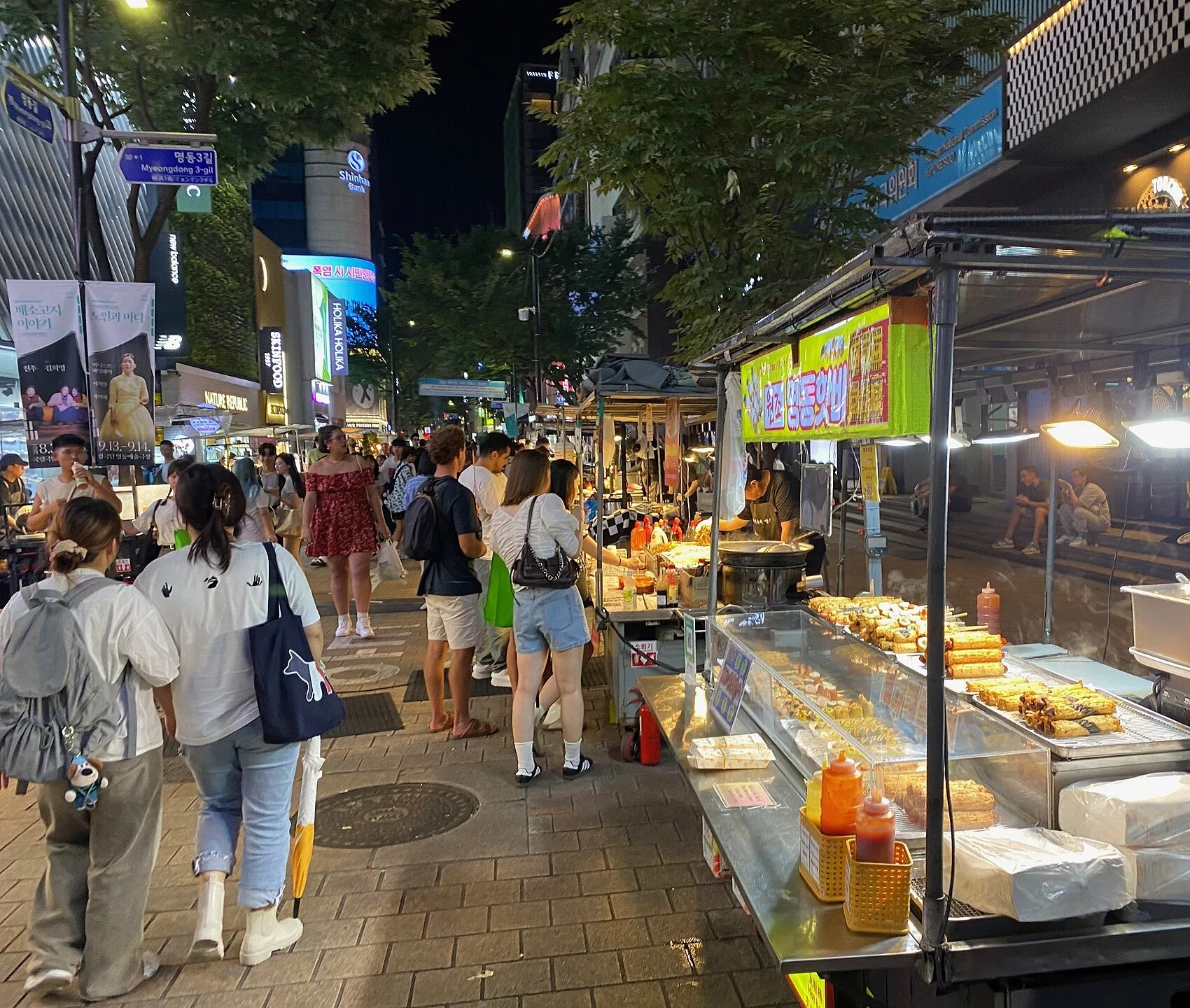
VisitSeoul, the Seoul Tourism Organization’s site, calls Myeongdong Seoul’s shopping mecca and a hub of commerce, banking and culture, with street stalls mixed among shops and plenty of Korean cosmetics stores. It is served by two stations, Myeongdong (Line 4) and Euljiro 1(il)-ga (Line 2), and VisitSeoul points shoppers to Myeongdong Station exits 5 to 10. Jung-gu, the district, says Myeongdong is part of a tourist special zone with Namdaemun, Bukchang-dong, Da-dong and Mugyo-dong, designated on 30 March 2000, and describes it as the cultural area foreigners visit most.
The classic sights are close. Myeongdong Cathedral, built in 1898, is Korea’s first brick Gothic-style church; you cannot go in during Mass but can visit at set hours, VisitSeoul says. The Namsan Cable Car station is about 571 m from Myeongdong Station exit 4; the ride up to the area near N Seoul Tower takes about three minutes, and the cable car runs daily from 10:00 to 23:00. Namdaemun Market is by Hoehyeon, one stop away on Line 4. For Gyeongbokgung Palace, ride Line 4 one stop to Chungmuro and change to Line 3 for four more stops: five stops in all, by the line map.
Street stalls are part of the scene. VisitSeoul describes stalls on both sides of the main street selling skewers, tornado potatoes, japchae, takoyaki and desserts. They come with a history: Jung-gu put Myeongdong’s stalls under a permit system in 2016 and, after overcharging complaints, pushed card payment and business registration; by December 2024, 278 of 350 stalls (79.4%) had registered. In crowded periods such as Halloween and the year-end, the district cuts the number of stalls that may open. Visitor help is easy to find: the Myeongdong Tourist Information Center is open from 09:00 to 18:00 (closed on Lunar New Year’s Day and Chuseok Day) with help in English, Chinese and Japanese, and red-uniformed walking guides cover the area from 10:00 to 19:00.
The downside is people. Jung-gu puts Myeongdong’s daily foot traffic at 1.5 million people on weekdays and 2 million at weekends (it does not say when this was measured); in a shopping district like this, expect crowded streets in the daytime. If you worry about being overcharged, note the Tourist Issue Assistance Center (1800-9008, daily 10:00 to 19:00; closed over the Lunar New Year and Chuseok holidays). According to VisitSeoul, foreign tourists staying less than a month can claim cash reimbursement of up to 500,000 won per person for unfair losses on shopping, dining or lodging in listed tourist areas, including Myeongdong, if they report within 14 days; losses at street stalls are excluded.
Hongdae: one train from the airport, and long nights
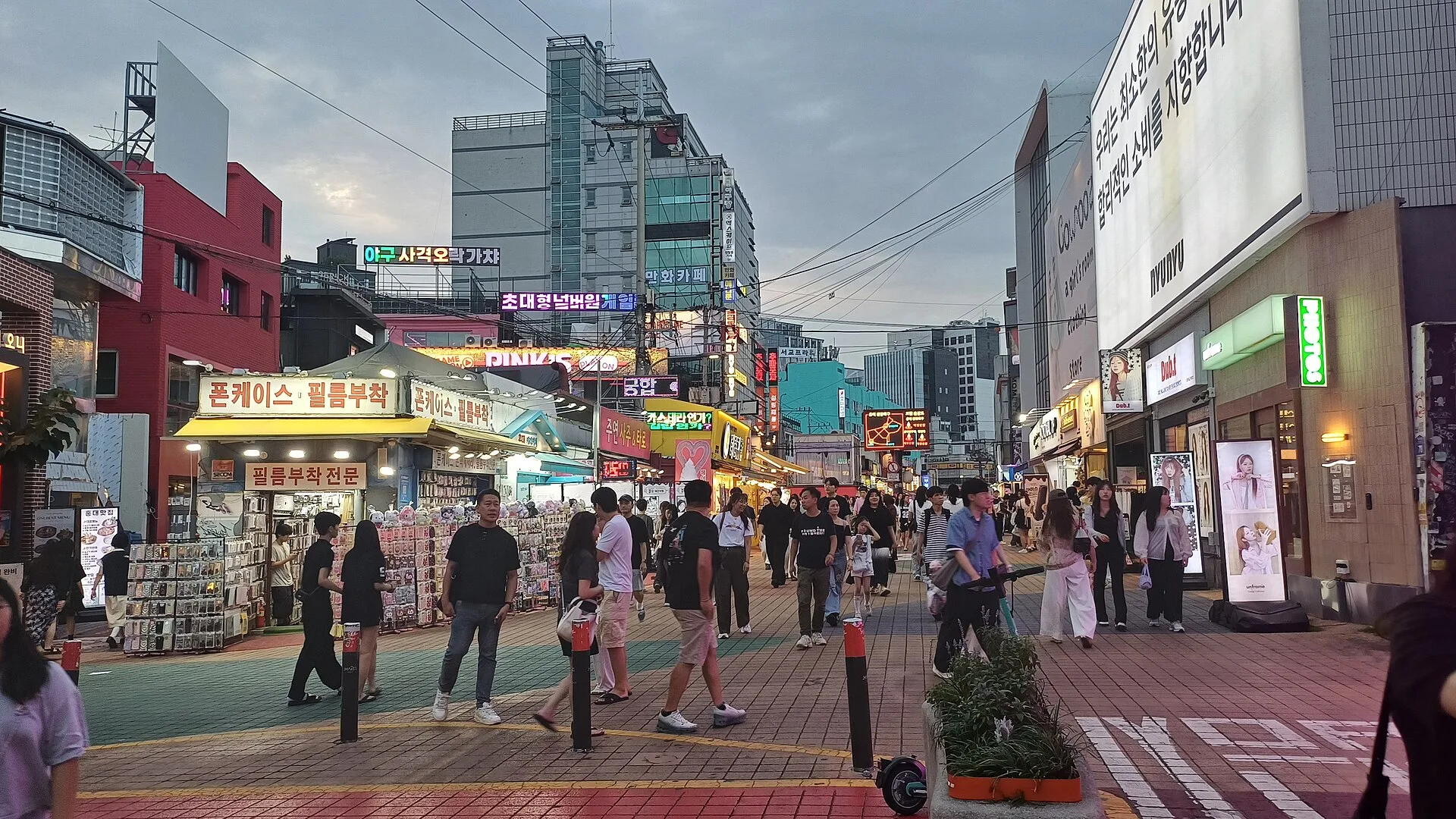
AREX describes the area around Hongik Univ. Station as a place where culture, art, shopping and youth meet, and one that has recently become a favourite of foreign visitors. The station is served by Line 2, AREX and the Gyeongui–Jungang Line, with Hapjeong one stop along Line 2. The Korea Tourism Organization describes Hongdae as a youth hangout of fashion, beauty and lifestyle shops, bookstores, cafés and restaurants that draws people by day for shopping and by night as a brightly lit district. Downtown is close, too: 6 stops on Line 2 to Euljiro 1(il)-ga for Myeongdong, or 6 stops to Gwanghwamun with a change from Line 2 to Line 5.
“Hongdae” is bigger than the station. The national tourism organization says the Seogyo-dong alleys around Hongik University stretch to Hapjeong, Sangsu and Gwangheungchang stations, with characterful shops, cafés and restaurants spreading towards Yeonnam-dong (from exit 3) and Yeonhui-dong. In Yeonnam-dong, the longest section of the 6.3 km Gyeongui Line Forest Park, nicknamed “Yeontral Park”, is about 447 m from exit 3; VisitSeoul describes it as a place where young people spread mats and drink beer.
After dark, street performance is the centre of it all. The national tourism organization picks out Walking Street, with constant busking and dance; the mural street on Wausan-ro 22-gil behind the university; and a club street that runs towards Sangsu Station. Mapo-gu, the district, says Walking Street, by Hongik Univ. Station exits 8 and 9, is noisy every night with buskers from all over the country, with pubs and barbecue restaurants around its wooden stage and plaza. In a notice dated 31 August 2026, the district dropped advance registration for buskers and now allocates slots by a monthly lottery, and amplifiers must stay within a 60 dB standard.
That energy can be a drawback when you pick a bed. In its busking rules, Mapo-gu reminds performers that homes and lodgings are close by, so a room right on Walking Street may be noisy at night. Remember that the airport express does not stop at Hongik Univ., and that for Halloween 2025 Seoul made the Hongdae tourist zone a priority crowd-management area and planned 616 safety staff there. Red-uniformed walking guides work the Hongdae area from 10:00 to 19:00, but VisitSeoul’s list of tourist information centers has no fixed one in Hongdae.
Gangnam: big avenues south of the river
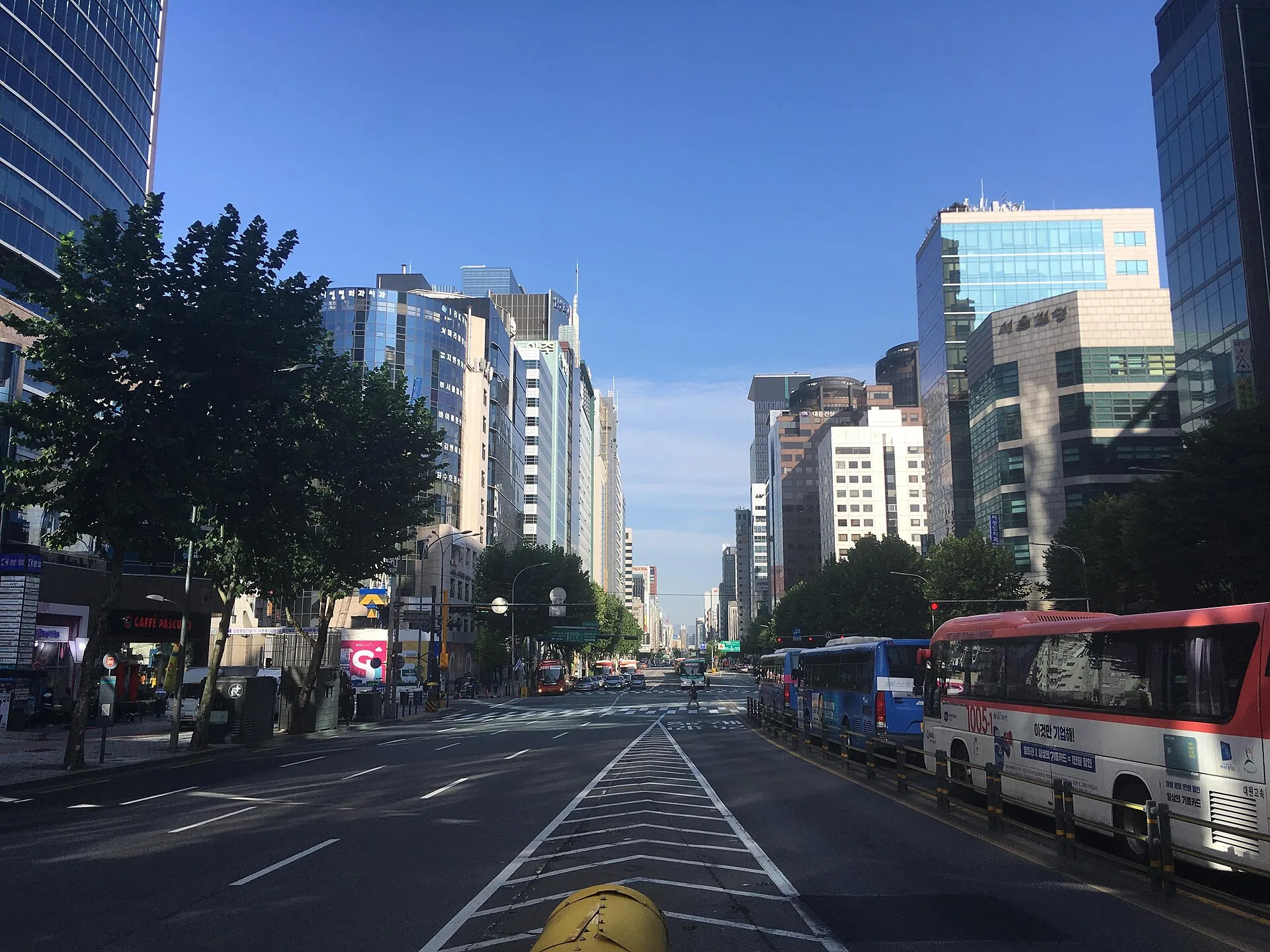
Gangnam Station is where Line 2 meets the Sinbundang Line, which its operator now brands as the DX LINE; one stop north, Sinnonhyeon also has Line 9. Seoul Metro says the station was named Gangnam because it sits at the centre of Gangnam-gu, yet Seocho-gu lists Gangnam and Yangjae stations in its Seocho 2-dong neighbourhood. Put together, the Gangnam Station area straddles the two districts, and Seocho-gu’s own history helps explain why: it was split off from Gangnam-gu on 1 January 1988.
The Korea Tourism Organization calls the Gangnam Station area the transport core of Gangnam, with Teheran-ro running east towards Jamsil and the road north crossing Hannam Bridge to the north side of the river. With easy transport, fashion stores, cinemas and big bookstores, crowds gather around exits 10 and 11 on weekday evenings and from the daytime at weekends, it says. VisitSeoul likewise describes the station area as a hub of fashion, beauty and business.
Gangnam’s well-known sights are a short ride away. The Gangnam MICE Special Tourism Zone, designated on 18 December 2014, is not at Gangnam Station but around COEX in Samseong-dong, three stops east on Line 2 via Yeoksam and Seolleung. Gangnam-gu lists COEX’s exhibitions, shopping, aquarium, Starfield Library and cinemas, plus Bongeunsa temple (founded in 794) five minutes’ walk away and a giant media facade on Yeongdong-daero that plays from sunset until 23:00. The Garosu-gil shopping street is near Sinsa Station exit 8, three stops north of Gangnam on the Sinbundang Line, or Apgujeong Station exit 4 on Line 3.
The drawbacks are the airport and the palaces. As above, there is no airport railway, so you need a limousine bus or a change of train, and Gyeongbokgung Station is 13 stops away via the Sinbundang Line and Line 3, or 14 via Line 2 and Line 3, with one change either way: the farthest of the three by station count. The Seocho Tourist Information Center behind Gangnam Station exit 9 is closed until the end of December 2026 and due to reopen in January 2027. And because “Gangnam” is used so loosely, check whether a listing is really near Gangnam Station or out by COEX or Sinsa.
Before you book: the station, the exit and the calendar
All three areas sit on Line 2. Euljiro 1(il)-ga (for Myeongdong) to Hongik Univ. is 6 stops, and Hongik Univ. to Gangnam is 17 stops with no change. Euljiro 1(il)-ga to Gangnam is 20 stops on Line 2, but from Myeongdong Station you can ride Line 4 nine stops to Sadang and change to Line 2 for four more, 13 in all. So whichever area you pick, the nearest station to your room, the exit and the lines that stop there matter more than the name of the neighbourhood. A “Hongdae” listing may be in Hapjeong, Sangsu or Yeonnam, and a “Gangnam” one may be by Sinnonhyeon, Yeoksam or Samseong.
Check your dates too. For Halloween 2025, Seoul named 14 expected crowd hotspots, and Myeongdong, Hongdae and Gangnam Station were all among the eight it made priority areas. Halloween falls on Saturday 31 October this year, and as of 19 October no 2026 plan could be found (the 2025 plan came out on 24 October), so if you are staying that weekend, look for the city’s and districts’ notices. Myeongdong thins out its street stalls at busy times such as the year-end for the same reason.
Related on Rank Three: for the airport trip itself, see Getting to Incheon Airport: rail, airport bus or taxi; for paying fares, T-money vs WOWPASS vs Climate Card: which transit card for Korea?; and for your first palace, Which Seoul palace first? Gyeongbokgung, Changdeokgung or Deoksugung.
Our three picks
- Myeongdong: central shopping streets near the palaces and NamsanMyeongdong
Two Line 4 stops from Seoul Station, so the AREX express and the Seoul Station City Airport Terminal are easy to use, and five stops from Gyeongbokgung. Myeongdong Cathedral, Namdaemun Market and the Namsan Cable Car are close, and there is a tourist information center. Expect crowds, and know the stalls’ history of overcharging complaints.
- Hongdae: one train from the airport, and long nightsHongdae
Ten stops from Incheon Terminal 1 on the AREX all-stop train with no change, three from Gimpo. Busking, the club street and Yeonnam-dong’s Gyeongui Line Forest Park are close, so nights run late. The express does not stop here, and rooms on Walking Street can be noisy.
- Gangnam: big avenues south of the riverGangnam
Gangnam Station (Line 2 and Sinbundang) and Sinnonhyeon (Line 9), with COEX and Garosu-gil each three stops away. No airport railway, so take limousine 6020 or 6009 or change trains, and Gyeongbokgung is 13 to 14 stops away, the farthest of the three.
Side by side
| Item | Myeongdong | Hongdae | Gangnam |
|---|---|---|---|
| Nearest stations (lines) | Myeongdong (Line 4), Euljiro 1(il)-ga (Line 2) | Hongik Univ. (Line 2, AREX, Gyeongui–Jungang) | Gangnam (Line 2, Sinbundang), Sinnonhyeon (Line 9) |
| Incheon Airport by rail | AREX express to Seoul Station (43 min from T1), then Line 4, 2 stops | AREX all-stop, 10 stops from T1, no change; the express does not stop | No direct line: Line 2 from Hongik Univ. (17 stops) or Line 9 from Magongnaru or Gimpo Airport |
| Incheon Airport by limousine bus | 6015 (ends at Myeongdong Station); night bus N6701 (Euljiro 1(il)-ga) | 6002 (Hapjeong, Hongik Univ.); night bus N6002 | 6020 (Gangnam Station), 6009 (Sinnonhyeon and Gangnam); no night bus stops at Gangnam Station |
| Gimpo Airport by rail | AREX 5 stops, then Line 4, 2 stops | AREX 3 stops | Line 9 express to Sinnonhyeon, no change (23 stations on the all-stop) |
| To the palaces (stations) | Gyeongbokgung Station: 5 stops, 1 change | Gwanghwamun Station: 6 stops, 1 change | Gyeongbokgung Station: 13 to 14 stops, 1 change |
| Nearby sights (official guides) | Myeongdong Cathedral, Namdaemun Market, Namsan Cable Car (about 571 m from exit 4) | Walking Street busking, Gyeongui Line Forest Park (about 447 m from exit 3) | COEX, Starfield Library and Bongeunsa (Samseong), Garosu-gil (Sinsa) |
| Evening (official descriptions) | Street-food stalls on both sides of the main street (official pages give no stall hours) | Walking Street noisy with buskers every night; club street towards Sangsu | Crowds around exits 10 and 11 on weekday evenings and from the daytime at weekends |
| Visitor help | Tourist information center 09:00–18:00; walking guides | Walking guides 10:00–19:00; no fixed center on the official list | Seocho center at Gangnam Station closed until end of December 2026 |
| Downsides | Crowds (1.5 million a weekday, 2 million at weekends, per Jung-gu); past overcharging complaints at stalls | Night noise near Walking Street; some airport-bound trains end at Geomam | No airport railway; farthest from the palaces by station count |
Where I would stay first
For a first trip to Seoul I would stay in Myeongdong. It is two stops from Seoul Station, where the AREX express stops; it has the fewest stops of the three to Gyeongbokgung, and Namsan and Namdaemun Market are close by. If you would rather not change trains with your luggage, or you want street music and bars late into the night, Hongdae, with the AREX all-stop train right at the station, is the better fit. If your days revolve around COEX, Garosu-gil or Gangnam’s fashion and beauty shops, staying in Gangnam cuts down on travel. Whichever you choose, check the nearest station and exit before you book.


