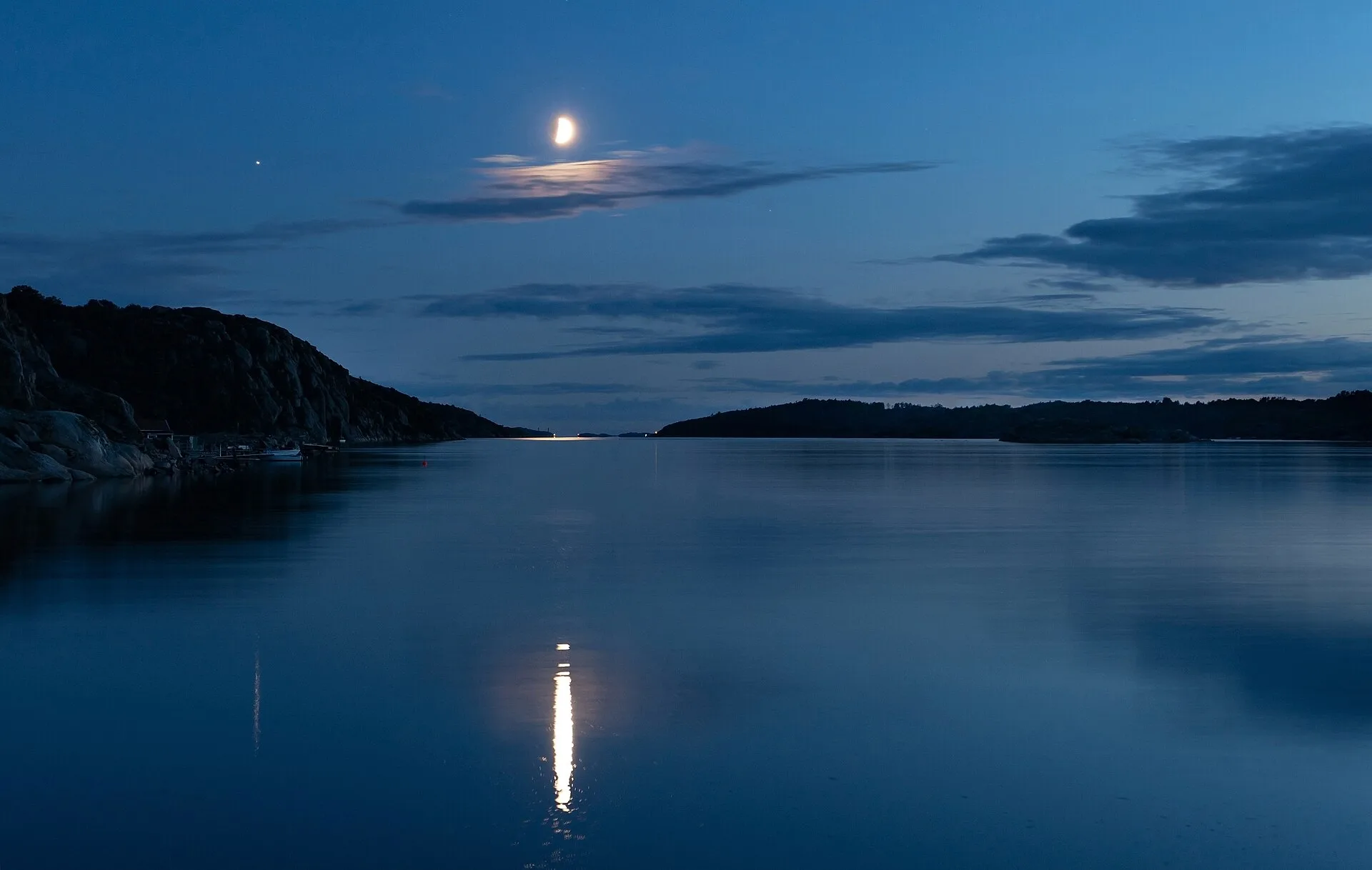
The first piece of equipment for watching the Moon may be no equipment at all. Look once, then decide whether you want a closer view. We compared unaided eyes, binoculars and a telescope using NASA guidance checked on October 5, 2026. This is desk research, not a same-night equipment test. The reference photograph was taken over Brofjorden in Sweden; it is not tonight’s Moon in Korea.
Unaided eyes
NASA explains that the Moon’s broad light and dark patterns are visible without an optical instrument. I would begin here to establish the habit of looking up. There is no mount to assemble or focus to adjust. Use a lunar map to identify a broad feature rather than expecting to recognize everything at once.
Small terrain features are the limitation, but counting craters need not be the entry requirement. Notice the apparent shape and position and record the date and time. That creates a question for another evening. Keep a reference photograph separate from your own observation record; a striking image from another night does not document what you personally saw.
Binoculars
NASA presents binoculars as a useful first observing tool. They are a candidate if you want a closer look without committing to a large setup. Borrow a pair before buying if possible. Find out whether looking with both eyes, locating the target and holding the instrument feel comfortable to you. Those are practical questions a specification table cannot answer completely.
A larger magnification number does not automatically make observing easier. NASA notes that higher magnification may call for support. Shaking can become distracting. Check weight, eye position and use with your glasses where relevant. We have not tested the optical quality of individual models or assumed that instruments with the same magnification perform identically.
A telescope
Consider a telescope when following smaller lunar terrain on a map becomes the attraction. NASA identifies mountains, craters and other surface features worth examining. This is a reason to explore the instrument, not a guarantee that every telescope provides the same view. Look for an observing event or borrowing opportunity to experience setup and target finding first.
Storage, transport and a stable place for the mount are part of the decision. If setting up feels less appealing than a quick look outside, binoculars may fit better. We have not selected a supposedly perfect beginner model or invented a performance promise for one price bracket. Aperture and magnification alone cannot describe the entire experience.
Do not wait only for a full Moon
NASA explains how shadows near the light-dark boundary reveal terrain. That boundary is called the terminator. It gives someone accustomed to full-Moon photographs a reason to observe other apparent shapes too. Use a lunar map to connect the feature you notice with its name rather than judging the night solely by how round the Moon looks.
We have not calculated tonight’s phase from the article date or photograph. Check current lunar position and weather separately. Buildings and clouds can decide whether an observing location works. Prefer a place you can reach safely instead of assuming you must travel somewhere remote. Clear access to the sky is a condition equipment price cannot buy.
Treat photography as the next question
NASA’s photography guidance discusses the difficulty of vibration when magnifying the Moon. Holding a phone to an eyepiece does not guarantee a clean result. Find and focus the target visually before adding the camera. Note your equipment and shooting conditions so that the next attempt has something specific to improve.
The camera result may differ from the impression at the eyepiece because exposure, framing and editing change the image. Another person’s photograph is not proof of your instrument’s performance. Keep observations and reference images distinct. Do not point observing instruments at the Sun; solar viewing is a separate activity requiring its own specialist equipment and guidance. Our table stays with lunar viewing and makes no invented resolution scores.
Our three picks
- Unaided eyesUnaided eyes
Build the habit without buying equipment
- BinocularsBinoculars
Explore a closer portable view
- TelescopeTelescope
Follow smaller lunar terrain
Side by side
| Compare | Unaided eyes | Binoculars | Telescope |
|---|---|---|---|
| Initial interest | Shape and broad patterns | Whole Moon and surface features | Smaller terrain |
| Preparation | Viewing place and map | Focus, eye position, support | Setup, target finding, focus |
| Carrying question | No instrument | Weight and hand shake | Instrument and mount |
| Trade-off | Limited fine detail | Stability matters at higher magnification | Setup and storage effort |
| Try first | Record date and time | Borrow and handle a pair | Find an event or loan |
| Shared condition | Check position and clouds | Check position and clouds | Check position and clouds |
| Not guaranteed | Tonight’s phase or visibility | A particular model’s optical result | Price-tier performance or photographs |
Our choice
Start with your eyes if you have not yet made a habit of Moon watching. Borrow binoculars when a closer view becomes interesting, and consider a telescope when you want to keep following smaller terrain. Before deciding what to buy, find out whether you can see the Moon from your chosen place tonight.
