Cards cover most purchases in Korea, but sooner or later a cash-only stall or market will want Korean won. There are three realistic ways to get it: withdraw it with your own card from a Global ATM, change cash you brought at a bank or a registered money changer, or use a WOWPASS machine, part of the prepaid card service for foreign visitors. Our separate guide compares ways to pay; this one is only about getting cash in hand. It is a research piece, not a test of the machines, built from official sources checked on 24 October 2026: the Seoul and Korea tourism organizations, Incheon and Gimpo airports, Korean banks, Korea Customs, the Bank of Korea, the Foreign Exchange Transactions Regulation and WOWPASS itself. Fees and rates vary by card and provider, so the only numbers here are the ones a provider or regulator publishes.
Before you start: where you need cash, and what you bring
Cards cover most of a trip to Korea, but not all of it. WOWPASS’s own FAQ names cash-only food stalls and underground shopping arcades as places where its card is no help, and sends users to its machines for cash. Korean won comes in 1,000, 5,000, 10,000 and 50,000-won notes and 10, 50, 100 and 500-won coins.
How much you carry has rules attached. Korea Customs says that if you arrive with more than USD 10,000 in total — foreign cash, won and cheques combined — you must declare it, and the declaration certificate cannot be issued once you have left the arrivals area. Leaving, up to USD 10,000 needs no declaration. For most visitors the real question is simply where, and on what terms, to get won.
One job comes before the flight. Your card issuer sets its own fees for foreign ATM withdrawals, currency conversion and credit-card cash advances, and none of the official sources we checked can tell you what yours charges. Ask your issuer about the card you plan to use.
Global ATMs: withdrawing won with your own card
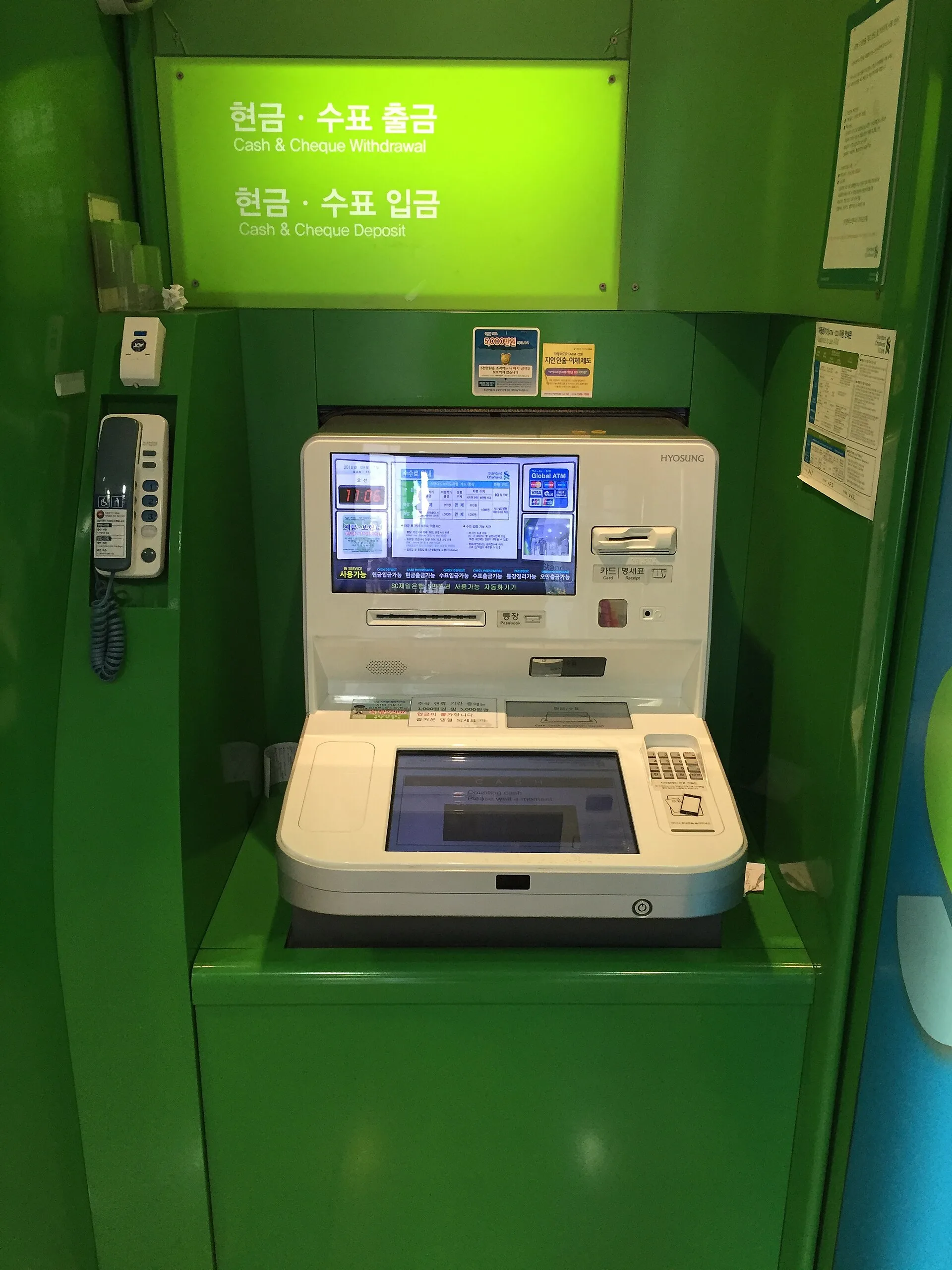
Seoul’s official tourism site says ATMs that take international cards are common and are marked with a “Global” sign or the logos of the banks or networks whose cards they accept. Most offer English, Chinese and Japanese menus; they typically run until 23:00, and many are open around the clock. Convenience stores have ATMs too, but they often charge higher transaction fees, the site adds, without giving amounts.
Few banks spell out which cards work. Hana Bank’s FAQ says foreign cards with Mastercard, Maestro, Cirrus, Visa, Plus, JCB or UnionPay logos can check balances at its Global ATMs, except cards from the Philippines and Malaysia, and warns that balance checks may be blocked or carry an inquiry fee depending on the country and card company, so ask your issuer. The answer says nothing about withdrawals. We found no official statement on American Express, Discover or Diners Club cards.
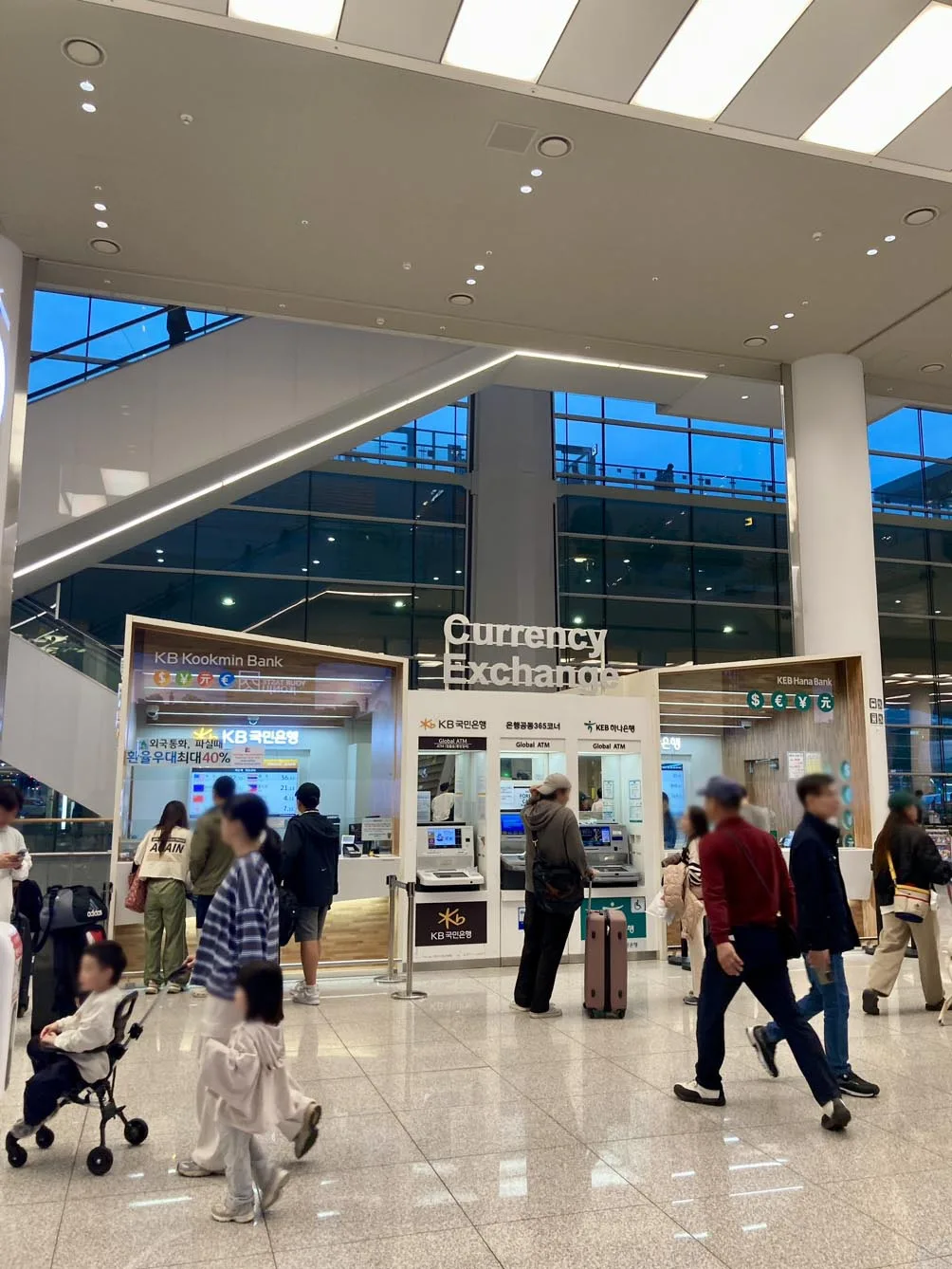
Incheon Airport has plenty of machines. Its facility list shows 24-hour public ATMs run by NICE Infra, at nine spots in Terminal 1 and four in Terminal 2, plus KB Kookmin, Woori and Hana bank ATMs in both terminals, mostly open 06:00 to 22:00 and a few around the clock. The list does not say which of them accept foreign cards, and a label such as “includes foreign currency ATM” is no promise that yours will work.
An ATM may offer to bill the withdrawal in your home currency instead of won, a practice called dynamic currency conversion. Visa requires ATMs that do this to show both amounts, the exchange rate and any fees or markup on screen and on the receipt, and to let you accept or decline. If details are missing or you feel pressured, Visa suggests declining and telling your issuer; declining does not cancel the withdrawal. I would choose won, which at least avoids the markup that comes with the ATM’s own conversion.
A credit card at an ATM gives you a cash advance; a debit card withdraws from your account. Korea’s Foreign Exchange Transactions Regulation names the two separately, but both count towards the won you may later change back at a bank. Check your issuer’s cash-advance terms before using a credit card. We found no official Korean bank page giving withdrawal limits or operator fees for foreign cards, so look for a fee on the screen before you confirm, and assume your issuer may add its own.
Banks and registered money changers: changing the cash you brought
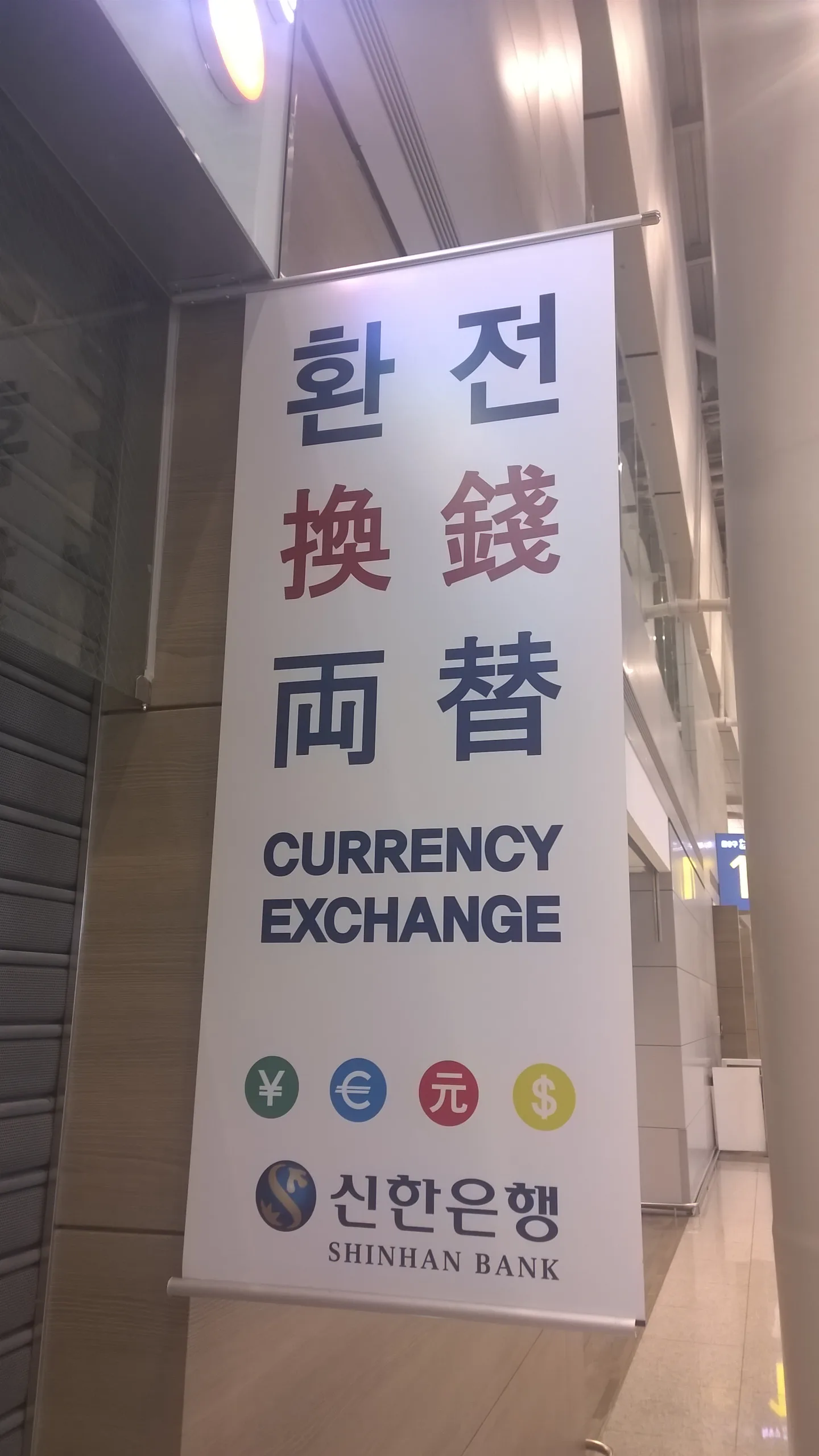
If you arrive with foreign banknotes, the Korea Tourism Organization’s advice is to change them at a bank or an authorized exchange centre. Banks generally open 09:00 to 16:00 on weekdays (hours vary), and Korea Post’s banking counters 09:00 to 16:30. It also warns that some banks and exchange centres may not exchange older banknotes, so check first if yours are an old series. If you land at night or at a weekend, use the airport counters. Incheon has exchange counters run by KB Kookmin, Hana and Woori in both terminals, most open 06:00 to 22:00 and some 24 hours, among them Woori’s counters near Exits 6 and 11 on the first floor of Terminal 1 and near Exit 7 on the first floor of Terminal 2. The full bank branches there keep weekday hours, 09:00 to 16:00. At Gimpo’s international terminal, Shinhan Bank runs counters on the second floor (06:00–19:00), in the third-floor departure hall (07:00–20:00) and in the first-floor arrivals hall (10:30–24:00).
Private money changers in the city must register with the Korea Customs Service. A registered changer has to display a sign in Korean and a foreign language, its registration certificate and that day’s buying and selling rates where customers can see them. Customs publishes a nationwide list of registered changers every month as an Excel file; the latest, for the end of September, went up on 2 October. Seoul’s tourism site says certified booths carry a sign with the word “Certified” and currency symbols, and advises avoiding uncertified ones.
Bring your passport: changers must record each customer’s name and passport number, the amount and the rate. Rates can differ slightly between branches and exchange booths of the same bank, Woori Bank notes, and banks post separate cash buying and selling rates; the gap between them is the bank’s margin. Leave foreign coins at home. Woori says they are bought in Korea at a discount of more than 50%.
The paperwork matters later. Changing less than USD 20,000 into won needs no report from a non-resident, according to Woori. When a bank buys foreign currency from you, it must give you one document proving it, such as an exchange certificate, receipt or statement, and a registered money changer must issue a certificate of foreign currency purchase too, although changers may skip the forms for up to USD 2,000 per person per day (USD 4,000 for changers that file their ledgers electronically with Customs). Keep whatever you are given: you need it to change leftover won back.
WOWPASS machines: foreign cash into a card balance, or into won
WOWPASS is a prepaid card and unmanned exchange service for foreign visitors, run by Orange Square, which Korea Customs describes as an unmanned money-exchange fintech company and which has run exchange machines since September 2018. South Korean nationals cannot use it, and you need your passport: the machine scans it when it issues a card. On 24 October the WOWPASS website listed 446 machines, at airports (Incheon, Gimpo and Jeju), subway stations and hotels among other places.
Feed foreign banknotes into a machine and they are added to your card balance; WOWPASS says the machines can also change foreign cash into won cash or pay out your balance. It says they accept 16 currencies, though the rate table on its site lists 15 foreign currencies, so check the screen for yours. WOWPASS says it charges no exchange fee, but “no fee” does not mean you get the base rate: the rate data on its own website gives each currency a standard rate, a lower rate for card top-ups and a lower one again for cash exchange. The cost is in the rate.
The fees WOWPASS lists that matter for cash are a one-time, non-refundable membership fee of 6,000 won and 1,000 won per cash withdrawal (a replacement card costs extra). Fees can change, so check the amount on the machine screen before you pay. To withdraw, register the card in the WOWPASS app, insert it in a machine, enter the eight-digit code the machine shows into the app and choose an amount: up to 100,000 won at a time, in won notes only. Amounts under 1,000 won and coins cannot be withdrawn, and the balance cannot be paid out in a foreign currency or, for now, refunded to a bank account.
There are limits too. WOWPASS says the balance can be at most 1,000,000 won, and machine top-ups or exchanges are capped at 2,000,000 won a day and 10,000,000 won a week; Korean regulation limits unmanned exchange machines to USD 2,000 per person per day (USD 4,000 for some operators). The biggest catch is at Incheon Airport. The machines in the CU convenience stores there, store No. 1 in Terminal 1 and No. 3 in Terminal 2, take only won cash to issue or top up cards; they do not exchange foreign cash or pay out balances. Gimpo’s machine, in the passage from the international terminal to the subway, offers every service, while the Jeju Airport machines do not exchange cash. Money added through PayPal in the app cannot be withdrawn as cash.
Leaving Korea: leftover won and your paperwork
Leftover won can be changed back at a bank. Under the Foreign Exchange Transactions Regulation, a bank may sell a non-resident foreign currency up to the amount the person changed into won at banks or money changers since their latest arrival, and won taken out in Korea with a foreign credit or debit card counts too. The bank has to see documents proving that record, so keep your ATM slips as well; we found no official word on which documents banks accept for card withdrawals. With no such record, up to USD 10,000 can still be bought. Woori Bank says you need your passport, plus the exchange certificate when you change back within an earlier record; a sale under the no-record USD 10,000 allowance is written in your passport (the regulation exempts amounts worth 1,000,000 won or less). Anything beyond your record needs a report to the Bank of Korea.
Registered money changers are stricter: they may change won back only within what you exchanged since arrival, against a re-exchange application, the purchase certificate and your passport, apart from the small-amount allowance of USD 2,000 a day (USD 4,000 at some). A WOWPASS balance cannot be paid out in a foreign currency, so withdraw it as won notes (a bank can then change them back under the rules above) or spend it, and we found nothing official on whether a WOWPASS receipt counts as proof of exchange at a bank. The T-money transit balance on a WOWPASS card is separate and cannot be withdrawn at WOWPASS machines; T-money refunds it at its refund points for a 500-won fee, and balances of 50,000 won or more only at its head office.
So keep every exchange certificate until you leave Korea.
Related on Rank Three: for paying by card, WOWPASS or a QR wallet instead of cash, see How to pay in Korea as a tourist: foreign card, WOWPASS or a QR wallet?; for the trip to the airport on your last day, Getting to Incheon Airport: rail, airport bus or taxi; and if you stay long enough to bank in Korea, Toss vs KakaoBank vs KB Star Banking: one app does not mean one bank.
Our three picks
- Global ATMs: withdrawing won with your own cardGlobal ATM
If you carry a foreign card and would rather take out cash as you need it. Look for an ATM with a “Global” sign or your card network’s logo, and if the screen offers to charge you in your home currency, read the rate and fees before you choose. Fees and limits depend on the ATM operator and your card issuer, so ask your issuer before you travel.
- Banks and registered money changers: changing the cash you broughtBank or registered money changer
If you bring foreign banknotes and want to change a larger sum at once. Take your passport, use a bank or a changer registered with Korea Customs, and compare the rates posted that day. Keep the exchange certificate or receipt: you need it to change leftover won back.
- WOWPASS machines: foreign cash into a card balance, or into wonWOWPASS machine
If you want foreign cash loaded onto one card for shopping and transit, with the option of taking some out as won. There is no exchange fee, but there is a 6,000-won membership fee, 1,000 won per withdrawal and a margin in the rate, and the Incheon Airport machines neither exchange foreign cash nor pay out balances.
Side by side
| What to check | Global ATM | Bank or registered changer | WOWPASS machine |
|---|---|---|---|
| What you bring | A foreign credit or debit card | Foreign banknotes and your passport | Foreign banknotes and your passport (not for Korean nationals) |
| Where to find it | ATMs with a “Global” sign or card logos (Incheon’s facility list does not say which take foreign cards) | Bank branches, airport counters, changers registered with Korea Customs | 446 machines (24 Oct): airports, subway stations, hotels |
| Hours | Typically to 23:00, many 24 hours (Visit Seoul) | Banks 09:00–16:00 weekdays; most Incheon counters 06:00–22:00, some 24 h | No official hours per machine |
| Costs the provider states | None found; check the screen, plus your issuer’s fees | Gap between cash buying and selling rates; varies by branch | No exchange fee; 6,000-won membership; 1,000 won per withdrawal; margin in the rate |
| Limits | Vary by card and ATM; none published | Banks: no report needed under USD 20,000 | Balance 1,000,000 won; machine top-up or exchange 2,000,000 won a day; 100,000 won per withdrawal |
| Proof you get | Keep ATM slips; withdrawals count towards re-exchange (accepted proof not stated) | Exchange certificate or receipt | Not stated whether it counts for re-exchange |
| Changing won back | At a bank, up to what you withdrew | Within your exchange record (certificate and passport) | Not into foreign currency; withdraw as won notes |
| Watch out for | Offers to charge in your home currency (DCC) | Passport needed; foreign coins discounted by over 50% | Incheon Airport machines: no foreign cash, no withdrawals |
Where I would start
On a first trip I would ask my card issuer about foreign ATM fees before leaving home and, if they were reasonable, take out won from Global ATMs as I needed it, always choosing to be charged in won. If I were bringing foreign cash, I would change it in one go at a bank or an airport counter, passport in hand, and keep the certificate until I flew home. WOWPASS suits travellers who want one card for shops and transit and like the idea of topping it up with cash; just remember that the machines at Incheon Airport will not take foreign notes, so look up a machine in the city first, or use the one at Gimpo if you fly in there.


