Math appeared in Korea’s trending searches. We compared EBSMath, Khan Academy and GeoGebra using operator material checked on October 7, 2026. This is desk research, not an experiment measuring learning gains. The starting points are Korean school-unit content, practice with progress tracking, and mathematical exploration. We focus on free educational resources for personal study; this is not a promise that every additional product and account feature is free.
EBSMath
The homepage organizes elementary, middle and high-school mathematics by grade and unit. It also provides menus for series, games, math problems and daily practice. I would start here when a Korean unit name is familiar but the explanation has not clicked. Knowing the topic gives you a more focused route into the library than a search for mathematics in general.
The trade-off is the variety of content: it is easy to keep browsing. Write down one concept to study and one problem to attempt afterward. A grade menu does not prove an exact match with your school’s sequence or exam format. Compare the scope with your textbook, and read the requirements for any member feature you want to use.
Khan Academy
The operator describes free lessons, videos, exercises and quizzes, with a Mastery system for tracking progress. I would shortlist it when you want a place to continue practicing at your own pace. An exercise record can make that plan more concrete. It is not a school grade or a qualification, and no improvement percentage is claimed here.
For a Korean learner, course names and language need an extra check. Our main sources are English-language operator guides. We did not verify that every desired course is available in Korean. Try a familiar unit before committing to a long course; otherwise reading the explanation and learning the mathematics can become two separate difficulties. Distinguish the core educational resources from paid AI extras.
GeoGebra
GeoGebra’s introduction brings geometry, algebra, graphing, statistics and other mathematics into its tools. Calculator Suite is accessible in a browser. I would explore it when the relationship between a formula and a picture is the question. Changing a coefficient in a quadratic function is a possible investigation to plan, rather than a calculation we claim to have tested for this article.
A tool does not turn an output into an explanation you understand. After exploring a graph, leave time to describe what changed. Use official learning material if the controls become the obstacle. Free personal educational use is also different from unrestricted commercial reuse: check the software’s conditions and the license of an individual classroom resource separately.
Work on one problem in stages
For a linear-function question, my proposed sequence would be to find an explanation, attempt exercises, then explore the relationship between the equation and its graph. Choose the stage you need rather than opening three services at once. Record an unfamiliar term, the reason an exercise went wrong, or the change you observed.
That is editorial study advice, not a tested learning intervention. Ask whether the difficulty is understanding the concept, making calculation errors or connecting symbols to a diagram. All three services may help with the same question; they do not need exclusive roles. A defined task gives you a better reason to open one of them than another addition to a growing bookmark list.
Read beyond the word free
Resource access, account conditions, privacy and additional products deserve separate attention. We did not test every account feature or language edition. Check current age and parent guidance before creating an account for a learner. None of these choices is presented as a guaranteed route to an exam result or a replacement for an official school submission.
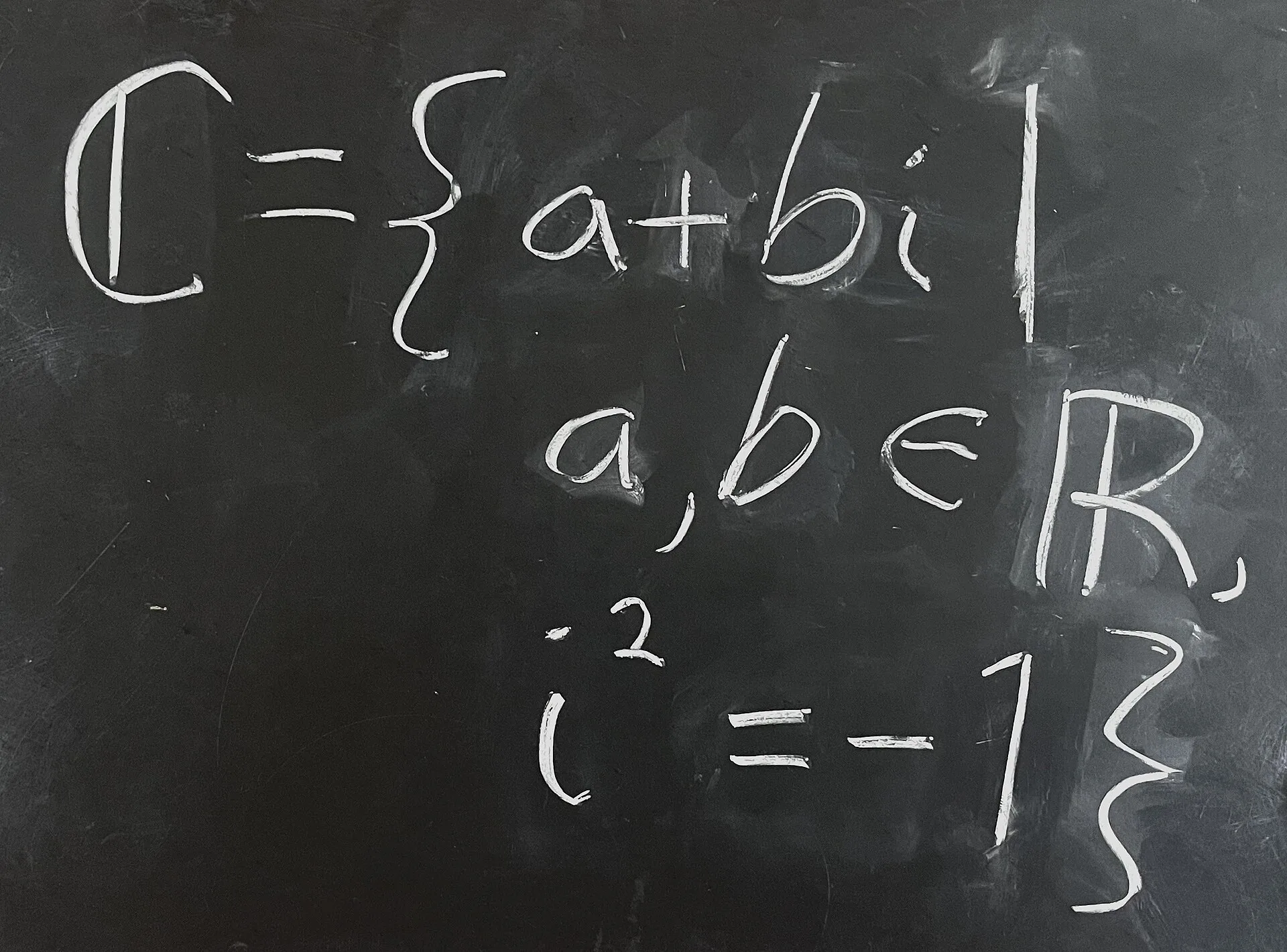
The photograph is a real chalkboard showing complex-number notation. It is not a screenshot, textbook or solution from these services. The table compares starting points and the work left for the learner. Open one service, specify today’s topic and finish with a short explanation of what you learned. That record will be more useful tomorrow than a longer list of links.
Our three picks
- EBSMathEBSMath
Start from a Korean school unit
- Khan AcademyKhan Academy
Combine practice with progress tracking
- GeoGebraGeoGebra
Explore formulas and geometry
Side by side
| Compare | EBSMath | Khan Academy | GeoGebra |
|---|---|---|---|
| Find first | Korean unit or concept | Course, practice and quizzes | Calculator, graphing or geometry tool |
| Operator description | Grade-based content menus | Free learning and Mastery | Dynamic mathematics and resources |
| First task | Search one difficult concept | Practice one familiar unit | Define a formula or diagram question |
| Your remaining work | Solve after the explanation | Review why errors happened | Describe what you observed |
| Watch for | Match your school’s scope | Language and curriculum correspondence | Controls and use conditions |
| Read the free-use scope | Feature-specific guidance | Core resources versus paid extras | Personal-use terms and resource licenses |
| Photo | Not a service screenshot | Not a service screenshot | Not a service screenshot |
Our choice
I would open EBSMath for a Korean unit explanation, Khan Academy for continued practice, or GeoGebra to explore a formula and its picture. Pick the first screen that matches today’s obstacle. You do not need all three open to make progress on one question.
