Search for train tickets in Korea and three names come up: KTX, SRT and ITX. Many guides still describe SRT as a separate high-speed train from Suseo Station, but that changed on 1 September 2026. Korea’s transport ministry announced that the merger of Korail and SR, the company that ran SRT, was complete and that KTX and SRT would run together as KTX from that day; the former SRT trains were renamed KTX-Sancheon. So the real choice today is between KTX from Seoul or Yongsan Station, KTX from Suseo (the old SRT), and the slower, cheaper ITX-Saemaeul and ITX-Maeum. This comparison is built from official Korail, transport ministry and Seoul Metro material checked on 17 October 2026; it is not a first-hand ride review. Plenty of travel advice still predates the merger, so check the date on anything else you read.
What changed: SRT now runs as KTX from Suseo
The merger came in steps. According to the ministry and Korail, a pilot from 25 February 2026 had one KTX a day run Suseo–Busan and one SRT a day run Seoul–Busan, and coupled KTX-plus-SRT trains were trialled from 15 May. On 3 August the Fair Trade Commission gave final approval for Korail to take over SR’s high-speed business, and Korail+ launched the same day as one app replacing the separate Korail Talk and SRT apps. Since 1 September every high-speed train has run as KTX.
Three changes matter to visitors. First, names: because the former SRT trains are now called KTX-Sancheon, the train type no longer tells you whether you are on the Seoul Station side or the Suseo side, and Korail asks passengers to check the train number and destination before boarding. Second, fares: KTX fares were brought down to the old SRT level, about 10% lower on average, so Seoul–Busan in standard class fell from 59,800 to 54,400 won. Korail says a minimum three-year period for keeping fares and mileage benefits was set during the Fair Trade Commission’s merger review, and that no decision has been made to put fares back up or cut mileage after that. Third, booking: every high-speed train can be searched and booked together on Korail’s website and the Korail+ app, and since 1 October 2026 tickets go on sale from 07:00 two months before departure instead of one, a change Korail says was made for foreign travellers.
Korail now runs 402 high-speed services a day on weekdays (270 on the Seoul side, 132 on the Suseo side) and 457 a day at weekends. Suseo gets Korail’s highest-capacity KTX sets, with 955 seats, and Suseo passengers now earn the same mileage and transfer discounts as other KTX riders. The old Korail Talk and SRT apps still sell tickets during a transition period, but the SRT app only books as a non-member, so if you are installing something new, install Korail+.
KTX from Seoul or Yongsan: the default, with the most high-speed routes
Korail’s original KTX network is centred on Seoul, Yongsan and Cheongnyangni stations north of the Han River, with more boarding points at stations such as Yeongdeungpo, Gwangmyeong and Suwon. In the official timetable that takes effect on 1 November 2026, trains on the Gyeongbu side to Busan, Dongdaegu, Pohang and Jinju can be boarded at Haengsin, Seoul, Yeongdeungpo, Gwangmyeong or Suwon, depending on the train; Honam and Jeolla Line trains to Gwangju-Songjeong, Mokpo and Yeosu-EXPO leave mainly from Yongsan; and KTX-Eum trains to Gangneung and Andong use Seoul, Cheongnyangni and Sangbong. Seoul Metro’s network data shows Seoul Station served by Lines 1 and 4, AREX, the Gyeongui–Jungang Line and GTX-A, and Yongsan by Line 1 and the Gyeongui–Jungang Line, so AREX brings you from Incheon Airport straight to Seoul Station. There has been no KTX from Incheon Airport since 1 September 2018.
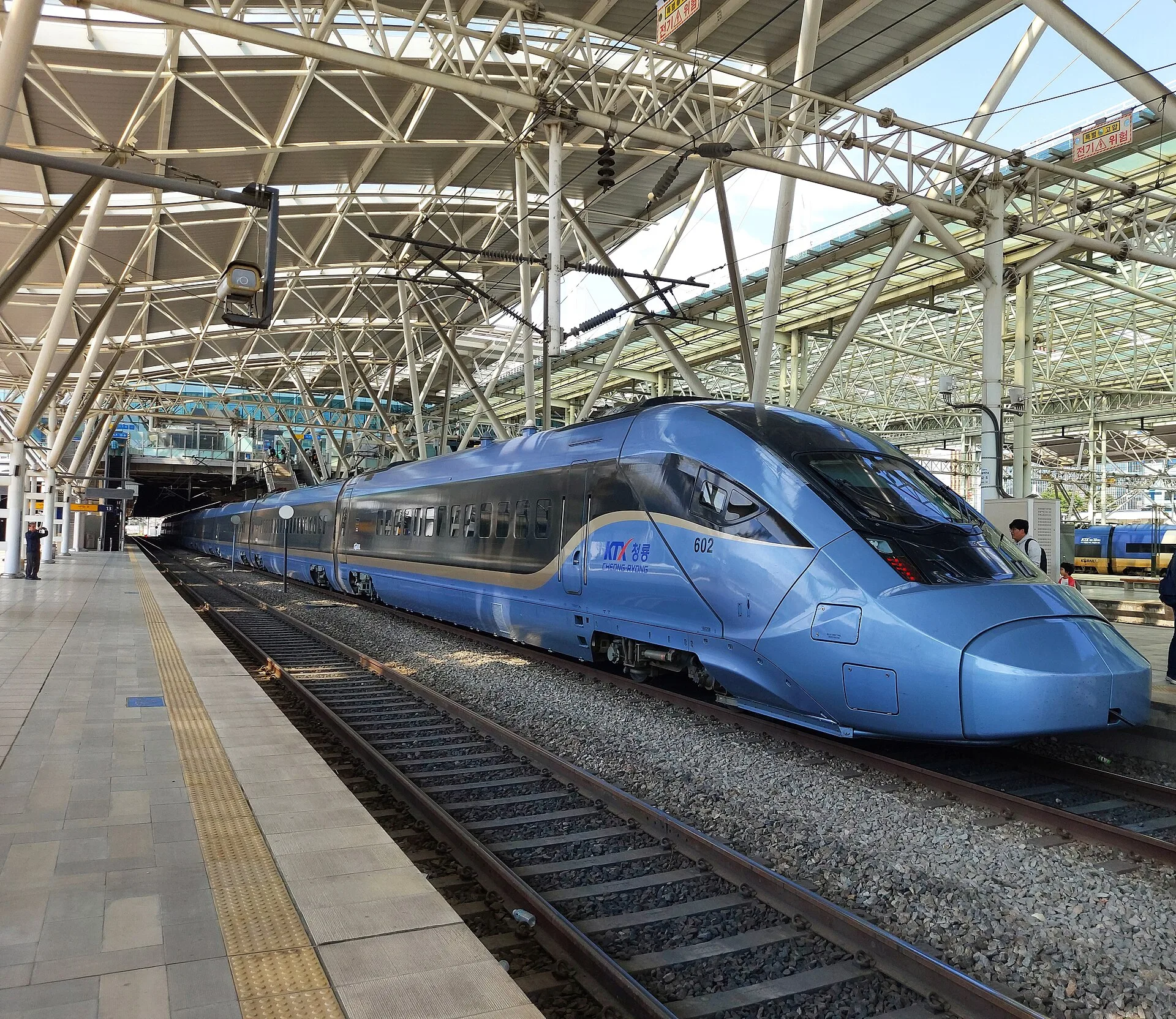
Fares and times: in the fare table effective 1 September 2026, Seoul–Busan costs 54,400 won in standard class and 78,900 won in first class. The fastest Seoul–Busan train in the November timetable is a KTX-Cheongryong at 2 hours 18 minutes, and the median of the Seoul–Busan departures, counted from the same timetable, is about 2 hours 44 minutes. Yongsan–Gwangju-Songjeong is 42,000 won, fastest 1 hour 36 minutes; Seoul–Gangneung is 27,600 won, fastest 1 hour 51 minutes, or 1 hour 27 minutes if you board at Cheongnyangni. KTX-Eum trains on the Gangneung and Jungang lines have a premium cabin (udeungsil) instead of first class.
For foreign visitors the big advantage is KORAIL PASS. Korail’s English notice lists KTX, including KTX-Sancheon and KTX-Eum, and conventional trains such as ITX-Saemaeul among the trains you can ride on the pass. This is also the widest high-speed network, reaching places Suseo doesn’t serve, such as Gangneung and Andong. The drawback is the trip to the station if you stay south of the river in Gangnam or Jamsil. I would make Seoul or Yongsan KTX the default for anyone staying downtown or around Hongdae, heading to Gangneung or Andong, or travelling on a pass.
KTX from Suseo (former SRT): the station for the Gangnam side
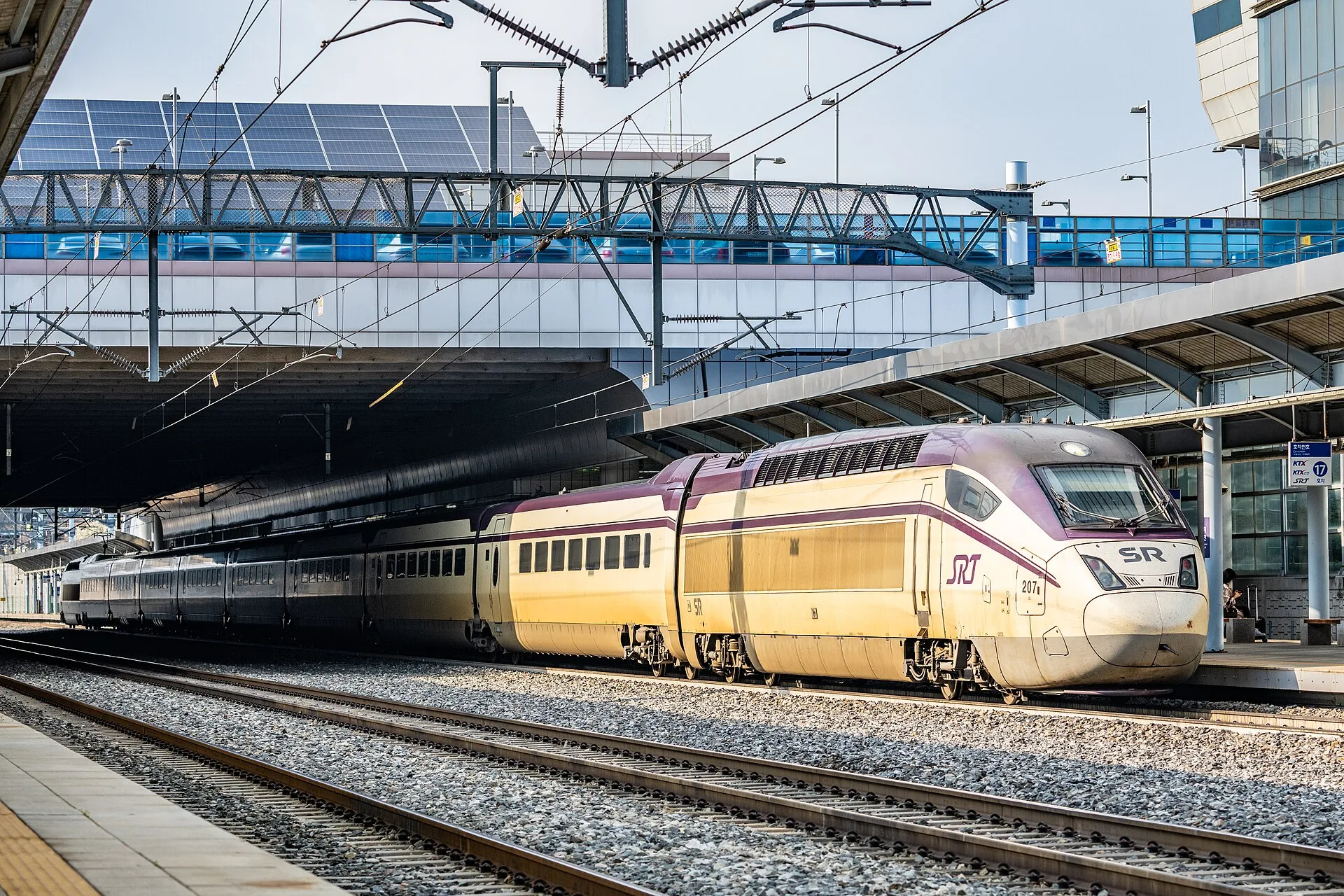
The old SRT routes are now sold as KTX from Suseo, Dongtan and Pyeongtaek-Jije. Seoul Metro’s network data shows Suseo Station on Line 3, the Suin–Bundang Line and GTX-A. Korail’s fare table has Suseo trains to Busan (Gyeongbu Line), Gwangju-Songjeong and Mokpo (Honam), Yeosu-EXPO (Jeolla), Jinju (Gyeongjeon) and Pohang (Donghae); there is nothing to Gangneung. In the November timetable Suseo has 29 daily departures for Busan, but only four a day each to Yeosu-EXPO and Pohang.
Fares are slightly lower than from Seoul Station: Suseo–Busan is 52,900 won in standard class and 76,700 won in first, 1,500 won (2,200 won in first) less than Seoul–Busan. The same pattern holds for Suseo–Dongdaegu, 37,500 won against 39,000 from Seoul, and Suseo–Gwangju-Songjeong, 40,900 won against 42,000 from Yongsan. The fastest Suseo–Busan train, running Friday to Monday, takes 2 hours 11 minutes; the fastest daily one takes 2 hours 19 minutes, and the median from the same timetable is about 2 hours 36 minutes.
The merger brought some upgrades: mileage and the conventional-train transfer discount now apply to Suseo trains, and non-reserved cars (cars 1–3) were added for weekday rush-hour season-ticket and non-reserved passengers. But one point matters for visitors. Korail’s KORAIL PASS notice, written before the merger, still says SRT trains cannot be used with the pass, and I found no official statement on whether the pass now covers KTX trains from Suseo. If you plan to board at Suseo on a pass, ask Korail’s call centre (+82-1599-7777) first, or choose a train from Seoul or Yongsan. I would pick Suseo for travellers staying in Gangnam, Jamsil or Bundang who buy ordinary tickets.
ITX-Saemaeul and ITX-Maeum: cheaper, not faster
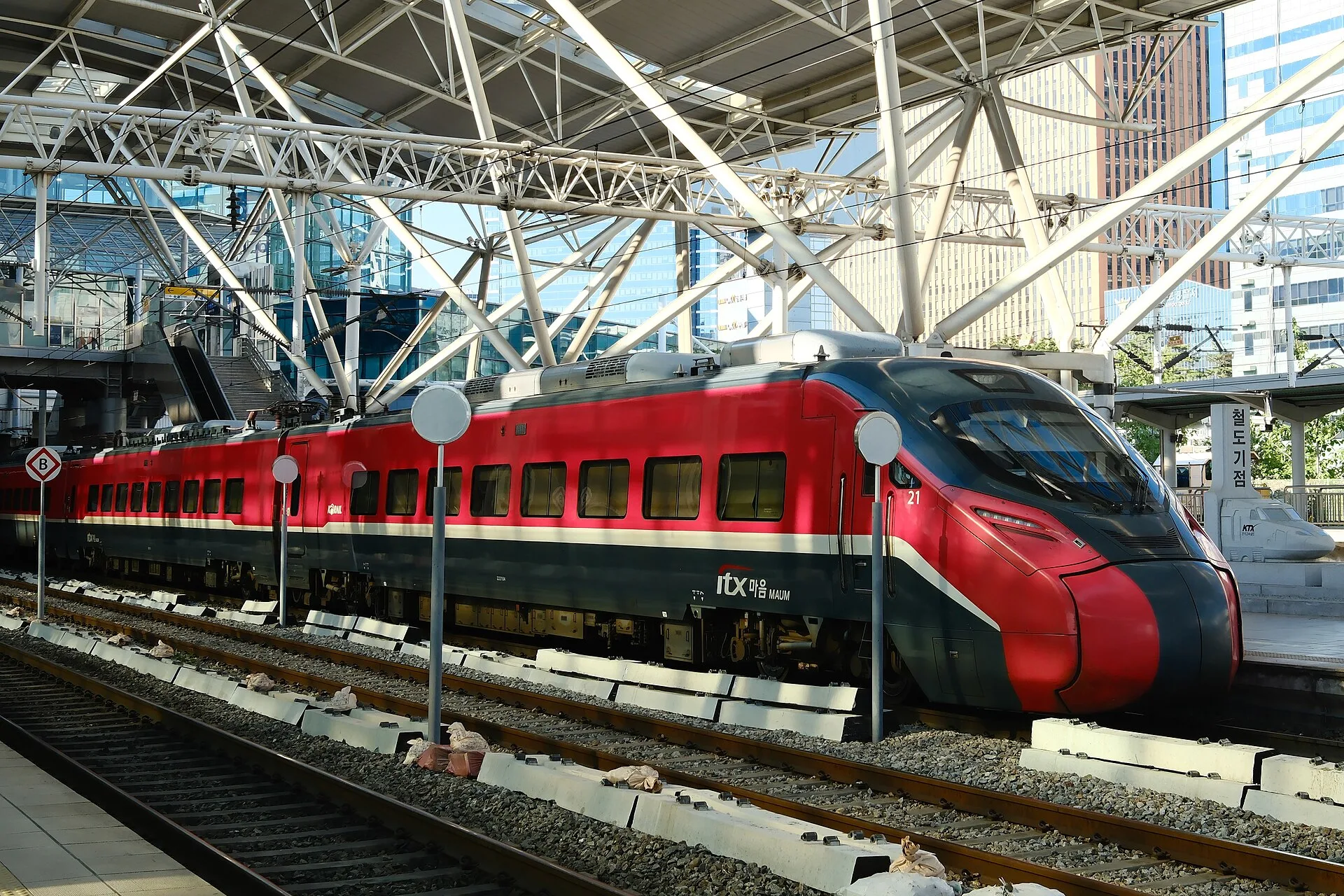
ITX trains are the faster end of Korail’s conventional, non-KTX services, and on long routes you will meet two of them: ITX-Saemaeul and ITX-Maeum. ITX-Maeum entered service on 1 September 2023. Korail describes it as running at up to 150 km/h in 4-car (264 seats) or 6-car (392 seats) units, with fold-down seats between cars for standing passengers, and charges the same fares as ITX-Saemaeul. ITX-Saemaeul is still in the November 2026 timetable, with 11 Seoul–Busan trains each way, and I found no Korail announcement of a retirement date.
The case for ITX is price and stops. In the September 2026 fare table, ITX-Saemaeul, ITX-Maeum and Saemaeul share one fare: Seoul–Busan is 42,600 won, 11,800 won less than KTX. It takes nearly twice as long: in the November timetable the fastest Seoul–Busan ITX-Saemaeul takes 4 hours 34 minutes and the fastest ITX-Maeum 4 hours 43 minutes. Yongsan–Mokpo is 39,600 won, 4 hours 20 minutes by ITX-Maeum, and Cheongnyangni–Andong is 21,100 won, 2 hours 33 minutes at best by ITX-Maeum, against 27,700 won and 1 hour 50 minutes by KTX-Eum. ITX also stops at smaller towns that KTX skips, and ITX-Maeum runs on many lines beyond the main trunk routes, including the Janghang, Chungbuk and Donghae lines.
The trade-off is time, plus a pass question. On a long route like Seoul–Busan, the money saved can feel small next to two extra hours. KORAIL PASS’s notice names ITX-Saemaeul and ITX-Cheongchun among pass trains but does not mention ITX-Maeum, so check before relying on it. ITX-Cheongchun, a double-decker on the Gyeongchun Line, serves a different purpose from the long-distance trains compared here. I would choose ITX when there is time to spare and the fare matters, or when the destination is a smaller town.
Booking as a visitor, and KORAIL PASS
Buy tickets on Korail’s English website (www.korail.com/global/eng), in the Korail+ app or at stations; the old letskorail.com address now redirects to korail.com. On the English website you pay by credit card, and Korail posts English notices when its foreign credit card service is temporarily unavailable, so if a payment fails, check the notices first. Korail+ supports seven languages and is due to support ten from November. Korail’s English notices also warn about unauthorised resale websites that charge more than the official price, and screenshots of tickets are not valid.
Refund fees depend on the day and how close you are to departure. Under Korail’s rules, tickets for Monday–Thursday departures can be refunded free until three hours before departure and for 5% after that. For Friday–Sunday, public holidays and the Seollal and Chuseok holidays there is a 400-won minimum fee until two days before, 5% the day before, 10% on the day until three hours before, and 20% in the last three hours. Since the merger, Korail says you can move a ticket to another train within seven days either side of the travel date without a fee, up to 30 minutes before departure.
KORAIL PASS is sold only to foreign visitors; Korean nationals cannot buy it. Adult prices on Korail’s English page are 131,000 won for 2 days, 186,000 for 3, 234,000 for 4 and 275,000 for 5, with child prices roughly half, and you choose the travel days within 10 days of the start date. Seats can be reserved from two months before departure, up to two a day, and a first-class seat costs pass holders 50% of the first-class price for that route. Refunds are possible only before the start date. Do the sums first: a Seoul–Busan return in standard class is 108,800 won, less than the 2-day pass, so the pass pays off only when you pack several long trips, such as Busan, Gangneung and Gwangju, into a few days.
Related on Rank Three: getting between the airport and Seoul is covered in Getting to Incheon Airport: rail, airport bus or taxi; for places to go by train, see Three Busan waterfront walks: North Port, Gwangalli and Dadaepo and A village day in Korea: Hahoe, Yangdong or Naganeupseong?.
Our three picks
- KTX from Seoul or Yongsan: the default, with the most high-speed routesKTX from Seoul or Yongsan
The widest high-speed network, reaching Busan, Gwangju, Gangneung and Andong, and AREX runs straight to Seoul Station from Incheon Airport. Seoul–Busan is 54,400 won in standard class, fastest 2 h 18 min. Covered by KORAIL PASS.
- KTX from Suseo (former SRT): the station for the Gangnam sideKTX from Suseo (former SRT)
Since 1 September 2026 SRT has run as KTX, booked in the same app. Suseo–Busan is 52,900 won in standard class. No trains to Gangneung, and check with Korail before using a pass.
- ITX-Saemaeul and ITX-Maeum: cheaper, not fasterITX-Saemaeul / ITX-Maeum
Seoul–Busan is 42,600 won, cheaper than KTX but over four and a half hours. Stops at smaller towns; ITX-Maeum is the newer train, in service since September 2023.
Side by side
| Item | KTX from Seoul/Yongsan | KTX from Suseo (ex-SRT) | ITX-Saemaeul / ITX-Maeum |
|---|---|---|---|
| Operator | Korail KTX (KTX-Cheongryong, KTX-Sancheon, KTX-Eum and others) | Korail KTX since 1 September 2026; ex-SRT trains renamed KTX-Sancheon | Korail conventional trains |
| Seoul-area stations | Seoul, Yongsan, Cheongnyangni, Yeongdeungpo, Gwangmyeong, Haengsin and others | Suseo, Dongtan, Pyeongtaek-Jije | Seoul and Yeongdeungpo (Gyeongbu), Yongsan (Honam, Jeolla), Cheongnyangni (Jungang) |
| Subway links | Seoul Station: Lines 1 and 4, AREX, Gyeongui–Jungang, GTX-A; Yongsan: Line 1, Gyeongui–Jungang | Suseo: Line 3, Suin–Bundang, GTX-A | Depends on the station |
| Main destinations | Busan, Dongdaegu, Gwangju-Songjeong, Mokpo, Yeosu-EXPO, Pohang, Gangneung, Andong | Busan, Gwangju-Songjeong, Mokpo, Jinju; Yeosu-EXPO and Pohang four a day; no Gangneung | Busan, Gwangju-Songjeong, Mokpo, Yeosu-EXPO, Andong and smaller towns |
| Seoul–Busan, standard class | 54,400 won (Seoul–Busan) | 52,900 won (Suseo–Busan) | 42,600 won (Seoul–Busan) |
| Fastest to Busan | 2 h 18 min from Seoul Station | 2 h 11 min (Fri–Mon); 2 h 19 min on daily trains | ITX-Saemaeul 4 h 34 min; ITX-Maeum 4 h 43 min |
| KORAIL PASS | Yes (KTX, KTX-Sancheon, KTX-Eum) | No official word since the merger; ask Korail | ITX-Saemaeul yes; ITX-Maeum not named |
| Best for | Downtown stays, Gangneung or Andong, pass users | Stays in Gangnam, Jamsil or Bundang | Time to spare, lower fares, smaller towns |
Where I would start
For a first train trip in Korea I would start with KTX from Seoul or Yongsan Station. AREX takes you straight to Seoul Station, it has the most high-speed routes, reaching Busan, Gwangju, Gangneung and Andong, and Korail’s own notice lists it among KORAIL PASS trains. If you are staying in Gangnam, Jamsil or Bundang, KTX from Suseo is closer and 1,500 won cheaper to Busan, and since it is now KTX you book it in the same place; just check with Korail before using a pass there. If you have time and want to save money, or are heading to a smaller town, take ITX-Saemaeul or ITX-Maeum: Seoul–Busan is 11,800 won cheaper than KTX but more than two hours slower. And if a guide tells you to take the SRT, look at its date. Since 1 September 2026, SRT has been KTX from Suseo.


