If you are about to start learning Korean, this guide compares three very different starting points: the King Sejong Institute, Talk To Me In Korean (TTMIK) and Duolingo. All three teach Hangul first, but they are built very differently. The King Sejong Institute is a free public course from a government-backed foundation, TTMIK sells a subscription to explanation-led lessons, and Duolingo is a free app for short daily exercises. This guide is built from official pages checked on 20 October 2026 (21 October in Korea): the King Sejong Institute Foundation and its Online King Sejong Institute notices, a press release from Korea’s Ministry of Culture, Sports and Tourism, TTMIK’s and Duolingo’s own pages and blogs, App Store listings, and TOPIK materials from NIIED and the Ministry of Education. It is a research piece, not a review based on using the apps, and prices and dates can change.
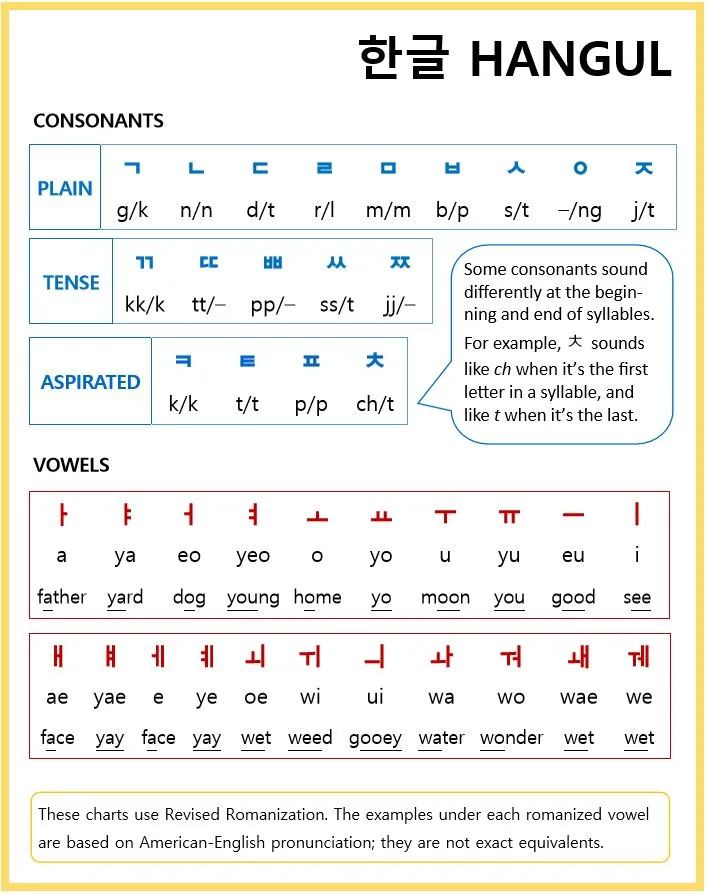
Start with Hangul: all three begin with the alphabet
The first hurdle in Korean is Hangul, the Korean alphabet. Once you see how consonants and vowels stack into syllable blocks, you can sound out words without romanization, and every later word and grammar point is easier to pick up. All three options in this guide start there, but they teach it in different amounts and styles.
The King Sejong Institute Foundation’s Online King Sejong Institute (Online KSI) has a 12-lesson Introductory course for complete beginners that focuses on Hangul and basic vocabulary, and the foundation’s free Mobile KSI app describes its content as running “from Hangul” to advanced grammar. Talk To Me In Korean (TTMIK) has a separate Hangeul course of eight video lessons, seven on reading and one on writing, with review quizzes; TTMIK pitches it as a way to learn to read Hangul in a couple of hours, and its FAQ tells complete beginners to start Level 1 with Hangeul.
Duolingo’s Korean course already had a dedicated Hangeul tab, and its July 2026 rebuild added alphabet sessions along the learning path. It shows a romanized transliteration for every Korean sentence, which you can switch on or off with the gear icon during a lesson. Transliteration helps on day one; my editorial suggestion is to switch it off once you know the letters, because reading Hangul directly is the skill everything else builds on. Whichever tool you choose, spend the first week on reading, then decide how you want to learn grammar and speaking.
King Sejong Institute: a free public curriculum with live classes by term
The King Sejong Institute Foundation (KSIF) is a public institution under Korea’s Ministry of Culture, Sports and Tourism that oversees Korean-language education abroad. Its Online KSI platform (iksi.or.kr) is a free online Korean course you can use on a computer or phone. There are also physical King Sejong Institutes around the world: on 30 June 2026 the ministry said 29 new ones brought the network to 273 institutes in 89 countries, that learners online and offline reached 239,020 in 2025, and that the first institute opened in Ulaanbaatar, Mongolia, in 2007.
Online KSI offers three formats. The Lecture Assisted type pairs recorded video lessons with live video classes taught by online teachers: Beginner, Intermediate and Advanced courses have 10 live sessions, two assignments with feedback and an achievement test in listening and reading, while the Introductory course has five live sessions. The Learning Assisted type adds three live sessions, two marked assignments and eight self-directed assignments to the videos, with one-to-one feedback from a teacher. The Self-learning type is video only, and you set your own pace.
The curriculum is built on the levels of Korea’s Standard Korean Curriculum, 1 to 6. After the 12-lesson Introductory course come Beginner 1 and 2 (20 lessons each), then Intermediate (levels 3 to 4) and Advanced (levels 5 to 6), each 40 lessons. The Introductory and Beginner courses are supported in English and many other languages (for live classes, some languages may not run if demand is low), but Intermediate and Advanced are taught in Korean only. If you rely on English explanations, plan for that switch once you finish Beginner.
The live classes follow a term calendar: four terms in 2026, with the Introductory course running five weeks and most other taught courses ten. A 2026 notice on course operations says live Zoom classes now require a camera and microphone, that you count as present only if you attend at least 75% of the 120-minute class with your camera on and face visible, and that two late arrivals count as one absence. Seats are first come, first served, with Lecture Assisted classes capped at 30 for Introductory and Beginner and 25 for Intermediate, and each account can take only one taught class per term. The next Introductory course runs 16 November to 20 December 2026, with registration from 26 October to 8 November (Korea time); KSIF notes that dates may change.
The apps and textbooks are free too. Mobile KSI advertises AI speaking assessment and handwriting-recognition writing practice, and says content you download can be studied offline. The KSI AI Korean Teacher app lets you practise by chatting with a chatbot on a topic you choose. Course textbooks are available as e-books, PDFs and audio files on the Nuri King Sejong Institute site (login required).
The trade-offs are real. Live classes have fixed terms and limited seats, so missing a registration window means waiting for the next term, and the camera rule will not suit everyone. Certificates are issued only for Lecture Assisted Beginner, Intermediate and Advanced courses, and KSIF says Online KSI certificates are not accepted as proof of Korean for visas; only certificates from physical institutes abroad are.
Talk To Me In Korean: a paid subscription that explains the why
TTMIK says it has been teaching Korean since 2009; its terms and conditions name the operator as G9 Co., Ltd. A subscription unlocks the whole catalogue of more than 1,700 lessons on the web and in its app. Each lesson has four steps: a warm-up, the lesson, speaking practice and a review quiz. TTMIK’s pitch is that it explains why Korean works the way it does, not only the rule, and that it builds speaking aloud into every lesson.
The course has 10 levels: Beginner (1 to 3), Intermediate (4 to 7) and Advanced (8 to 10). Each level pairs a Core Grammar course with a “Speak & Write” course that practises the same example sentences in speaking and writing. Core Grammar Level 1 has 26 video-and-audio lessons, 3 hours 39 minutes in total, taught in English and Korean and starting with greetings. A three-minute online level test places you, and the app description mentions a TOPIK I course available only on the new site and app, plus occasional live classes with teachers.
It is a paid subscription. On 20 October 2026, TTMIK’s pricing page listed, in US dollars excluding tax: Monthly at $16.99 a month with a 7-day free trial; Standard at $122 a year (about $10.17 a month) with a 7-day free trial; and Smart Save at $85.40 a year (about $7.12 a month) with no trial. All plans renew at the first-payment price, and tax varies by country. The US App Store showed slightly different in-app prices, $16.99 a month or $121.99 a year. Both the website and the TTMIK Courses app are for subscribers: signing up in the app is free, but the full content needs a subscription. The course site runs on a new system, so people with old talktomeinkorean.com accounts must sign up again.
You can try before paying. The first lesson of Core Grammar 1 is free with just your name and email, and the free “Talk To Me In Korean” podcast is on Apple Podcasts. The feed, though, keeps only a few numbered lessons per level (three for most levels) alongside recent weekly conversation episodes, so treat it as a sample and listening practice rather than the full course. When you finish a course on the website, TTMIK emails a certificate of completion.
The main drawback is the cost: it is the only one of the three where the core course is paid. Lessons are explained in English and Korean, which suits English speakers but helps less if English is not your strong language. I also found no official mapping of TTMIK’s 10 levels to Korea’s standard curriculum or to CEFR.
Duolingo Korean: free daily practice, rebuilt in July 2026
Duolingo’s App Store listing says every course is free, and Korean is one of them. The free version carries ads and an “Energy” limit: according to Duolingo, lessons use up Energy, streaks of correct answers earn some back, it refills fully in about a day, and you can top it up by watching an ad or spending gems. When Duolingo announced Energy in July 2025 it was a test with some users; the current App Store copy lists unlimited Energy as a perk of the paid Super tier.
The July 2026 rebuild changed the Korean course substantially. Beyond the alphabet sessions and the transliteration switch, it set clearer grammar goals for lessons and added new exercise types. Duolingo has said since April 2026, and again in the July post, that the course now teaches up to CEFR B2, a Duolingo Score of 129, where most learners could previously reach only A2 (a score of 59). The Duolingo Score runs to 160; Duolingo describes it as a more granular measure than a CEFR level, which covers a broad range of material, though its Score post still says the Score is shown only in the Spanish, French and English courses. Duolingo also says that, in addition to English, Japanese and Chinese speakers, Korean is now available to speakers of 27 languages, including Spanish, Portuguese, German and French.
There are two paid tiers. Super removes ads, gives unlimited Energy and has a 14-day free trial; the US App Store lists several Super prices without plan lengths, so I have not quoted one. Max adds AI features on top of Super, but for English speakers learning Korean the only Max feature is Video Call, an AI-powered spoken chat with the Duolingo character Lily; Roleplay is not offered for Korean. In its December 2025 year-in-review post, Duolingo said it had made Video Call with Lily available to Android users learning Korean. Explain My Answer, which explains the grammar or vocabulary behind a wrong answer, used to be a Max feature and has been free for most Korean learners since 1 January 2026.
The drawbacks come from the format. Short, repeated exercises mean grammar arrives as lesson goals and answer explanations rather than full lectures like TTMIK’s. There is no human teacher, spoken conversation practice depends on Max’s Video Call, and the free version comes with ads and the Energy limit.
Choosing by goal, and the next step: TOPIK
These are three different models, not rungs on one ladder. To learn Hangul and greetings before a trip, any of the three will do, and the free routes are Duolingo’s Hangeul tab or Online KSI’s Introductory course. If you want a structured course with teachers at no cost, Online KSI’s Lecture Assisted classes fit, as long as you plan around terms and registration dates. If you are willing to pay for English explanations of the why and speaking practice in every lesson, TTMIK fits. If you are already studying elsewhere and want a few minutes of daily review, Duolingo is the natural add-on. My editorial suggestion for a zero-cost start: build the backbone with KSIF’s free textbooks and courses, and use Duolingo for daily review.
If you need to prove your level, the next step is the Test of Proficiency in Korean (TOPIK). It is run by the National Institute for International Education (NIIED) under Korea’s Ministry of Education for overseas Koreans and foreigners, and its results are used for Korean university admission, jobs and residence or work visas. Scores are valid for two years from the results date. TOPIK I awards levels 1 and 2 and TOPIK II levels 3 to 6, both by total score. On the paper test, TOPIK I level 1 is 80 to 139 and level 2 is 140 to 200 out of 200; TOPIK II levels 3 to 6 start at 120, 150, 190 and 230 out of 300. A separate speaking test also reports levels 1 to 6, on a 200-point scale.
The official 2026 plan has six paper sittings, six internet-based (IBT) sittings and three speaking tests this year. Fees in Korea are KRW 40,000 for paper TOPIK I, 55,000 for paper TOPIK II, 70,000 for IBT TOPIK I, 95,000 for IBT TOPIK II and 80,000 for the speaking test. The remaining 2026 sittings are the 15th IBT and the 12th speaking test on 24 October (results 13 and 16 November), the 109th paper test on 15 November (results 22 December) and the 16th IBT on 28 November (results 18 December). Registration in Korea has closed for all of them, and the plan lists the 109th paper test only for Korea and parts of Asia and Europe. Dates can differ by region, and registration periods and fees abroad are set by local test administrators, so check with yours.
None of the three tools’ certificates or scores stand in for TOPIK: Online KSI certificates are not accepted for visas, the Duolingo Score is a progress measure, and a TTMIK certificate confirms that you finished a course. Any of the three is a fine place to start; when you need proof, start with the TOPIK calendar.
Related on Rank Three: for dictionaries to bookmark while you study, see Three Korean dictionaries to bookmark for Hangeul Day; for the map apps that work best in Korea, Naver Map vs KakaoMap vs Google Maps for finding restaurants; and for staying online on a trip, Internet for a Korea trip: physical SIM, eSIM or pocket Wi-Fi?.
Our three picks
- King Sejong Institute: a free public curriculum with live classes by termOnline King Sejong Institute (KSIF)
Free and built on Korea’s Standard Korean Curriculum, levels 1 to 6. Lecture Assisted courses add 10 live Zoom classes and two marked assignments (the Introductory course has five live classes and no assignments), but terms and seats are fixed and a camera is required. The next Introductory course starts 16 November 2026 (registration 26 October to 8 November, Korea time). Intermediate and above are taught in Korean only.
- Talk To Me In Korean: a paid subscription that explains the whyTalk To Me In Korean (TTMIK)
More than 1,700 lessons; the Core Grammar track explains the why in English and Korean, with speaking practice in every lesson. A paid subscription: on 20 October 2026, $16.99 a month or $85.40 to $122 a year on the web, excluding tax. The first lesson and part of the podcast are free to try.
- Duolingo Korean: free daily practice, rebuilt in July 2026Duolingo Korean
Free, short daily practice. The July 2026 rebuild added alphabet sessions on the path and a transliteration switch alongside the existing Hangeul tab, and Duolingo says the course now reaches CEFR B2 (Duolingo Score 129). The free version has ads and an Energy limit; AI Video Call is a paid Max feature.
Side by side
| Item | King Sejong Institute (Online KSI) | TTMIK | Duolingo |
|---|---|---|---|
| Run by | King Sejong Institute Foundation, a public body under the culture ministry | G9 Co., Ltd. (teaching since 2009) | Duolingo, Inc. |
| Cost (checked 20 October 2026) | Online courses, apps and e-textbooks free | Web: $16.99/month, $85.40–$122/year (excluding tax); iOS $16.99/month or $121.99/year; first lesson and podcast free | Course free (ads, Energy limit); Super with a 14-day trial; Max paid |
| Learning Hangul | 12-lesson Introductory course; Mobile KSI app | 8-video Hangeul course (7 reading, 1 writing) | Hangeul tab, alphabet sessions on the path, transliteration on/off |
| Course structure | Introductory, then Beginner, Intermediate, Advanced (Standard Korean Curriculum levels 1–6); four terms a year | 10 levels (Beginner 1–3, Intermediate 4–7, Advanced 8–10); Core Grammar plus Speak & Write | Path of sections and units; since 2026, up to CEFR B2 (Score 129) |
| Language of instruction | Introductory and Beginner supported in English and other languages; Intermediate and Advanced in Korean only | English and Korean for Core Grammar (some courses all in Korean) | From English, Japanese, Chinese, Spanish, French and many other languages |
| Speaking and teachers | Live Zoom classes (camera and mic required, first come, first served), 1:1 assignment feedback, AI chatbot app | Speaking step in every lesson; occasional live classes (per app description) | Speaking exercises; AI Video Call with Max (no Roleplay for Korean) |
| Certificates and next step | Only Lecture Assisted Beginner–Advanced; not accepted for visas | Emailed certificate for courses finished on the website; TOPIK I course | Duolingo Score is a progress measure, not a certificate |
| Watch out for | Fixed terms and seats; Korean-only from Intermediate | Core course is paid; no official curriculum mapping found | No long grammar lectures or human teacher; ads in the free version |
| Good for | A free, structured course with teachers | Understanding the why through English explanations, and speaking | Building a short daily habit |
Where I would start
If I had to pick one, I would start with the Online King Sejong Institute. It is free, it follows Korea’s Standard Korean Curriculum from the Introductory course all the way to Advanced, its textbooks and apps cost nothing, and if you plan around the terms you also get live classes with a teacher. The next Introductory course starts on 16 November, with registration from 26 October to 8 November (Korea time). If you need English explanations of the why before grammar sticks, take TTMIK’s free first lesson and decide on a subscription after that. Keep Duolingo alongside either one for daily review, and look up the TOPIK calendar when you need to prove your level.

