Korean street snacks can be a puzzle at first, starting with the names. Tteokbokki in its red sauce, hotteok pressed flat on a griddle and bungeoppang lifted out of a fish-shaped mould are three you will keep running into, yet they taste and are made very differently: tteokbokki is the spicy one, hotteok and bungeoppang are sweet. This guide compares their official English names, ingredients and taste, origins, season, where to find them in Seoul and Busan, and what to check before you order. It is a research piece, not a review: the facts come from the Korean Food Promotion Institute’s menu-name guide and recipes, the Standard Korean Language Dictionary, the Encyclopedia of Korean Culture, the National Folk Museum of Korea’s Encyclopedia of Korean Folk Culture, the Ministry of Food and Drug Safety (MFDS) database and official tourism pages, checked on 28 October 2026 (US Central time; the morning of 29 October in Korea). I did not taste them or visit the shops, and I do not recommend particular stalls or rank the three.
Bunsik and street snacks: what is sold where
In Korea all three fall under bunsik, a word for snack-bar food, or simply street food. VisitKorea explains that bunsik literally means food made from flour but is used for any simple, convenient meal, and that its great advantage is the low price, which makes it easy to order several dishes at once. On snack-bar menus you will often see “tteok-twi-sun”, short for tteokbokki, twigim (deep-fried snacks) and sundae (Korean blood sausage); VisitKorea calls them the three most popular bunsik dishes.
The three are quite different. Tteokbokki is rice cake simmered or stir-fried in sauce, most often a sweet-spicy chili-paste one, and with sundae or fried snacks on the side it can make a quick meal. Hotteok and bungeoppang are closer to desserts: wheat dough or batter wrapped around a sweet filling. VisitKorea lists bungeoppang and hotteok among the street snacks you can only find in certain seasons. The National Folk Museum of Korea’s Encyclopedia of Korean Folk Culture, however, says hotteok has become an anytime snack and that bungeoppang is now sold whatever the season. You will see more of both in winter, but they are not winter-only.
One more word helps: pulppang, the family bungeoppang belongs to. The Encyclopedia of Korean Culture, published by the Academy of Korean Studies (AKS), describes pulppang as wheat batter poured into an iron mould with red-bean paste in the middle, and says obangtteok, ingeoppang (carp bread), bungeoppang, gukhwappang (chrysanthemum bread) and walnut cakes are all pulppang named after the shape of their mould. This guide gives no prices, because I found no official price series for these snacks; prices vary by stall and neighbourhood, so check the menu board.
Tteokbokki: chewy rice cakes in a sweet-spicy chili sauce
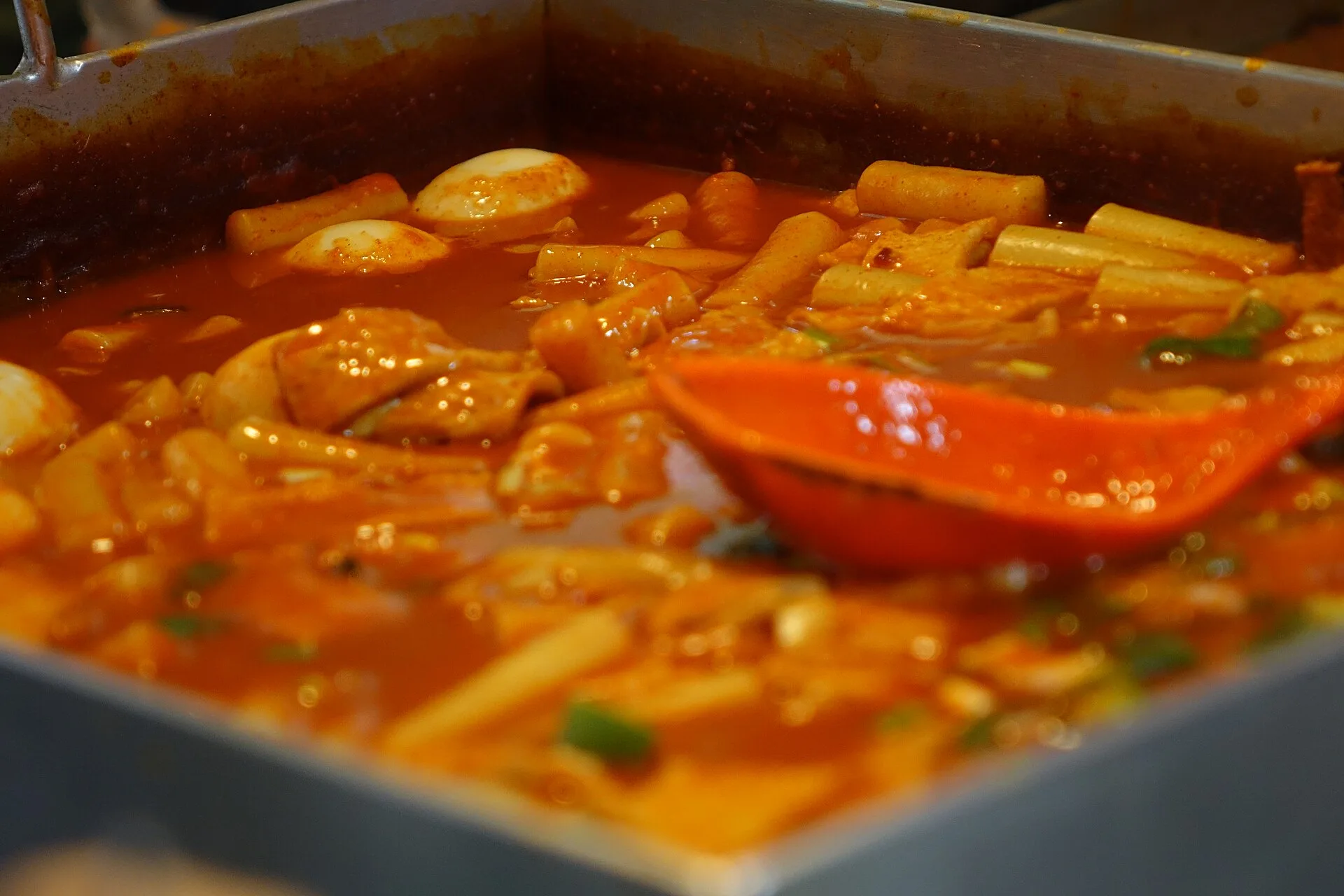
The Korean Food Promotion Institute’s official guide to menu names writes 떡볶이 as “Tteokbokki”, in English “Stir-fried Rice Cake”. Gungjung tteokbokki is “Royal Stir-fried Rice Cake”, and the instant and soupy versions are also listed as “Stir-fried Rice Cake”. The Standard Korean Language Dictionary defines tteokbokki as garaetteok (long cylinders of rice cake) cut to size and stir-fried with vegetables and seasoning, adding that the seasoning can be soy sauce or gochujang (red chili paste).
What you meet on the street today is the gochujang kind. The institute’s recipe for four uses 500 g of tteokbokki rice cakes, 150 g of fish cake and 360 ml of water, with 3 tablespoons of gochujang, half a tablespoon of soy sauce, 2 tablespoons of sugar and a tablespoon of corn syrup. It suggests anchovy-and-kelp stock instead of water for more savoury depth, and more chili powder with onion, carrot and spring onion for extra heat. With sugar and syrup in the sauce, it is spicy and sweet at once; VisitKorea calls the sweet-spicy chili-paste version the most common. The institute draws the line simply: ordinary tteokbokki is spicy, gungjung tteokbokki tastes of soy sauce. Its gungjung recipe uses rice cake, soy sauce, sesame oil, minced beef, mung bean sprouts, carrot, onion and spring onion, and no gochujang. VisitKorea notes that the royal-court version became rare as the red kind took over, and that you usually find it at restaurants specialising in traditional Korean food.
The soy version has the longer history. According to the Folk Museum’s encyclopedia, the name tteokbokki appears in two late-19th-century recipe books, Gyugon yoram and Siuijeonseo, and until about the 1960s it meant rice cake stir-fried in oil with beef and vegetables in a soy seasoning, a special New Year dish of the royal court and aristocratic households. After the 1950s it turned into wheat-flour rice cake, fish cake and vegetables simmered in gochujang. The encyclopedia says, with care, that the gochujang version is “well known” to have been devised by Ma Bok-rim, who opened a tteokbokki shop in Sindang-dong, Jung-gu, Seoul in 1953. VisitKorea says the Sindang-dong tteokbokki alley started in the late 1970s and became famous in the 1980s, while “some claim” it goes back to the 1950s.
The rice cake changes the texture. The Folk Museum distinguishes rice tteok (ssal-tteok) from wheat tteok (mil-tteok) and notes they differ in texture once cooked; VisitKorea says the wheat kind soaks up sauce while the rice kind is chewier. Cabbage, carrot and fish cake are the usual add-ins; boiled eggs or processed meat are optional, ramyeon noodles make it rabokki and chewy jjolmyeon noodles make jjolbokki. A soupy version for dipping fried snacks and gimbap appeared in the early 2010s, and rosé tteokbokki, with cream or milk in the sauce, became popular in the late 2010s.
Here are two places that official guides point to. Sindang-dong Tteokbokki Town (address on VisitKorea: 10-18 Dasan-ro 33-gil, Jung-gu, Seoul) is around Exit 8 of Sindang Station on Lines 2 and 6, according to the Jung-gu District Office, which describes cooking it at the table with the add-ins you choose. Tongin Market (Line 3, Gyeongbokgung Station Exit 2) has an alley of gireum (oil) tteokbokki, rice cake marinated in soy seasoning and fried on an oiled griddle; Visit Seoul explains that you buy the market’s brass coins (₩500 each) and trade them for food such as oil tteokbokki at participating stalls to fill a lunch box. In the MFDS food nutrient database, home-style tteokbokki (analysed in 2018) shows 144 kcal and 391 mg of sodium per 100 g.
Hotteok: a pressed pancake with melted brown sugar inside
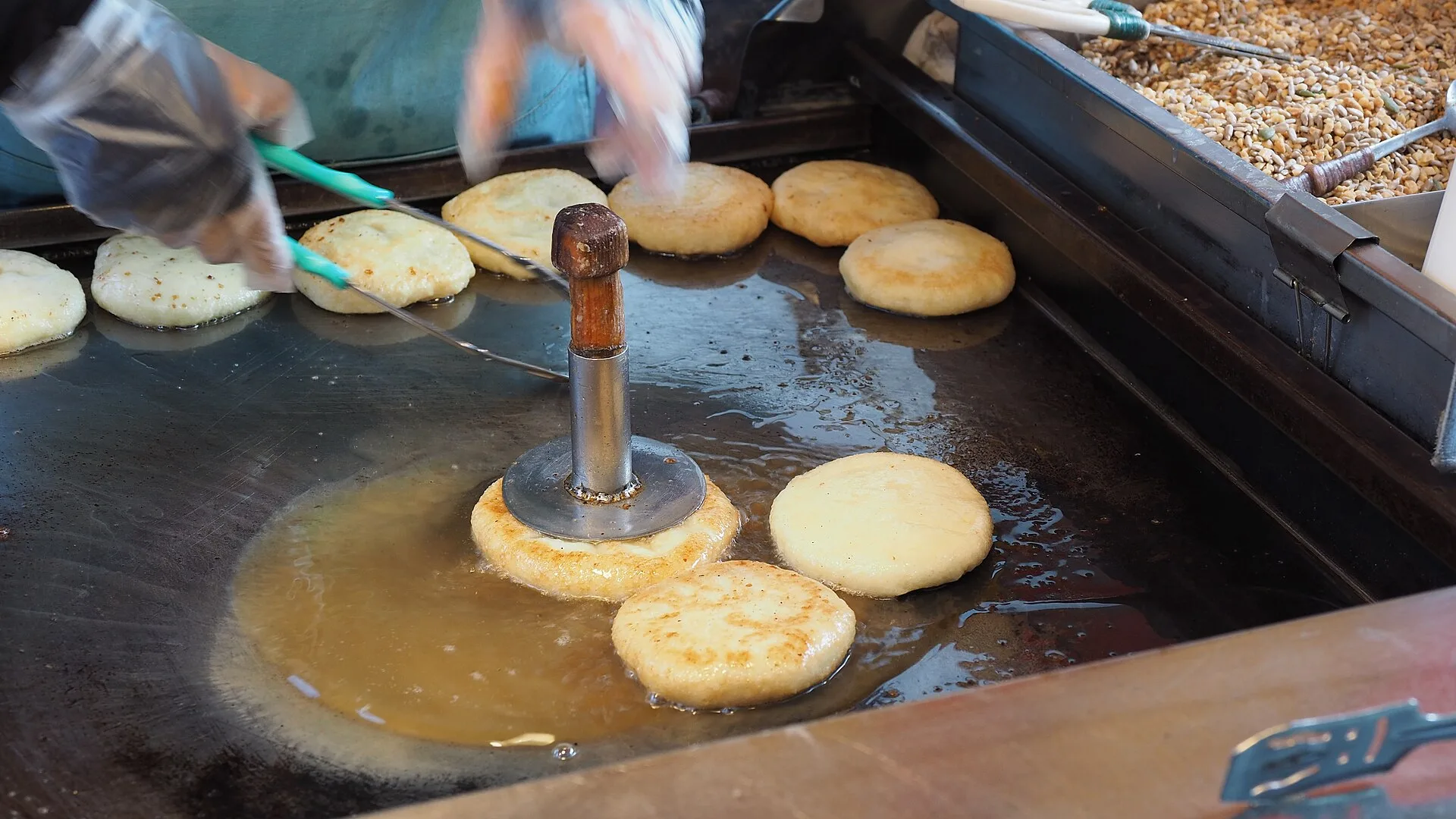
The menu-name guide writes 호떡 as “Hotteok”, in English “Syrup-filled Pancake”, and seed hotteok as “Korean Pancake with Seed and Brown Sugar Filling”. The Standard Korean Language Dictionary defines it as wheat-flour or glutinous-rice-flour dough with a sugar filling, fried flat and round on an oiled griddle or pan, and says it came from China. The Folk Museum’s encyclopedia calls hotteok one of Korea’s most iconic winter street foods: the brown sugar inside melts as it cooks into a sticky, honey-like syrup, and the cake is pressed flat on the griddle with a press.
Sources differ slightly on when it arrived. The AKS encyclopedia’s hotteok entry says ethnic-Chinese migrants brought it from China in the 1880s, but the same encyclopedia’s seed-hotteok entry says the exact time is unknown and only guesses it came with Qing merchants after 1882. The Folk Museum says it “is known” to have come with Chinese who moved from Qing China in the 19th century. The AKS hotteok entry counts 1,139 Chinese-run hotteok shops across Korea in October 1930. The Folk Museum’s food-life entry says hotteok in the 1920s were baked in a clay oven rather than fried, and that frying in oil is thought to date from the arrival of cooking oil in the 1970s.
The usual filling is cinnamon brown sugar, but vegetables, peanuts and other nuts are also used, and today there are honey, cheese, green tea, mugwort and red-bean versions, plus multigrain and nut hotteok. Busan has its own: seed hotteok from Nampo-dong, dough fried in oil, split open and stuffed with sunflower seeds, nuts and raisins, handed over in a paper cup. AKS says it reportedly began on the streets of Nampo-dong in the 1980s, and Visit Busan says that although it is sold elsewhere now, the original along BIFF Plaza in Nampo-dong is unbeatable.
In Seoul, Namdaemun Market is known for yachae (vegetable) hotteok filled with glass noodles and vegetables. A Visit Seoul page last edited in 2022 says it is fried in oil and topped with a sauce made with soy sauce, paprika and Cheongyang chilies, among other things, and puts the stall five minutes’ walk from Exit 6 of Hoehyeon Station on Line 4. The same page warns that you may be surprised how hot it is inside, and to eat it slowly while it cools. The MFDS database lists restaurant hotteok at 147 kcal, but marks it as a calculated reference value (2024) on a 100 mL basis, so it cannot be compared directly with the tteokbokki figure.
Bungeoppang: a fish-shaped bun with red-bean filling
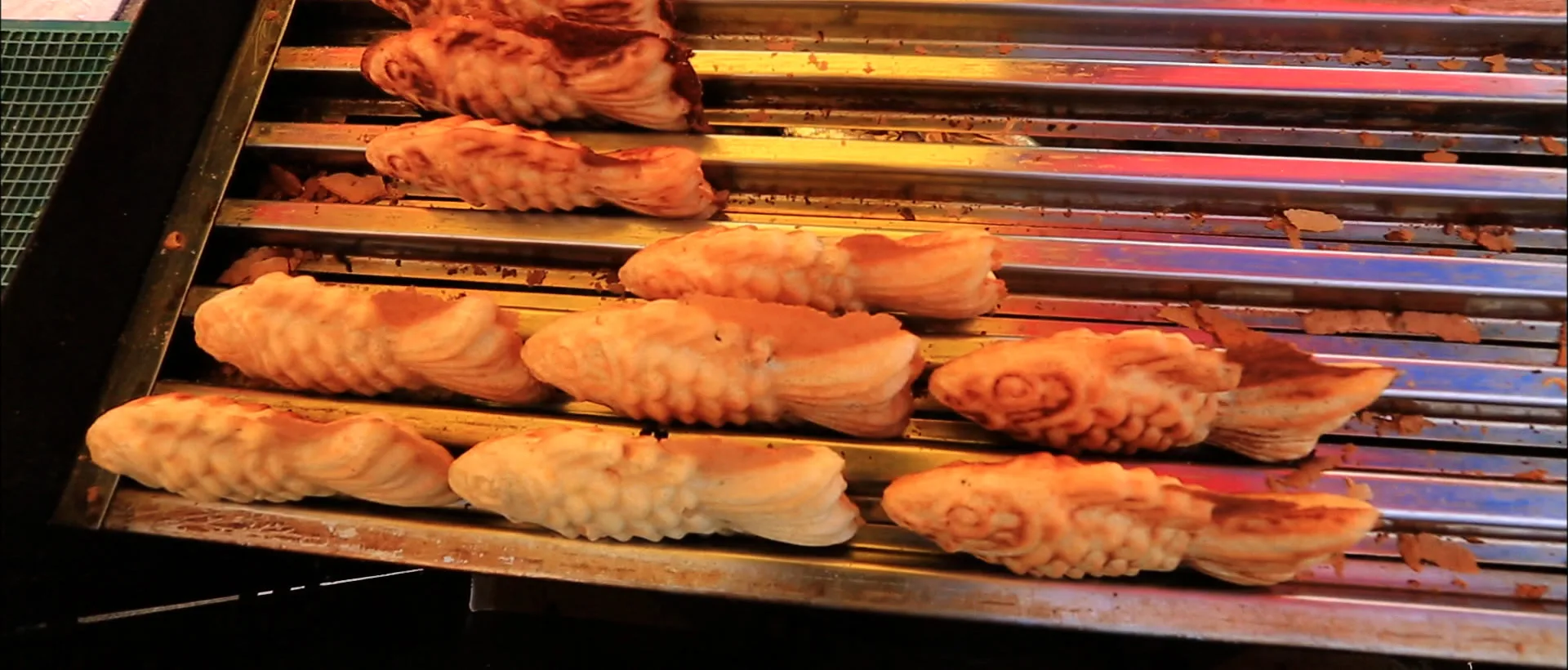
The menu-name guide writes 붕어빵 as “Bungeoppang”, in English “Fish-shaped Bread”. The Standard Korean Language Dictionary defines it as a pulppang made by putting thin wheat batter and red-bean filling into a crucian-carp-shaped mould. According to the AKS encyclopedia, pulppang batter mixes wheat flour, sugar, baking soda and other ingredients; batter goes into the mould, then red-bean filling, then more batter, and the mould is closed and turned. VisitKorea says it is crispiest right after you buy it from a street cart.
Its roots are Japanese. The Folk Museum says bungeoppang began when taiyaki, a traditional Japanese confection, reached Korea in the 1930s. Taiyaki, though, is baked in a sea-bream mould, while bungeoppang, as the name says, is a crucian carp. The menu-name guide’s Japanese column renders 붕어빵 as たい焼き (taiyaki), but they are not the same shape. After the Korean War, US aid made wheat plentiful, and pulppang stalls, which needed little money or skill, spread. They began to disappear from city streets before the 1988 Seoul Olympics, seen as an eyesore, and came back during the 1997 financial crisis, which is why some people see bungeoppang sales as a recession indicator.
It was popular on cold days and mainly sold in winter, but it is now sold year-round. Besides red bean there are choux cream, chocolate, myeongran-mayo (pollock roe and mayonnaise), corn and pizza versions, plus mini bungeoppang. The Folk Museum says neighbourhood stalls have dwindled, so you now find it mostly in particular places such as tourist areas, and names Insa-dong in Seoul and Nampo-dong in Busan among the spots foreign visitors seek out: Insa-dong for traditional red bean, Busan for versions with seafood.
The word has a life of its own, too. Koreans call a child who looks just like a parent a “bungeoppang”, and younger Koreans say a home near a bungeoppang stall is in a “bungsegwon”, a play on yeoksegwon, the word for the area around a subway station. Search the MFDS database for 붕어빵 and you get only 12 franchise products and no generic street-style entry, so I give no calorie figure.
Before you order: ingredients, diets and a hot centre
Tteokbokki is not just rice cake. The institute’s recipe includes fish cake and suggests anchovy-and-kelp stock, and VisitKorea says snack-bar fish cakes are usually skewered and boiled in anchovy broth. Boiled eggs or processed meat may go in, and wheat tteok contains wheat. If you are vegetarian or avoid fish, ask about the broth and the fish cake first.
Hotteok dough is wheat or glutinous-rice flour. Seed hotteok carries nuts and seeds such as peanuts, sunflower seeds and pumpkin seeds, so skip it if you have a peanut, tree-nut or seed allergy; vegetable hotteok contains glass noodles. Bungeoppang is wheat batter and red bean, but I found no official source on whether street batters contain egg or milk, so ask the vendor if it matters. VisitKorea advises vegetarians to tell staff in advance and suggests showing the phrase “육류, 달걀, 해산물 등을 먹지 못합니다” (I cannot eat any meat, eggs, and seafood).
Visit Seoul warns that Namdaemun’s vegetable hotteok can be surprisingly hot when you bite into it and suggests eating it slowly while it cools; a hotteok full of melted sugar deserves the same care.
Related on Rank Three: for a gimbap to dip in tteokbokki sauce, see Three ways to order gimbap: regular rolls, mini rolls and Chungmu; for a stew to eat with rice, Kimchi jjigae vs doenjang jjigae vs sundubu jjigae: which Korean stew to order?; and for a city trip built around one bakery, Three Korean Bakery Trips: Sungsimdang, Iseongdang, and Samsong.
Our three picks
- Tteokbokki: chewy rice cakes in a sweet-spicy chili sauceTteokbokki
Pick it if you want something spicy, or a snack that can stand in for a light meal. It sits at the centre of bunsik, so snack bars and markets have it, often with sundae and fried snacks as “tteok-twi-sun”. If chili worries you, look for Tongin Market’s soy-seasoned oil tteokbokki, or order soy-sauce gungjung tteokbokki at a restaurant serving traditional Korean food. It may contain fish cake and anchovy stock.
- Hotteok: a pressed pancake with melted brown sugar insideHotteok
Pick it on a cold day when you want something warm and sweet. The point is the melted brown-sugar syrup, so eat it slowly once it cools a little. In Busan, try Nampo-dong seed hotteok; in Seoul, Namdaemun Market also has a vegetable version filled with glass noodles. Seed hotteok contains peanuts, nuts and seeds.
- Bungeoppang: a fish-shaped bun with red-bean fillingBungeoppang
Pick it for a light, sweet snack to eat on the move. Wheat batter and red bean are the base, with fillings such as choux cream and chocolate too. VisitKorea says it is crispiest right after you buy it. Neighbourhood stalls have thinned out, so look around tourist areas and shops.
Side by side
| What to check | Tteokbokki | Hotteok | Bungeoppang |
|---|---|---|---|
| Official English menu name | Tteokbokki / Stir-fried Rice Cake | Hotteok / Syrup-filled Pancake | Bungeoppang / Fish-shaped Bread |
| Base | Rice cake (rice or wheat) | Wheat or glutinous-rice dough | Thin wheat batter (pulppang) |
| How it is made | Simmered or stir-fried in sauce; instant version cooked at the table | Pressed flat on an oiled griddle; seed hotteok fried, split and filled | Batter and red bean baked in a fish-shaped iron mould |
| Taste (as sources describe it) | Sweet-spicy chili paste most common; gungjung version tastes of soy | Sweet melted brown-sugar syrup; vegetable hotteok has glass noodles and vegetables instead of sugar | Sweet red bean; choux cream, chocolate and others too |
| Season (as sources put it) | No seasonal label; the centre of bunsik | Iconic winter street food, now eaten any time | Mainly winter in the past, now year-round |
| Where official guides point | Sindang-dong Tteokbokki Town (Sindang Stn Exit 8 area); Tongin Market oil tteokbokki (Gyeongbokgung Stn Exit 2) | BIFF Plaza, Nampo-dong, Busan, for seed hotteok; Namdaemun vegetable hotteok (Hoehyeon Stn Exit 6, 2022 page) | Tourist-area stalls and shops, such as Insa-dong and Nampo-dong |
| MFDS energy example (different data types, not comparable) | Home-style 144 kcal per 100 g (analysed data, 2018) | Restaurant 147 kcal (calculated reference, 2024; page basis 100 mL) | No generic entry (franchise products only) |
| Ingredients to ask about | Fish cake, anchovy broth, wheat in mil-tteok, egg or processed meat | Wheat or glutinous rice; peanuts, nuts and seeds in seed hotteok; glass noodles in vegetable hotteok | Wheat and red bean; egg or milk not documented |
| Good for | Sweet-spicy; snack or light meal | A warm sweet treat (mind the hot centre) | A light sweet snack on the go |
Where I would start
If I had to pick one, I would start with tteokbokki. It sits at the centre of bunsik, so it is easy to find in snack bars and markets, and with sundae or fried snacks it turns a snack into a meal. If you are wary of chili, begin with Tongin Market’s soy-seasoned oil tteokbokki, or gungjung tteokbokki at a restaurant serving traditional Korean food. On a cold day when you want something sweet, add a hotteok or a bungeoppang. Just remember that tteokbokki may contain fish cake and anchovy broth and seed hotteok contains peanuts, nuts and seeds, so if you are vegetarian or have allergies, ask before you order.


