This guide picks three everyday Korean noodle dishes that work very differently: kalguksu, janchi-guksu and jjolmyeon. All three are wheat noodles, but they differ in how the noodles are made, whether there is a broth, whether the bowl is hot or cold and whether it is spicy. It compares them on noodles, broth and sauce, temperature and heat, origins and meaning, and what to know when you order. It is a research guide, not a tasting: the facts come from the Academy of Korean Studies’ Encyclopedia of Korean Culture, the National Folk Museum of Korea’s Encyclopedia of Korean Folk Culture, the National Institute of Korean Language’s dictionary, the Korean Food Promotion Institute, VisitKorea, VISITSEOUL and the Korea Consumer Agency, checked on 1 November 2026 (US Central time; 2 November in Korea). It does not review or rank restaurants.
How the three differ: the noodles, the broth and the temperature
All three names end in guksu or myeon, both words for noodles, but the noodles themselves are made differently. The National Institute of Korean Language’s Standard Korean Language Dictionary defines kalguksu as noodles made by rolling wheat dough thin with a rolling pin and cutting it into strips with a knife; janchi-guksu as noodles “mainly eaten on feast days”, served in a hot clear broth with assorted garnishes; and jjolmyeon as noodles made chewy, usually mixed with vegetables and a gochujang (red chilli paste) sauce. In short: knife-cut noodles, thin dried noodles that are boiled and drained, and thick chewy noodles.
Then there is the broth. The Academy of Korean Studies’ Encyclopedia of Korean Culture describes noodle dishes as noodles boiled and then either served in a broth or mixed with a sauce, and these three cover both. Kalguksu is cooked in its broth and arrives hot; janchi-guksu is boiled noodles with a warm clear broth poured over; jjolmyeon has no broth at all: its noodles are rinsed in cold water and mixed with sauce. The same encyclopedia notes that noodle presses came into use from the middle of the Joseon period, that dried wheat noodles spread after 1900 and that wheat noodle dishes became everyday food after 1945, when imported flour became plentiful. Today all three are wheat noodles.
It helps to know the English names you will see on menus. The Korean Food Promotion Institute’s official menu-name guide gives Kalguksu (Noodle Soup), Janchiguksu (Banquet Noodles) and Jjolmyeon (Spicy Chewy Noodles). VisitKorea’s food glossary uses the same names and adds another Korean name for janchi-guksu, myeolchi-guksu, translated as noodles in dried anchovy broth. Kalguksu comes in many versions named after their main ingredient: dak-kalguksu (Noodle Soup with Chicken), bajirak-kalguksu (Noodle Soup with Clams), deulkkae-kalguksu (Noodle Soup with Perilla Seeds), jang-kalguksu (Gochujang and Doenjang Noodle Soup) and pat-kalguksu (Red Bean Paste Noodle Soup).
Kalguksu: knife-cut noodles cooked in a hot broth
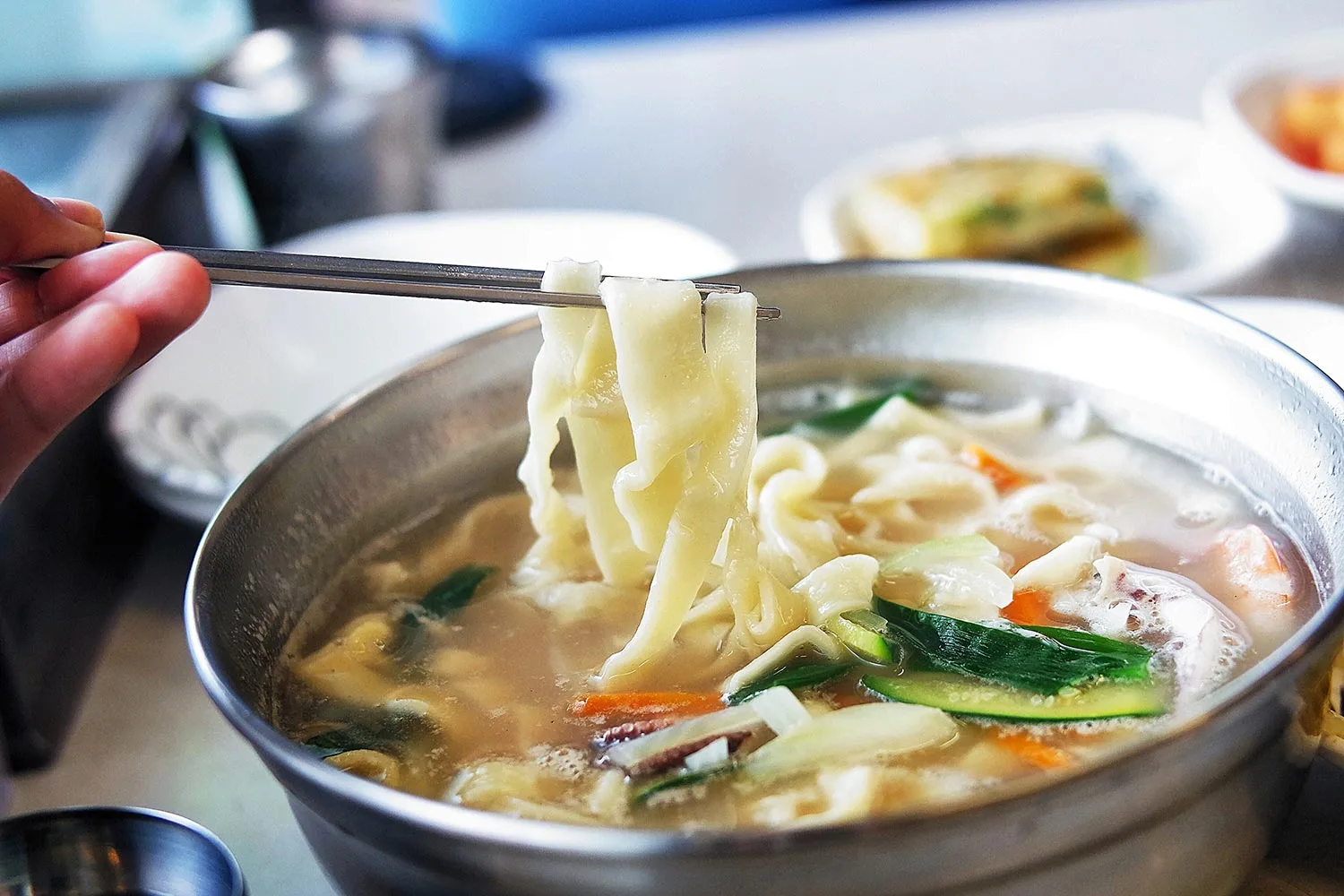
VisitKorea describes kalguksu as hand-kneaded wheat dough rolled out, cut into noodles with a knife and boiled in a broth made with chicken, anchovies or Manila clams, with potato, courgette, spring onion and dried laver added. The name joins kal, a knife, and guksu, noodles. The Encyclopedia of Korean Culture adds a detail that explains the look of the bowl: today the noodles are usually boiled straight in the broth, which makes the soup cloudy but gives it a nutty, savoury depth. Unlike noodles that are boiled, rinsed and then served in a clear broth, kalguksu arrives in an opaque soup.
The dish is old, but it did not start as a wheat noodle. According to the same encyclopedia and the National Folk Museum of Korea’s Encyclopedia of Korean Folk Culture, Joseon-era cookbooks already describe noodles cut from rolled dough, made mainly from buckwheat because wheat flour was scarce and expensive (the two encyclopedias cite different book and recipe names). The folk encyclopedia’s English Hallyu entry says kalguksu was originally a summer delicacy that could only be made once the wheat had been harvested, topped with potato and courgette from the same season, and that it became food for ordinary people after the Korean War, when wheat flour became cheap and common with American aid.
There are many versions. The folk encyclopedia names beef-bone, anchovy and chicken kalguksu as the three main kinds by broth, and VisitKorea says beef-bone soup is the most common base among meat-based versions. The Korean Food Promotion Institute’s kalguksu recipe uses chicken broth with shredded chicken, courgette and spring onion, and its bajirak-kalguksu is made with a broth of boiled clams. Both recipes come with a separate seasoning sauce of soy sauce, chilli powder and green chilli, so the heat is mostly up to you (the clam recipe also simmers deseeded green and red chillies in the soup). Jang-kalguksu from Gangwon Province is cooked with gochujang or doenjang (soybean paste) stirred into the broth; the folk encyclopedia records local names such as honghap-kalguksu with mussels in Yangyang, kkoldu-guksu in Yeongwol and kotdeungchigi-guksu in Jeongseon.
Where to try it: VISITSEOUL, the Seoul tourism site, describes a kalguksu alley in Namdaemun Market lined on both sides with kalguksu eateries. VisitKorea says kalguksu is good in any season but especially on rainy or cold days, and has a separate guide to the dish in Daejeon. For a price benchmark, the Korea Consumer Agency’s dine-out price page lists a single serving of kalguksu in Seoul at 10,038 won for September 2026. It is a provisional figure from government survey data, and it can move when the surveyed restaurants change.
Janchi-guksu: thin noodles in a clear broth, the banquet bowl
Janchi means a feast, and janchi-guksu is the feast noodle. The Encyclopedia of Korean Folk Culture explains that it was the signature dish served to guests at weddings, birthday parties and 60th-birthday celebrations, offered with the wish that they would live a good, long life like the long strands of noodles. Its entry on noodles in rites of passage adds that noodles were an essential ritual food at first-birthday parties, 60th birthdays, weddings and ancestral rites. Korean even has an idiom for it: the dictionary records guksu-reul meokda, “to eat noodles”, as a figurative way of saying someone is getting married, because noodles were commonly served at wedding receptions.
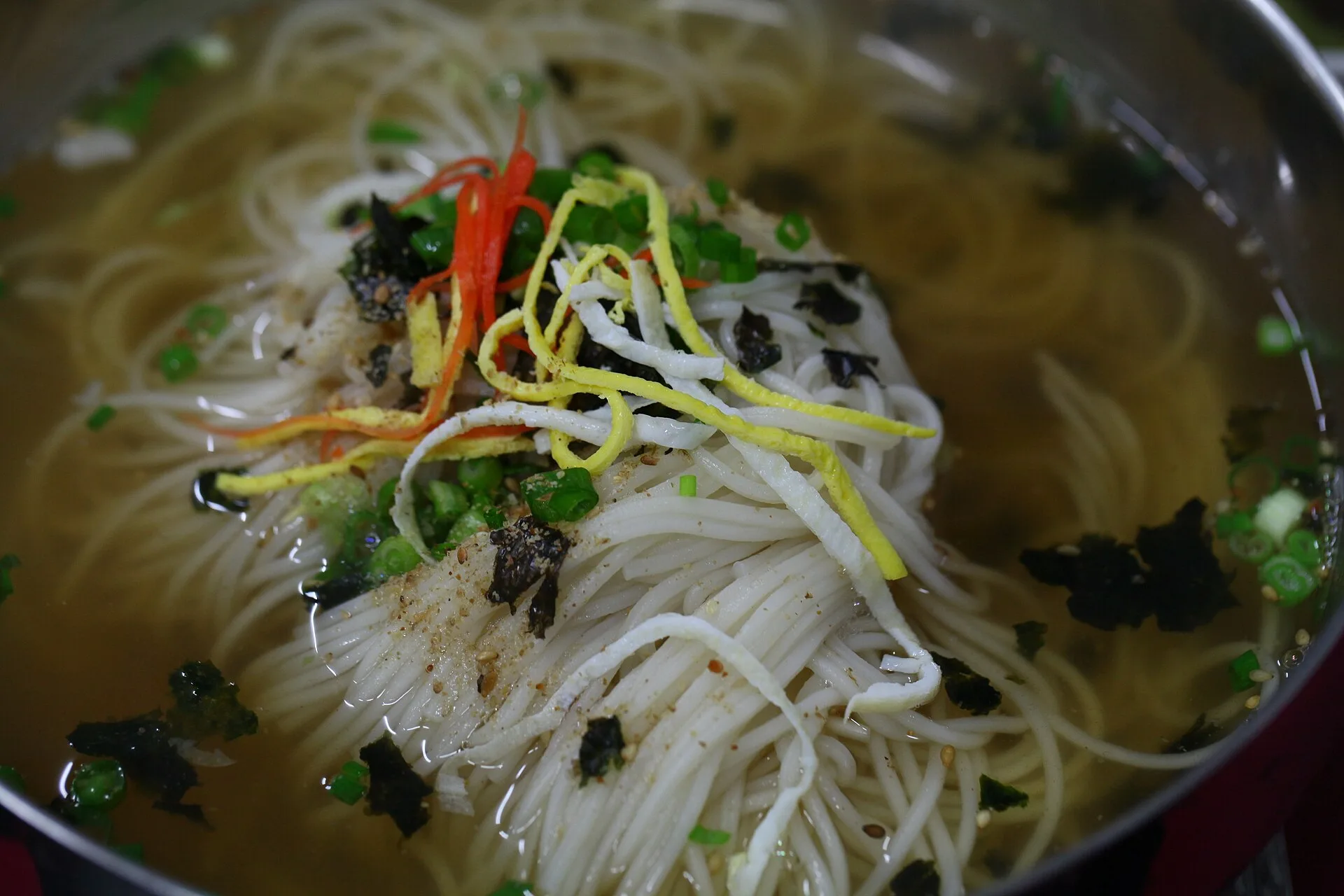
The broth is clear and mild. VisitKorea describes noodles topped with spring onion and egg strips in a broth made with anchovies, large-eyed herring and kelp, notes that soy-sauce seasoning can be added and calls it an affordable, easy dish. The Korean Food Promotion Institute’s recipe boils thin dried wheat noodles, tops them with courgette, carrot and egg strips, and pours over an anchovy broth seasoned with soup soy sauce and salt. Anchovy was not always the base, though: the folk encyclopedia explains that the dish was originally made with jangguk, a beef broth made by stir-frying finely cut beef and adding water, and that anchovy broth is what most people use now.
It also went from special-occasion food to everyday food. The same encyclopedia says noodles were treated as a precious dish in the Joseon period because wheat flour was costly, but that noodles in clear broth became a cheap, frequent meal and, for a long time, one of the most common quick meals at markets alongside rice soups. It calls janchi-guksu one of Korea’s representative noodle dishes, widely sold in restaurants.
For a first-timer, I think janchi-guksu is the easy one: not spicy, with thin noodles that slip down easily and what the folk encyclopedia calls a refreshing, clean-tasting broth. The one thing to check is that the broth is usually made from anchovies and herring, so ask first if you avoid fish stock.
Jjolmyeon: thick, chewy noodles in a sweet, sour and spicy sauce, served cold
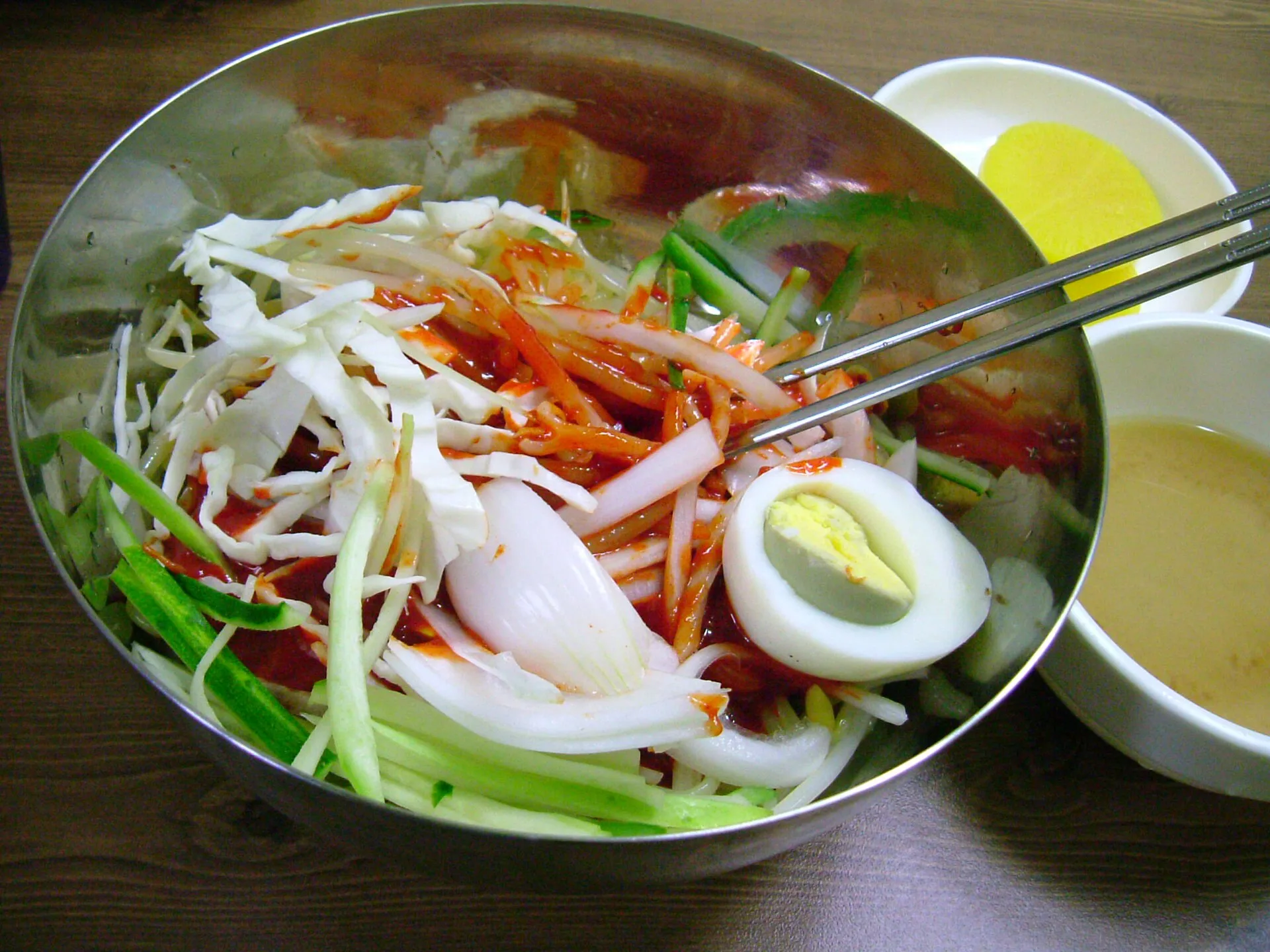
Jjolmyeon is usually a mixed noodle dish with no broth. The Encyclopedia of Korean Culture defines it as thick, chewy, cold noodles topped with crunchy vegetables such as bean sprouts, cabbage, cucumber and carrot, garnished with egg and mixed with a sweet and spicy sauce. The sauce is gochujang mixed with garlic juice, vinegar, sugar, ginger juice and lemon juice, and the noodles are boiled for three to four minutes and rinsed well in cold water. VisitKorea explains that jjol comes from jjolgit, a word for a chewy texture, that the yellow noodles are thicker than buckwheat noodles and chewy, and that the dish is a popular item at bunsik (snack) shops.
Of the three, jjolmyeon has the most specific origin story. The folk encyclopedia notes that while many noodle dishes have unclear or disputed origins, jjolmyeon’s period and region are clearly known. The Encyclopedia of Korean Culture says a noodle factory in Incheon began mass-producing jjolmyeon noodles in the early 1970s and that chain restaurants spread the dish nationwide after 1987. It also says there are two accounts of how it began. In the first, a noodle factory in what is now Gyeong-dong, Jemulpo-gu, Incheon, was rushing naengmyeon orders when a worker fitted the wrong die to the extruder, producing thick noodles; the factory gave them to a nearby snack shop, which mixed them with chilli-vinegar sauce and vegetables and sold them, and the dish spread from there. In the second, another Incheon firm, licensed to make noodles around 1970, deliberately developed thick, tough noodles and supplied the same snack shop; the noodles were as tough as rubber bands, hence the name, and with a fiery sauce the dish became a hit with students. VisitKorea’s guide to Incheon’s Sinpo International Market tells the short version: jjolmyeon was born in Incheon, quite by accident, when thick noodles were produced by mistake.
Wheat flour is the backdrop here too. The Encyclopedia of Korean Culture explains that in the 1960s and 1970s, when rice and barley were short, the government ran a campaign to cut rice consumption and promote flour that arrived as aid, and that Incheon, with its port and railway, gained flour mills, noodle factories and snack shops. The encyclopedia calls jjolmyeon a representative everyday dish that began in Incheon, and VisitKorea still describes it as a popular snack-shop item. VisitKorea lists jjolmyeon among the dishes at Sinpo International Market and suggests pairing it with dumplings or fried snacks.
On paper, it is the boldest of the three: spicy, sweet and sour sauce, chewy noodles and crunchy vegetables, eaten cold. If you are not used to chilli, ask for less sauce, and expect a real chew: VisitKorea describes the noodles as thicker than buckwheat noodles and chewy.
When you order: spice, what is in the broth, vegetarian requests and extra noodles
Spice first. Only jjolmyeon is spicy by default. Kalguksu and janchi-guksu come in mild broths; with kalguksu you add as much of the chilli seasoning sauce as you like, as in the Korean Food Promotion Institute’s recipe. Versions with gochujang in the broth, such as Gangwon-style jang-kalguksu, are hot from the start, so read the menu name.
What is in the broth, and vegetarian requests. VisitKorea’s tips for vegetarians point out that Korean food is often made with meat or fish broth and that many restaurants have no separate vegetarian menu, so it is best to state your diet clearly before ordering and name the ingredients to leave out. For these three dishes, kalguksu broth is usually beef bone, chicken, anchovy or clam, and janchi-guksu’s is usually anchovy, often with herring or kelp. Jjolmyeon has no broth but is topped with egg, and all three are wheat noodles, so check before ordering if you avoid wheat, egg or seafood. The same guide recommends kongguksu, a summer dish of noodles in cold ground-soybean soup, as suitable for vegetarians, with the caveat that egg may be added as a garnish.
Portions and pairings. If one bowl is not enough, ask for myeon-chuga or sari-chuga, the extra serving of noodles listed in VisitKorea’s glossary. With jjolmyeon, VisitKorea’s suggestion of dumplings or fried snacks on the side is a good one.
And if cold noodles are what you are after, there are naengmyeon and milmyeon too. Jjolmyeon is close enough to naengmyeon that one origin story begins at a naengmyeon noodle press, but the noodles and the way they are served are different; the post linked below explains those two.
Related on Rank Three: to compare cold noodles, Pyongyang vs Hamheung naengmyeon vs Busan milmyeon: which Korean cold noodles to order?; for dumplings to go with your noodles, Three Seoul Mandu Stops: Jaha, Gaeseong Koong, and Mandujip; and for noodles to cook in your room, Three Familiar Korean Ramyun Bags: Shin, Jin, and Samyang.
Our three picks
- Kalguksu: knife-cut noodles cooked in a hot brothKalguksu
For a warm, filling bowl on a cold or rainy day: knife-cut noodles cooked in beef-bone, chicken, anchovy or clam broth, which turns cloudy and savoury. Not spicy unless you add the seasoning sauce; jang-kalguksu is the hot version.
- Janchi-guksu: thin noodles in a clear broth, the banquet bowlJanchi-guksu
For something mild and clean-tasting: thin noodles, usually in a clear anchovy and herring broth, with egg strips and spring onion, the noodle once served at weddings and birthdays as a wish for a long life. Ask first if you avoid fish stock.
- Jjolmyeon: thick, chewy noodles in a sweet, sour and spicy sauce, served coldJjolmyeon
For a cold, spicy, sweet and sour bowl: thick, very chewy noodles with vegetables and egg, mixed with a gochujang sauce, a snack-shop staple said to have started in 1970s Incheon. Ask for less sauce if you are new to chilli.
Side by side
| What to check | Kalguksu | Janchi-guksu | Jjolmyeon |
|---|---|---|---|
| Official English menu name (KFPI) | Kalguksu (Noodle Soup) | Janchiguksu (Banquet Noodles) | Jjolmyeon (Spicy Chewy Noodles) |
| Noodles | Wheat dough rolled thin and cut into strips with a knife | Thin dried wheat noodles, boiled and drained | Thick, chewy yellow noodles |
| Broth or sauce | Beef-bone, chicken, anchovy or clam broth; the noodles cook in it | Clear broth of anchovy, herring and kelp poured over (originally a beef broth) | No broth; mixed with gochujang, vinegar and sugar |
| Temperature | Hot | Warm | Cold (noodles rinsed in cold water) |
| Spice | Mild; add chilli seasoning to taste (jang-kalguksu is hot) | Mild | Spicy, sweet and sour |
| Typical toppings | Courgette, potato, spring onion, laver | Egg strips, spring onion, courgette, carrot, laver | Bean sprouts, cabbage, cucumber, carrot, boiled egg |
| Origin and meaning | Buckwheat noodles in the Joseon era; a summer dish after the wheat harvest; everyday food after the Korean War | Served at weddings, birthdays and 60th birthdays as a wish for long life | Early-1970s Incheon noodle factory (two accounts of exactly how) |
| Where official guides point you | Kalguksu restaurants; Namdaemun Market Kalguksu Alley (VISITSEOUL) | Noodle restaurants; traditional markets (VisitKorea) | Snack shops; Sinpo International Market, Incheon (VisitKorea) |
| Check for | Wheat; beef-bone, chicken, anchovy or shellfish broth | Wheat; anchovy and herring broth; egg | Wheat; egg; chilli paste |
| Good for (editor’s view) | A filling, warming bowl on a cold day | A mild, non-spicy first meal | Fans of spicy mixed noodles |
So which should you try first?
If it is your first Korean noodle dish, I would start with janchi-guksu: mild and simple, with a clear broth and thin noodles that show you the basics without any heat. On a cold day, or when you want a proper meal, choose kalguksu; the noodles cook in the broth, so it is rich and filling, and you decide the spice with the seasoning sauce. If you like chilli and tang, go for jjolmyeon, ideally at a snack shop with dumplings or fried snacks on the side. All three are wheat noodles, and kalguksu and janchi-guksu are usually made with fish or meat broth, so say what you avoid before you order.


