On a Korean menu, bibimbap is rarely just one dish. Next to plain bibimbap you will often find Jeonju bibimbap, dolsot bibimbap and yukhoe bibimbap, each at a slightly different price, and a first-timer naturally wonders what the difference is, whether anything is raw and how spicy it will be. This guide compares the three on rice, beef, egg, bowl, side soup, official English names and what to watch for when ordering. It is a research guide, not a tasting: the facts come from the Academy of Korean Studies’ Encyclopedia of Korean Culture, the National Folk Museum of Korea’s Encyclopedia of Korean Folk Culture, the Korean Food Promotion Institute, Jeonju city, UNESCO, VisitKorea, the Ministry of Food and Drug Safety and the Korea Consumer Agency, checked on 31 October 2026 (US Central time; 1 November in Korea). It does not review or rank restaurants.
Start with bibimbap: rice for mixing, served two ways
The Encyclopedia of Korean Culture defines bibimbap as white rice mixed with assorted side dishes such as stir-fried meat, namul (seasoned vegetables) and fried kelp. It was also called golddongban, and the royal court simply called it bibim. According to the National Folk Museum of Korea’s Encyclopedia of Korean Folk Culture, the first written recipe appears in Siuijeonseo, a handwritten Hangul cookbook from the late 19th century.
The same encyclopedia distinguishes two ways of serving it. Mixed before it is shared out, bibimbap is home-style; served with the ingredients neatly arranged on top for each diner to mix, it is restaurant-style, a form that spread with city restaurants in the 20th century. What you are served in a restaurant is usually the second kind, so stir it all together with your spoon. VisitKorea describes the usual toppings as spinach, bracken, bean sprouts and other vegetables plus egg and beef, seasoned with red chili paste and sesame oil. The Korean Food Promotion Institute says there is no fixed set of vegetables and that a soy-sauce seasoning can replace gochujang.
Some regions are famous for their own versions. The Encyclopedia of Korean Culture singles out Jeonju and Jinju, and the folk museum adds that Pyongyang and Haeju bibimbap were well known too.
Before comparing the three in this guide, note that they are not divided along the same line. Jeonju bibimbap is defined by a place and its recipe, dolsot bibimbap by the bowl, and yukhoe bibimbap by the topping. So they overlap: the institute’s official menu names include a “Beef Tartare Hot Stone Pot Bibimbap”, and the Jeonju restaurants listed by the city’s tourism site serve Jeonju bibimbap both in brassware and in hot stone pots.
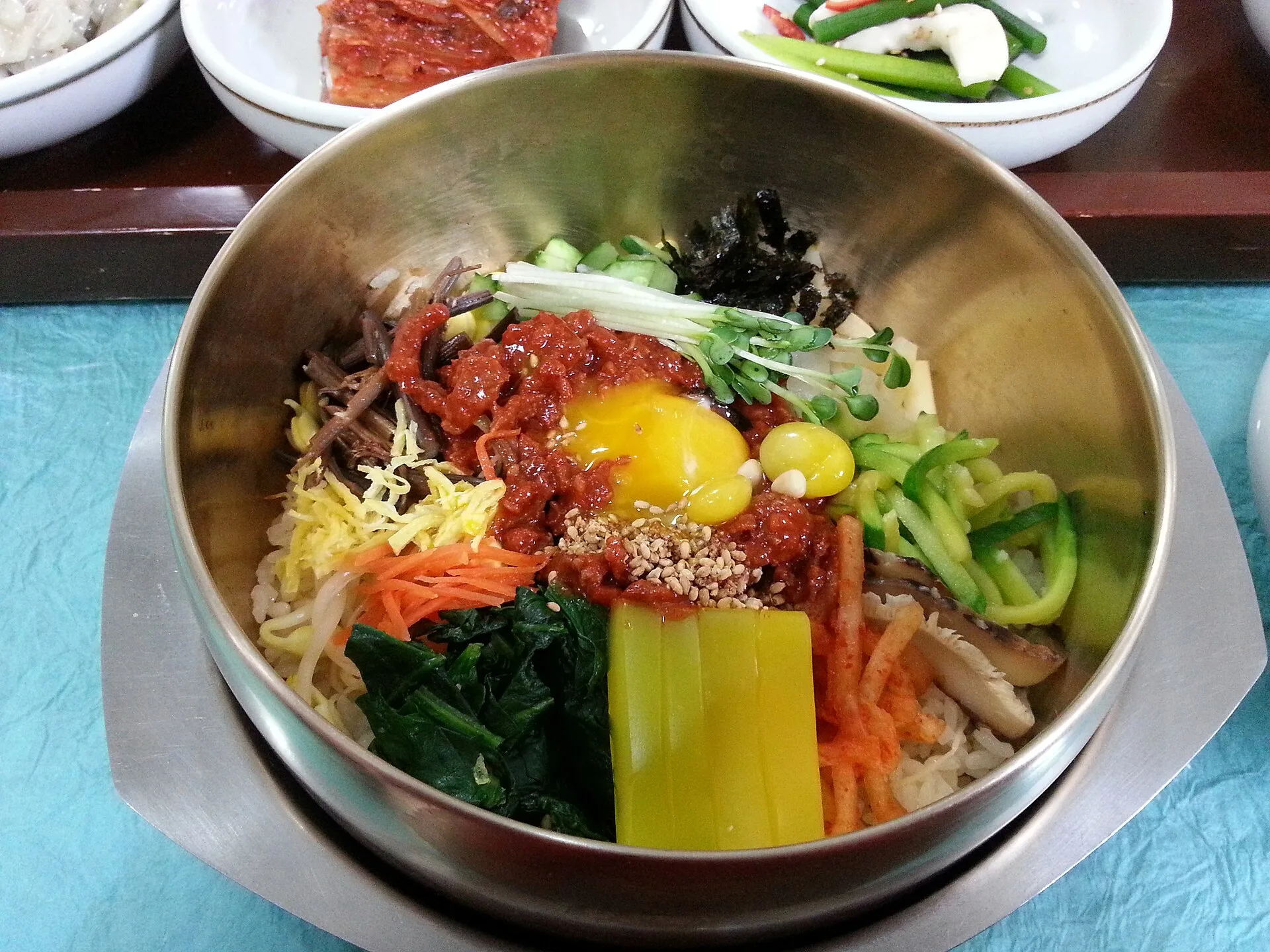
Jeonju bibimbap: broth-cooked rice, bean sprouts, yellow jelly and a brass bowl
Jeonju bibimbap was designated a provincial intangible heritage item, as a traditional food, on 6 October 2008. The Encyclopedia of Korean Culture’s 2022 entry describes the recipe: rice cooked in beef-bone broth until fluffy, served in a brass (yugi) bowl, with the cooked vegetables arranged by colour, yukhoe (seasoned raw beef) in the centre and pine nuts, chestnuts, ginkgo, walnuts and fried kelp as garnish. Some versions use gochujang stir-fried with beef instead of yukhoe, or just a raw egg yolk instead of egg strips; VisitKorea says the egg white is usually cooked and sliced while the yolk is left raw, or a fried egg is used instead.
There is no single correct recipe, starting with the rice. The sources variously describe beef-bone broth (the 2022 encyclopedia entry and Jeonju city), brisket stock (the encyclopedia’s 1995 entry) and either ox-bone broth or a bean-sprout broth (VisitKorea). The folk museum says Jeonju restaurants each developed their own recipes in the 1960s, bone-broth rice being one restaurant’s method, and that the dish is very hard to pin to one recipe.
What the versions share is local produce. The folk museum points to bean sprouts grown from small black soybeans and mung bean jelly. The yellow version, hwangpomuk, is mung bean jelly coloured with gardenia, and VisitKorea calls it the ingredient that sets Jeonju bibimbap apart from other regions’ versions. According to the 1995 encyclopedia entry, the ingredient list runs to about thirty, the main ones being rice, bean sprouts, hwangpomuk, gochujang, raw or stir-fried beef, soy sauce, sesame oil and egg, and Jeonju bibimbap always comes with bean sprout soup.
The folk museum says that under Japanese rule it was a simple meal around Jeonju’s Nambu Market, nicknamed “baengbaengdori bibimbap” because it was mixed by whirling spoons round and round, and that in the early 1950s a restaurant dressed it up with better greens and raw beef. Once known as bean sprout bibimbap, it took the name Jeonju bibimbap after Seoul department stores presented it as a Jeonju speciality at regional food fairs in the 1970s. Theories about its origin, from palace food to ancestral-rite food, cannot be settled, according to the 2022 encyclopedia entry.
The city is known for food in its own right: UNESCO has listed Jeonju in its Creative Cities Network for gastronomy since 2012. That recognises the city, not the dish. Jeonju also holds a bibimbap festival each year; the 2026 edition ran from 2 to 4 October around Deokjin Park. It began in 2007 and its dates can change from year to year; the sources we checked do not yet give 2027 dates.
The thing to know when ordering is the raw element. The centre may hold raw beef or a raw yolk, so if you do not eat raw food, ask what goes on top before you order.
Dolsot bibimbap: what a hot stone pot changes
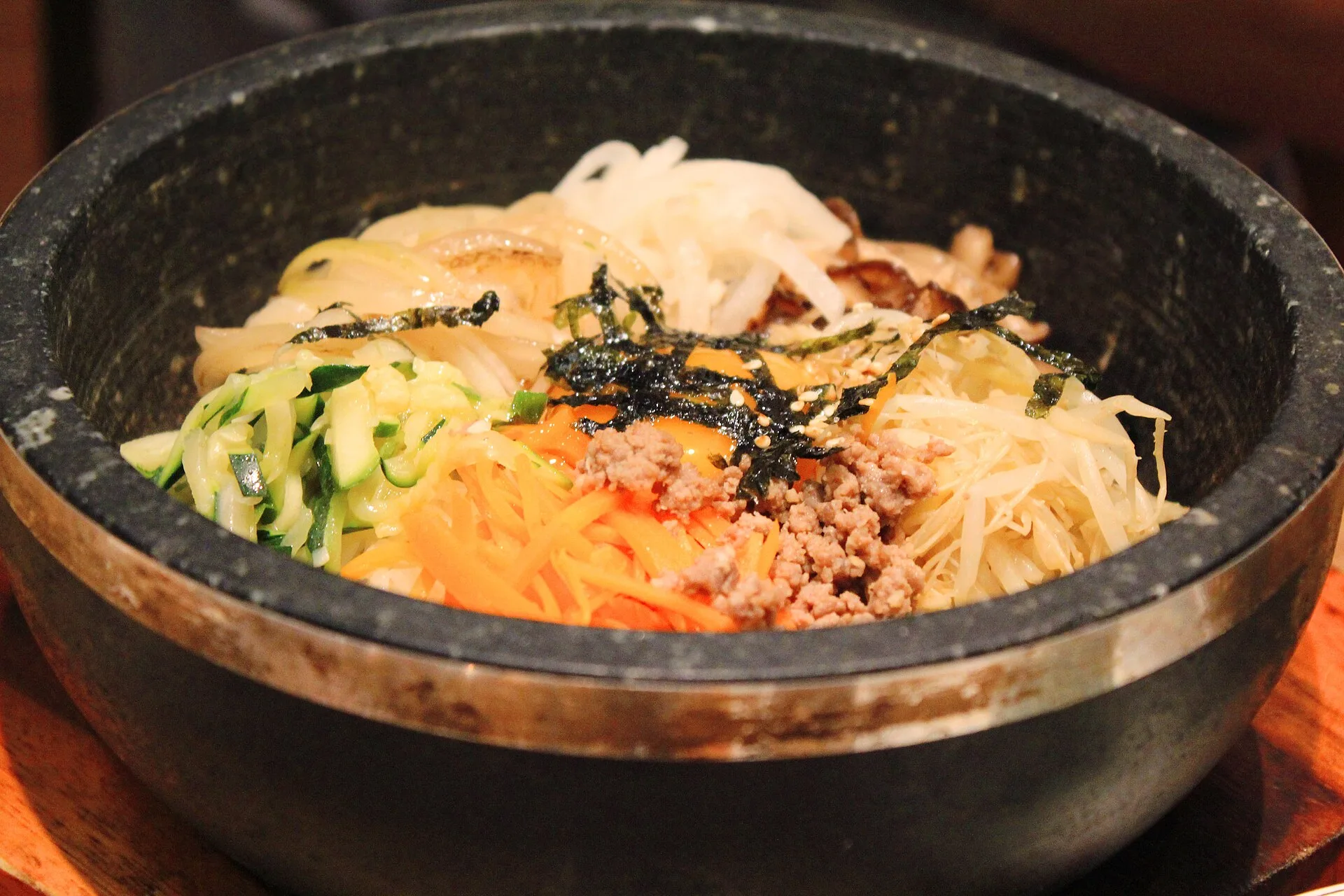
Dolsot bibimbap is defined by its bowl, the dolsot, or stone pot. The folk museum explains that most are made of gopdol, a talc-like stone, which holds and spreads heat well, so rice cooked in it does not burn easily and stays warm for a long time.
The Korean Food Promotion Institute’s recipe puts sesame oil in the pot, adds cooked rice and toppings including stir-fried beef and a fried egg, heats the pot for about five minutes and serves it with a gochujang sauce. Its English notes say the greased pot keeps its heat until you finish and adds a crispy texture to the rice. VisitKorea’s food glossary describes rice cooked in an agalmatolite stone pot and topped with vegetables, stir-fried minced beef, an egg yolk and red chili paste, says it has a richer flavour and stays hot longer than ordinary bibimbap, and notes that it often comes with bean sprout soup. We found no official Korean-language source that treats a crust of scorched rice as a defining feature, so do not count on one.
The folk museum traces it to Jeonju. Its entry on stone-pot rice says a bibimbap restaurant in Jeonju first developed dolsot bibimbap and, after several failures, succeeded in making a gopdol bowl in 1969, registering “Jeonju gopdol bibimbap” as a trademark. Entries in the same encyclopedia disagree on when it reached Seoul, giving the early 1970s and 1981. Today, the museum says, you are more likely to come across a dolsot in a restaurant than at home.
For a first-timer, the appeal is a bowl that stays hot to the last spoonful. Made the institute’s way, with cooked beef and a fried egg, it has no raw meat or raw egg, but some places add an egg yolk, as in VisitKorea’s description, so say so if you would rather not have one. The pot is heated before it reaches you, so keep your hands off it; that last tip is ours, not an official one.
Yukhoe bibimbap: bibimbap topped with raw beef
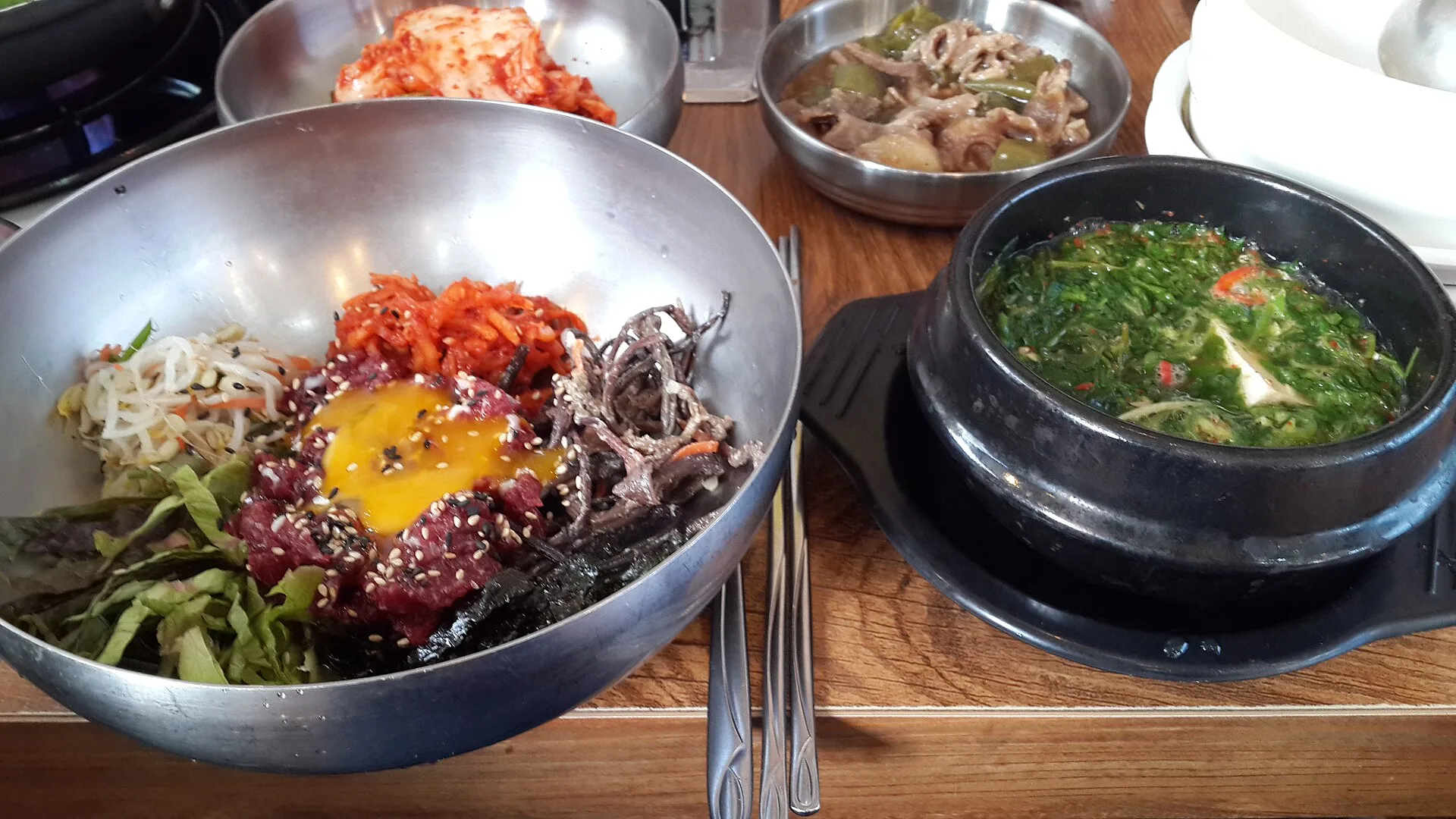
Yukhoe, in the Encyclopedia of Korean Culture’s words, is lean beef sliced thin and dressed raw with seasoning. The folk museum’s English entry adds that liver, omasum and other cuts are sometimes used, and that as yukhoe became common, preparations multiplied: marinated in gochujang or soy sauce, served with pear juice or sliced pear, or coated with egg yolk. The official English menu name for 육회비빔밥 is “Beef Tartare Bibimbap”.
In the Korean Food Promotion Institute’s recipe, julienned, marinated raw beef and seasonal vegetables go on the rice, with the beef in the centre over julienned pear and sliced garlic and an egg yolk on top; you add soy-sauce or gochujang seasoning to taste, and it is sometimes served hot in a stone pot or brass bowl. VisitKorea contrasts ordinary bibimbap, made with cooked beef, with the yukhoe version, topped with raw beef seasoned with red chili paste, garlic and sesame oil. Its glossary adds an egg yolk, crushed laver and sesame salt, all mixed with sesame oil and seasoned chili paste.
The dish grew up with cattle markets. The folk museum says freer slaughter and new public cattle markets in the early 1900s made fresh beef easier to get, and that yukhoe and dishes such as yukhoe bibimbap developed around those markets; from the 1920s, restaurants began serving bibimbap with raw beef to set it apart from the home-style dish. The classic example is Jinju bibimbap from South Gyeongsang province: namul, raw beef and a broth of minced clams, mixed with gochujang and served in a brass bowl. The story that it began during the battles at Jinju Fortress survives only by word of mouth. Jeonju bibimbap can carry raw beef too, so the two overlap.
Choose it knowing that you are eating raw meat. When Korea’s Ministry of Food and Drug Safety inspected businesses handling raw beef and offal in March 2026, it cited the rise in food poisoning as temperatures climb; its April results reported food-poisoning bacteria in some of the raw-meat products tested, and those products were ordered destroyed. The inspection covered every producer of raw-consumption meat and businesses that had failed tests in 2025, for example for food-poisoning bacteria, so the results are not a market-wide rate. The minister advised consumers buying yukhoe to check its colour and condition, storage temperature and packaging, to eat it as soon as possible after buying, and said that elderly or frail people and children in particular need to take care.
When you order: menu names, spice, raw ingredients and vegetarian requests
For menu names, the reference is the Korean Food Promotion Institute’s guide to foreign-language names for 800 Korean dishes, credited to the agriculture and culture ministries, the National Institute of Korean Language, the Korea Tourism Organization, the Rural Development Administration and the institute itself. Bibimbap stays “Bibimbap”; 전주비빔밥 is “Jeonju Bibimbap”, 돌솥비빔밥 “Hot Stone Pot Bibimbap”, 육회비빔밥 “Beef Tartare Bibimbap” and 산채비빔밥 “Wild Vegetable Bibimbap”. Look for those English names, or the Korean, on a menu.
You can control the heat. Gochujang is a red chili pepper paste. The Encyclopedia of Korean Culture says stir-fried gochujang is served in a separate dish so each diner can adjust the spice, and the institute’s recipe says a soy-sauce seasoning can be used instead of gochujang. If the paste is already on top, mix in a little at a time rather than all at once.
Vegetarians need to ask. VisitKorea notes that most bibimbap menus include meat and eggs, so ask for them to be left out when you order; it also warns that Korean food is often made with meat or fish broth and points to temple food, which uses no meat at all. Of the three dishes here, yukhoe bibimbap is built around raw beef, so leaving it out makes a different dish.
Prices vary by restaurant. On the Korea Consumer Agency’s dine-out price page (September 2026, provisional figures), an ordinary portion of bibimbap is listed at 12,000 won in Seoul and 12,100 won in Jeonbuk (formerly North Jeolla Province), the province that includes Jeonju. Those are figures for bibimbap in general, not for these three styles, and the agency itself warns that comparing regions may not be meaningful. This is a research guide rather than a tasting, so we make no claims about which tastes best.
Related on Rank Three: for another everyday rice dish, Three ways to order gimbap: regular rolls, mini rolls and Chungmu; for the side dish on every table, Buying one tub of kimchi: baechu, kkakdugi or geotjeori?; and if you plan a night in Jeonju, Bukchon vs Jeonju vs Gyeongju: where to try a hanok stay in Korea?.
Our three picks
- Jeonju bibimbap: broth-cooked rice, bean sprouts, yellow jelly and a brass bowlJeonju bibimbap
If you want to see bibimbap in its full colourful form: rice often cooked in beef broth (recipes vary), Jeonju bean sprouts, yellow mung bean jelly, a brass bowl and bean sprout soup. The centre may hold raw beef or a raw egg yolk, so ask before ordering if you avoid raw food.
- Dolsot bibimbap: what a hot stone pot changesDolsot bibimbap
For a first order, or if raw food worries you: the heated stone pot keeps it hot to the end, and the Korean Food Promotion Institute’s recipe tops it with cooked beef and a fried egg. Some places add a raw yolk, so say if you would rather not.
- Yukhoe bibimbap: bibimbap topped with raw beefYukhoe bibimbap
If you enjoy raw beef and want a meat-led bowl: seasoned raw beef with egg yolk and pear (as in the KFPI recipe); Jinju bibimbap is the classic regional version. The food-safety ministry asks elderly or frail people and children in particular to take care with raw meat.
Side by side
| What to check | Jeonju bibimbap | Dolsot bibimbap | Yukhoe bibimbap |
|---|---|---|---|
| Official English menu name | Jeonju Bibimbap | Hot Stone Pot Bibimbap (Dolsotbibimbap) | Beef Tartare Bibimbap (Yukhoebibimbap) |
| Defined by | A place (Jeonju) and its recipe and produce | The bowl (a heated stone pot) | The topping (seasoned raw beef) |
| Rice | Often described as cooked in beef-bone broth, but sources and restaurants differ | Cooked rice in an oiled stone pot, then heated (KFPI) | Plain cooked rice (KFPI recipe) |
| Beef | Raw beef in the centre, or gochujang stir-fried with beef | Stir-fried beef (KFPI, VisitKorea) | Seasoned raw beef over pear and garlic (KFPI) |
| Egg | Egg strips or a raw yolk | Fried egg (KFPI) or a yolk (VisitKorea) | Raw egg yolk |
| Stand-out ingredients | Yellow mung bean jelly (hwangpomuk), Jeonju bean sprouts, pine nut, chestnut and ginkgo garnish | A stone pot that keeps it hot to the end | Raw beef, pear, crushed laver and sesame salt (VisitKorea) |
| Bowl | Brass (yugi) | Stone pot, usually gopdol | Ordinary bowl; sometimes a stone pot or brass bowl |
| Served with | Bean sprout soup (always, per the 1995 encyclopedia entry) | Often bean sprout soup (VisitKorea) | Not stated in general sources; Jinju bibimbap comes with a hearty beef soup (Encyclopedia of Korean Culture) |
| Raw ingredients | May include raw beef and a raw yolk | No raw meat or raw egg in the KFPI recipe; some places add a yolk | Raw beef is the point; MFDS urges care for the elderly or frail and children |
| Good for (our view) | Seeing the traditional spread and many namul | A hot bowl and first-timers wary of raw food | Fans of yukhoe |
So, which should you order?
For a first bibimbap, we would start with dolsot bibimbap: it stays hot to the end, and made the institute’s way, with cooked beef and a fried egg, it has no raw meat or raw egg. If raw food does not bother you and you want to see what bibimbap can be, order Jeonju bibimbap, with its yellow jelly, bean sprouts, brass bowl and bean sprout soup, especially if you are in Jeonju. If you love yukhoe, yukhoe bibimbap is the answer; just order it knowing that the beef is raw. The three overlap, so check the English name and photo on the menu, add gochujang a little at a time, and if you are vegetarian, ask for the meat and eggs to be left out and check whether the rice or soup is made with meat broth.


