Kimchi jjigae, doenjang jjigae and sundubu jjigae are three stews you will often meet on Korean restaurant menus. All three are boiled in an earthenware pot or a small saucepan and eaten with rice, but they are built on different things, carry different amounts of chili and use different meats and stocks. This guide compares them for first-time visitors and anyone new to Korean food. It is a research piece, not a tasting: the facts come from the Korean Food Promotion Institute’s menu-name guide and its recipe collection (called the standard recipes here), the Standard Korean Language Dictionary, the Academy of Korean Studies’ Encyclopedia of Korean Culture, the National Folk Museum’s Encyclopedia of Korean Folk Culture, the Ministry of Food and Drug Safety’s food nutrient database, the Korea Consumer Agency’s price portal and VisitKorea, all checked on 27 October 2026 (US Central time; the morning of 28 October in Korea). No restaurant is recommended, and the three stews are not ranked.
What jjigae is, and how it arrives at the table
The Standard Korean Language Dictionary defines jjigae as a side dish boiled in a ttukbaegi (an earthenware pot) or a small saucepan with only a little broth, holding meat, vegetables or tofu and seasoned with soy sauce, doenjang, gochujang or salted-seafood brine. The Encyclopedia of Korean Culture draws the line by broth: boiled dishes with a lot of broth are tang or guk, and those with somewhat less are jjigae. The National Folk Museum’s Encyclopedia of Korean Folk Culture adds that jjigae has less broth and more solids than guk and tends to be more strongly seasoned, but that the boundaries between guk, tang and jjigae are not strict.
A jjigae is part of a rice meal rather than a dish on its own. The Encyclopedia of Korean Culture says jjigae always appears on a table built around grain dishes such as rice, and gives one reason Koreans like it: plain, unseasoned rice is easier to eat with a jjigae on the side. At the Joseon court it was called jochi, divided into clear jochi and soybean-paste jochi, and, the encyclopedia says, both were always served on the king’s table.
The pot is usually the same too. All three are commonly cooked in, or served in, a ttukbaegi. According to the Folk Museum’s encyclopedia, a ttukbaegi holds its heat, so the food stays hot until you finish, and it can go straight onto a flame without cracking. It may reach your table still bubbling, so do not grab it with bare hands.
The Korean Food Promotion Institute’s English recipe text names kimchi jjigae, along with doenjang jjigae, as one of the most common dishes in a Korean set meal (its wording is “Korean table d’hote”). VisitKorea describes the basic baekban table as rice, soup, kimchi and various side dishes, called banchan, and baekbanjip as ordinary restaurants serving rice with side dishes. VisitKorea adds that there is no need to tip in Korean restaurants and that asking for more water or side dishes costs nothing extra; more and more places now have self-service stations for water and side dishes, or ordering kiosks.
Of the three, only kimchi jjigae appears in the official dining-out price survey. The Korea Consumer Agency’s price portal publishes figures from the Ministry of the Interior and Safety for eight dining-out items, one of which is the kimchi-jjigae baekban (one regular serving). Seoul’s average was ₩8,846 in September 2026, against ₩8,577 in October 2025. Doenjang jjigae and sundubu jjigae are not surveyed. The portal calls the figures provisional and warns that comparing regions, or different months, may not be appropriate, because the surveyed restaurants and the quality of what they serve differ. Remember that this is the price of a set meal with rice and side dishes, not of the stew alone.
Kimchi jjigae: well-fermented kimchi and pork
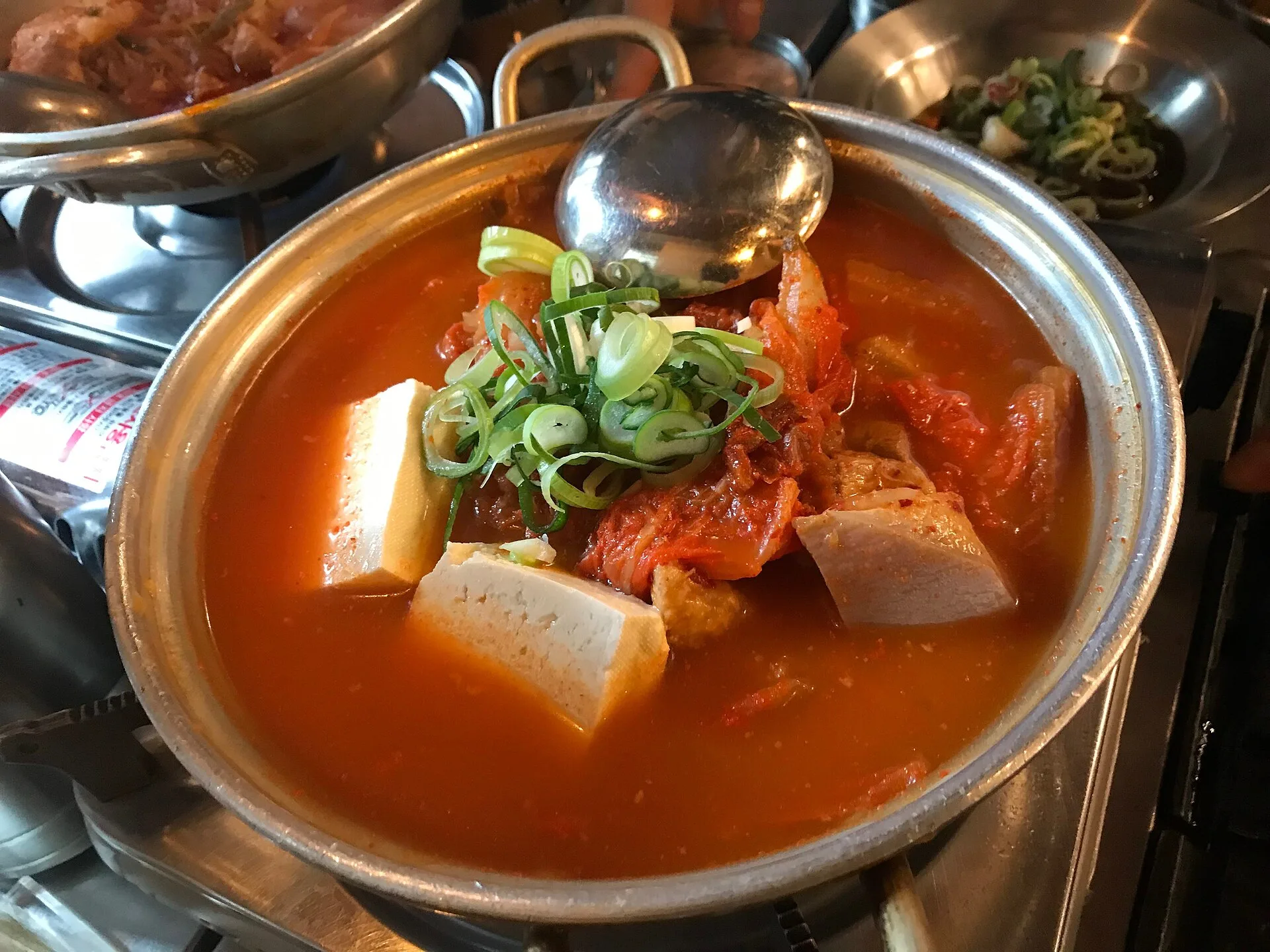
The institute’s menu-name guide writes 김치찌개 as Kimchijjigae, in English Kimchi Stew. It also lists names with the main ingredient put in front: Pork and Kimchi Stew (돼지고기김치찌개), Tuna and Kimchi Stew (참치김치찌개) or Saury and Kimchi Stew (꽁치김치찌개). The Folk Museum’s encyclopedia defines kimchi jjigae as sour napa-cabbage kimchi boiled with pork, tofu and the like, and says that today it generally uses sour napa-cabbage kimchi and contains pork.
The institute’s standard recipe for four uses 500 g of napa-cabbage kimchi, 200 g of pork belly (or 400 g of pork ribs), cooking oil, four cups of water, a 300 g block of tofu, scallions, two tablespoons of soup soy sauce, a tablespoon of sugar and some salt. The pork is stir-fried, the kimchi goes in and is stir-fried too, then water is added and the stew simmers for about 20 minutes before the tofu and scallions go in for about 10 more. A tip notes that anchovy broth is sometimes used instead of pork or beef. The Folk Museum adds that mushrooms can replace the meat, and that canned tuna, which most households keep, can go in too.
In the standard recipe, the heat comes from the kimchi. That recipe adds no chili powder or gochujang of its own, but the napa-cabbage kimchi it is built on is made with red chili powder. The institute’s English text calls kimchi jjigae a spicy stew of well-fermented, matured kimchi, and the Folk Museum speaks of sour kimchi, so expect sourness on top of the heat.
There is no firm origin story. The Encyclopedia of Korean Culture says the court called it kimchi jochi, and that it is “thought to” have begun as a way to use kimchi that was left over or had turned sour, or for days when people did not want to eat their winter kimchi raw; it only conjectures that the dish appeared after Koreans began making kimchi with chili. The Folk Museum describes kimchi jjigae as a dish eaten at home with family and at restaurants with friends or coworkers.
For a rough nutrition reference, the Ministry of Food and Drug Safety’s food nutrient database has a restaurant kimchi jjigae row (food code D306-266000000-0001, a laboratory analysis from 2012): a 400 g serving with 61 kcal and 491 mg of sodium per 100 g; the database shows that 491 mg as 24.55% of an adult’s daily reference value. It is an analysis value created in 2012, and real bowls will vary.
Doenjang jjigae: soybean paste and only a little chili
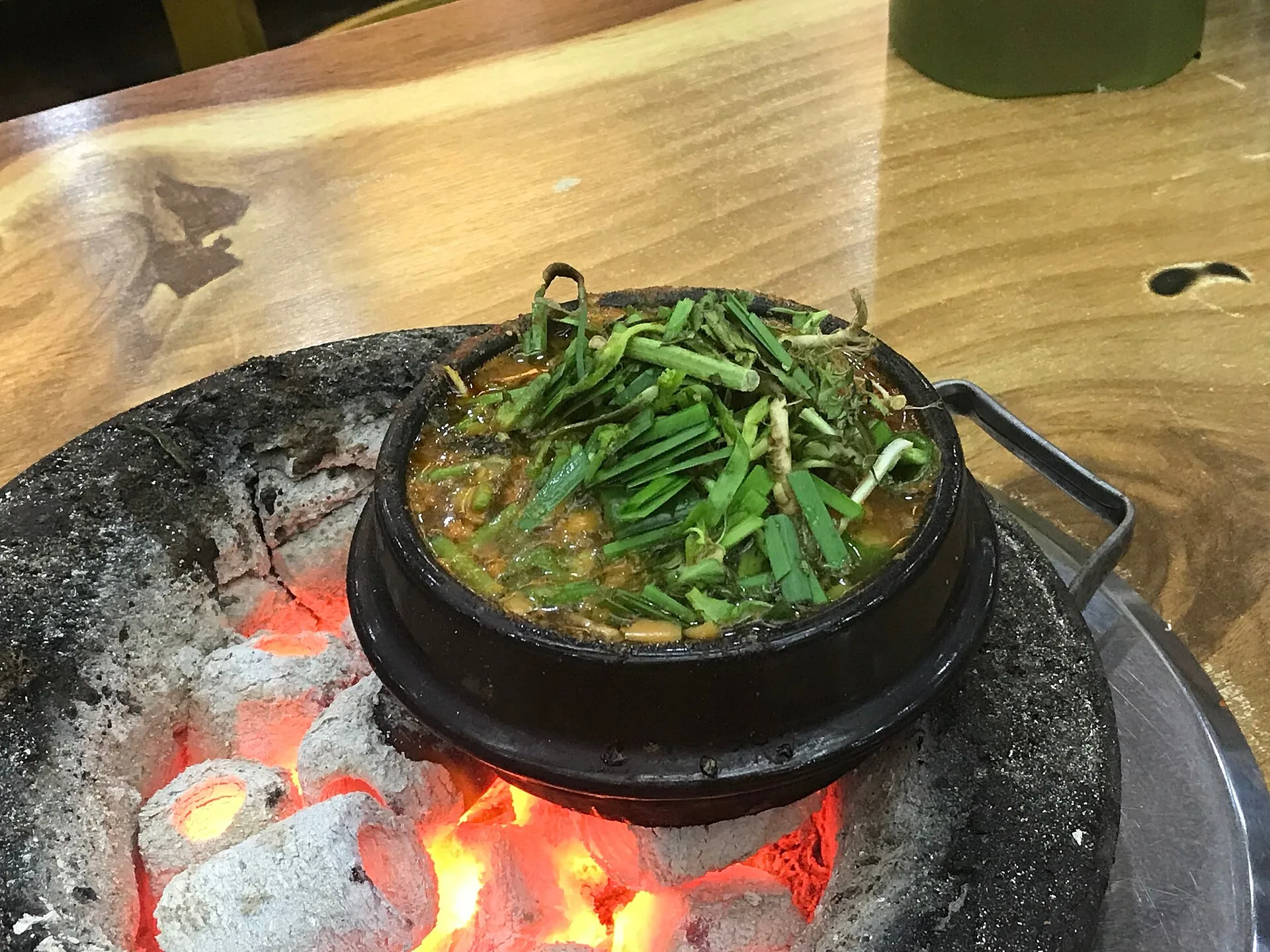
The guide writes 된장찌개 as Doenjangjjigae, in English Soybean Paste Stew. You may also meet Beef Brisket Soybean Paste Stew (차돌된장찌개) or Seafood Soybean Paste Stew (해물된장찌개), while cheonggukjang jjigae, Rich Soybean Paste Stew, is a different dish. The Encyclopedia of Korean Culture describes doenjang jjigae as doenjang boiled with various ingredients, its hallmark being vegetables, tofu, seafood and meat cooked together. Doenjang itself is made by mashing meju, blocks of fermented soybeans, with salt, and the Folk Museum’s English entry notes that grains such as wheat, non-glutinous rice and barley are often mixed into the meju to speed fermentation and add a little sweetness.
Chili is not the point of this stew. The Encyclopedia of Korean Culture says a little gochujang or chili powder is sometimes mixed in with the doenjang, and that the ingredients change with the season: green chilies in summer, mushrooms in autumn, dried radish greens in winter. The institute’s standard recipe for four uses 100 g of beef sirloin, a block of tofu, potato, shiitake mushrooms, onion, four green chilies, minced scallion and garlic and four tablespoons of doenjang, with just one teaspoon of chili powder.
The broth may not be vegetarian even when the bowl looks it. The Folk Museum says a stock is sometimes made in advance with beef, anchovies, clams or dried shrimp to deepen the flavour, and the institute describes tofu and vegetables such as potato and zucchini boiled in beef, dried-anchovy or shellfish broth with doenjang; its tip lists potato, radish, peppers, mushrooms, kimchi and onion as common additions. A version called gang-doenjang jjigae puts the taste of the doenjang itself forward; the Encyclopedia of Korean Culture says it is best served in the small ttukbaegi it was cooked in.
When do Koreans order it? VisitKorea mentions doenjang jjigae or fried rice as the way to finish a Korean barbecue meal. The Folk Museum’s English entry says doenjang jjigae was such an everyday dish that old cookbooks hardly mention it, and that a 1924 cookbook, Joseon Mussang Shinshik Yori Jebeop, told cooks always to use a ttukbaegi for it.
The nutrient database’s home-style doenjang jjigae row (D106-275000000-0001, analysed in 2018) shows a 200 g serving with 46 kcal and 318 mg of sodium per 100 g.
Sundubu jjigae: unpressed tofu, and sometimes an egg
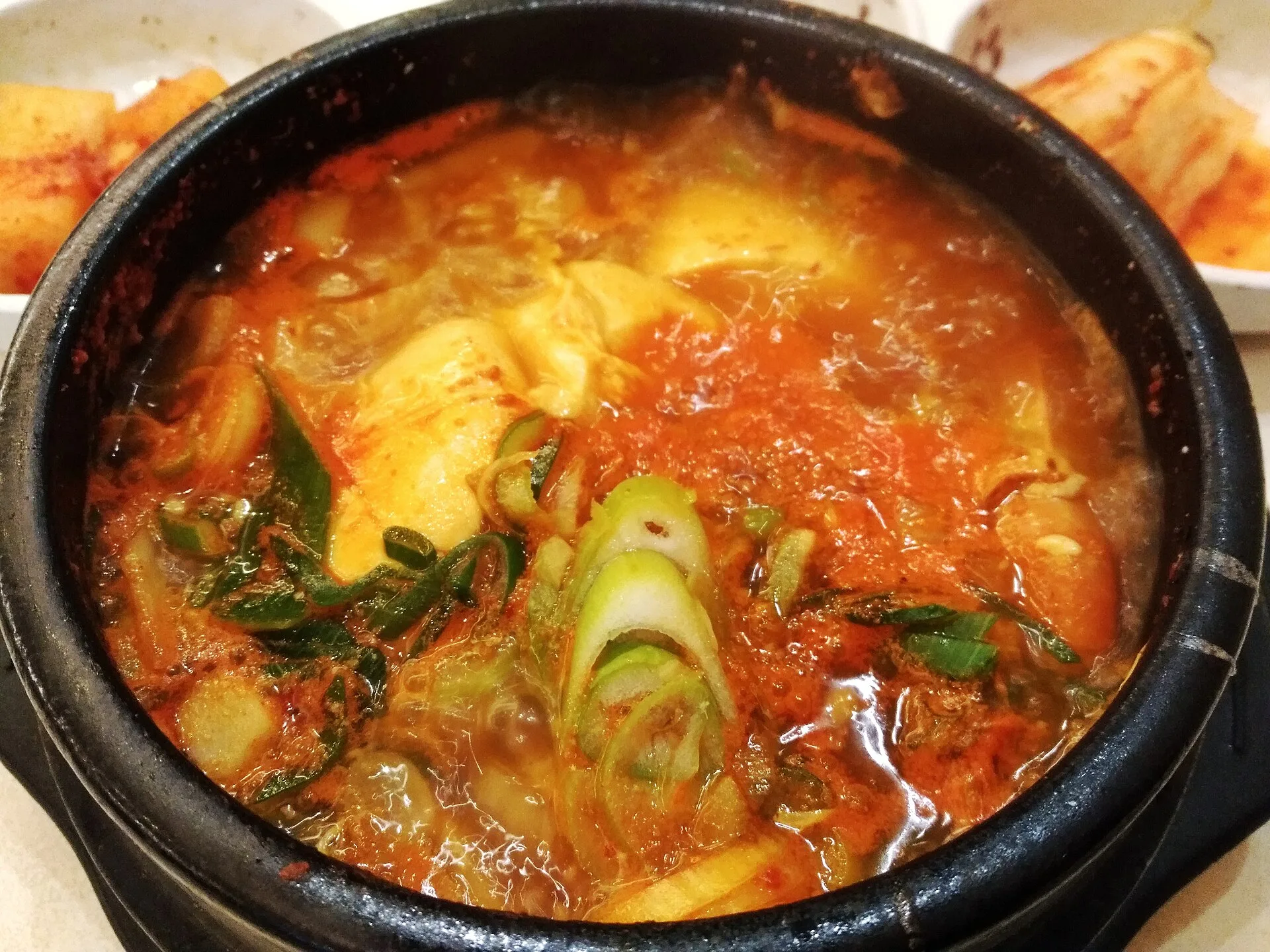
The guide writes 순두부찌개 as Sundubujjigae, in English Soft Bean Curd Stew; the seafood version is Seafood and Soft Bean Curd Stew. Sundubu is tofu left as it is when the soy protein has set, before any pressing, and the Encyclopedia of Korean Culture calls it soft and easy to digest. The institute suggests silken tofu (yeondubu) rather than firm tofu if you cannot find sundubu, which also tells you the two are not the same product.
How hot it is depends on the cook. The Folk Museum says sundubu jjigae was originally seasoned with soy sauce and salt or with salted shrimp, but versions made spicy with chili powder gradually became the mainstream. Ingredients are sometimes stir-fried in chili oil, and versions with chili oil and egg spread through restaurant franchises in place of the milder style. The institute says there are spicy and mild versions, though its own recipe uses a seasoning paste with a tablespoon of chili powder.
The standard recipe for four uses 500 g of sundubu, 100 g of ground pork, oyster mushrooms, water, salt and four eggs, with a paste of chili powder, sesame oil, minced scallion, garlic and soup soy sauce. The finished stew is divided into small individual pots and an egg is cracked into each and cooked until the white sets. The Folk Museum’s English entry describes meat stir-fried in the ttukbaegi first, then stock, sundubu and often clams or other seafood, with an egg “sometimes” cracked into the hot stew, so do not count on the egg. There are many variations, such as kimchi sundubu jjigae or ham-and-cheese sundubu jjigae.
The Folk Museum describes sundubu jjigae, a spicy yet soft stew eaten with rice and banchan, as a good way to experience Korean food, and says that despite expectations that foreigners would find it too hot, it has been widely loved abroad and is especially well known in the United States. Do not confuse it with Chodang sundubu from Gangneung on the east coast: VisitKorea describes that as soft curd made by setting soy milk with seawater and served without pressing out the water.
A search of the nutrient database turns up no plain sundubu jjigae row. The closest home-style row, kimchi sundubu jjigae (D106-291030000-0001, analysed in 2017), shows a 200 g serving with 35 kcal and 151 mg of sodium per 100 g. The three rows quoted in this guide differ in year, recipe and restaurant or home style, so they cannot tell you which stew is the saltiest.
Before you order: vegetarian, allergy and heat checks
If you are vegetarian, assume that none of the three is suitable as served. VisitKorea warns that many traditional Korean stews are made from meat or fish broth and suggests asking for your order to be made with plain water. The same page, last updated in November 2022, says most Korean restaurants have no set procedure for dietary needs and cook to their recipe unless asked, and suggests showing a written note in Korean such as 육류, 달걀, 해산물 등을 먹지 못합니다 (“I cannot eat any meat, eggs, and seafood”). The institute’s recipe for the napa-cabbage kimchi behind kimchi jjigae uses salted shrimp and anchovy sauce, doenjang jjigae stock may be beef, anchovy, clam or dried shrimp, and sundubu jjigae often has pork or clams, and sometimes an egg.
For allergies, assume soy in all three: kimchi jjigae has tofu and soup soy sauce, doenjang jjigae has doenjang and tofu, and sundubu jjigae is built on soft tofu. The meju for doenjang often contains wheat or barley, and the Encyclopedia of Korean Culture describes doenjang jjigae made with mak-gochujang, a barley or wheat gochujang made for stews. Other things to ask about are shrimp and anchovy (in the kimchi’s salted seafood), clams (doenjang and sundubu jjigae), egg (sundubu jjigae), and pork or beef. I found no official allergen guide for restaurant stews, so ask the restaurant directly; if wheat or barley is a concern, ask about the soy sauce, gochujang and other seasonings too, not just the doenjang.
If chili worries you, doenjang jjigae is a gentle place to start. Kimchi jjigae brings the kimchi’s heat and sourness together, and the spicy style of sundubu jjigae, with a chili-powder seasoning or chili oil, is the common one. No official source rates spiciness on a scale, so this comparison goes by what the standard recipes put in.
Related on Rank Three: to buy the kimchi itself, see Buying one tub of kimchi: baechu, kkakdugi or geotjeori?; for an instant spicy broth at home, Three Familiar Korean Ramyun Bags: Shin, Jin, and Samyang; and to compare three Seoul restaurants for another classic soup, Three Seoul Seolleongtang Bowls: Imun, Mapo Ok, and Oegojip.
Our three picks
- Kimchi jjigae: well-fermented kimchi and porkKimchi jjigae
If you want the stew Koreans commonly eat at home and at restaurants. Well-fermented, sour kimchi boiled with pork and tofu gives heat and sourness together. In Seoul the official average for a kimchi-jjigae set meal was ₩8,846 in September 2026 (provisional). Kimchi may contain salted shrimp or anchovy sauce, so take care if you avoid seafood.
- Doenjang jjigae: soybean paste and only a little chiliDoenjang jjigae
If chili worries you. A soybean-paste broth with tofu and vegetables such as potato, zucchini and mushrooms; the standard recipe’s only heat is a teaspoon of chili powder and a few green chilies. It also turns up at the end of Korean barbecue meals. The stock may contain beef, anchovy or clams.
- Sundubu jjigae: unpressed tofu, and sometimes an eggSundubu jjigae
If you like soft textures. Unpressed tofu boiled with pork or clams, sometimes with an egg cracked in. The spicy style is the mainstream today, but mild versions exist. Check for clams, egg and pork.
Side by side
| What to check | Kimchi jjigae | Doenjang jjigae | Sundubu jjigae |
|---|---|---|---|
| English menu name (Korean Food Promotion Institute) | Kimchijjigae / Kimchi Stew | Doenjangjjigae / Soybean Paste Stew | Sundubujjigae / Soft Bean Curd Stew |
| Built on | Well-fermented (sour) napa-cabbage kimchi | Doenjang, a soybean paste made from meju and salt | Sundubu, soft tofu that is never pressed |
| Where the heat comes from (standard recipe) | The chili in the kimchi; no extra chili powder | One teaspoon of chili powder and green chilies | A chili-powder paste (one tablespoon); mild versions exist |
| Typical meat and stock | Pork belly or ribs; tuna or saury versions; anchovy broth instead | Beef; stock of anchovy, clams or dried shrimp | Ground pork; clams and other seafood |
| Other ingredients | Tofu, scallions | Tofu, potato, zucchini, mushrooms, onion, green chili | Oyster mushrooms, scallions, egg |
| Pot and setting | Saucepan or ttukbaegi; common in set meals | Ttukbaegi; also ends barbecue meals | Ttukbaegi or small pot; an egg may be cracked in |
| Official Seoul average price | Kimchi-jjigae set meal ₩8,846 (September 2026, provisional) | Not surveyed | Not surveyed |
| Nutrient database example (per 100 g as shown; not comparable across columns) | Restaurant: 61 kcal, 491 mg sodium (2012 analysis) | Home-style: 46 kcal, 318 mg sodium (2018 analysis) | Home-style kimchi sundubu: 35 kcal, 151 mg sodium (2017 analysis) |
| Vegetarian and allergy flags | Pork; salted shrimp and anchovy sauce in the kimchi; soy | Soy; wheat or barley in meju; meat or seafood stock | Soy; pork; clams; egg |
| Good for | Trying a stew eaten at home and out | Anyone wary of chili | Fans of soft textures |
Where I would start
If I were choosing a first stew in Korea for someone who does not know how much chili they can take, I would pick doenjang jjigae: the standard recipe’s only heat is a teaspoon of chili powder and a few green chilies, and it is built on tofu, potato, mushrooms and onion. If heat and sourness are welcome, I would go for kimchi jjigae; for soft tofu, sundubu jjigae. Whichever you choose, the stock may contain meat or seafood, so ask before you order if you are vegetarian or have allergies.


