Sit down at a Korean barbecue restaurant and the menu is mostly a list of cuts. This guide compares three of them: samgyeopsal, moksal and galbi. All three are grilled at your table and often wrapped in lettuce, but they come from different parts of the animal, one of them can be beef or pork, and only one is usually marinated. This explainer is built from Korea’s official meat-cut standard (Ministry of Food and Drug Safety), the Korean Food Promotion Institute’s official menu translations, the Korea Tourism Organization’s VisitKorea food guides, two national encyclopedias and the Rural Development Administration’s food composition database, all checked on 19 October 2026 (20 October in Korea). It is a research piece, not a tasting report, and it leaves out prices because they vary from restaurant to restaurant.
Reading a Korean BBQ menu: the words around the cut
Korean barbecue menus usually show what animal the meat comes from, which cut it is and how it is seasoned. 돼지 (dwaeji) means pork and 소 (so) means beef. 양념 (yangnyeom) means marinated, usually in a soy or chili-paste sauce, and 생 (saeng), as in 생갈비, marks meat served plain. So 소갈비 is beef ribs and 돼지갈비 is pork ribs, while 생갈비 and 양념갈비 are the plain and marinated versions. Samgyeopsal and moksal normally arrive unmarinated: the Korean Food Promotion Institute, which publishes the official English names for Korean dishes, describes samgyeopsal as grilled without marinade and moksal as seasoned only with salt and pepper.
You usually cook at the table. VisitKorea lists tables with a built-in charcoal grill among the handy features of Korean restaurants, and the National Folk Museum’s encyclopedia explains that when propane gas arrived in the 1970s, most galbi restaurants moved the brazier and grill plate onto the table so that customers grill the meat themselves. The cooked meat goes into a wrap: a lettuce or perilla leaf with garlic, chili and ssamjang. Ssamjang is soybean paste mixed with red chili paste, minced garlic, green onion, sesame seeds and sesame oil; its official English name is “Ssamjang (Red Chili and Soybean Paste)”.
It also pays to read the origin label on the menu or wall. Under Korea’s origin-labelling law, restaurants must state in Korean where the beef and pork they cook and serve come from. The examples in the rules read 삼겹살(돼지고기: 국내산), meaning pork belly from domestic pork, and 소갈비(쇠고기: 국내산 한우), beef ribs from domestic Hanwoo cattle; imported meat names the country, as in 소갈비(쇠고기: 미국산) for US beef. Domestic beef must also say whether it is Hanwoo, dairy cattle (젖소) or other beef cattle (육우). English is optional, so the label may be in Korean only: 국내산 means domestic.
Samgyeopsal: three layers of pork belly
Korea’s official cut standard, issued by the Ministry of Food and Drug Safety for meat sellers’ labels (not restaurant menus), divides pork into seven primal cuts: tenderloin, loin, 목심 (neck), front leg, hind leg, belly (삼겹살) and ribs (갈비). The belly runs below the loin from the fifth or sixth rib back to the hind leg. Its official retail cuts include samgyeopsal itself plus galmaegisal (the diaphragm), deunggalbi (back ribs), tosisal and odolsamgyeop, a belly strip that keeps the rib cartilage. So the back ribs on some menus are, officially, part of the belly rather than the rib primal.
The name means “three-layer flesh”, from the bands of lean and fat you see in a slice; the Encyclopedia of Korean Culture says it used to be called segyeopsal (세겹살). Belly was long boiled for sliced pork or steamed rather than grilled. Restaurants specialising in grilled samgyeopsal seem to have appeared in the late 1970s, portable gas burners helped grilling spread from the mid-1980s by easing the smoke problem of charcoal and coal briquettes, and by the 1997 financial crisis it had become a mass favourite, the encyclopedia says.
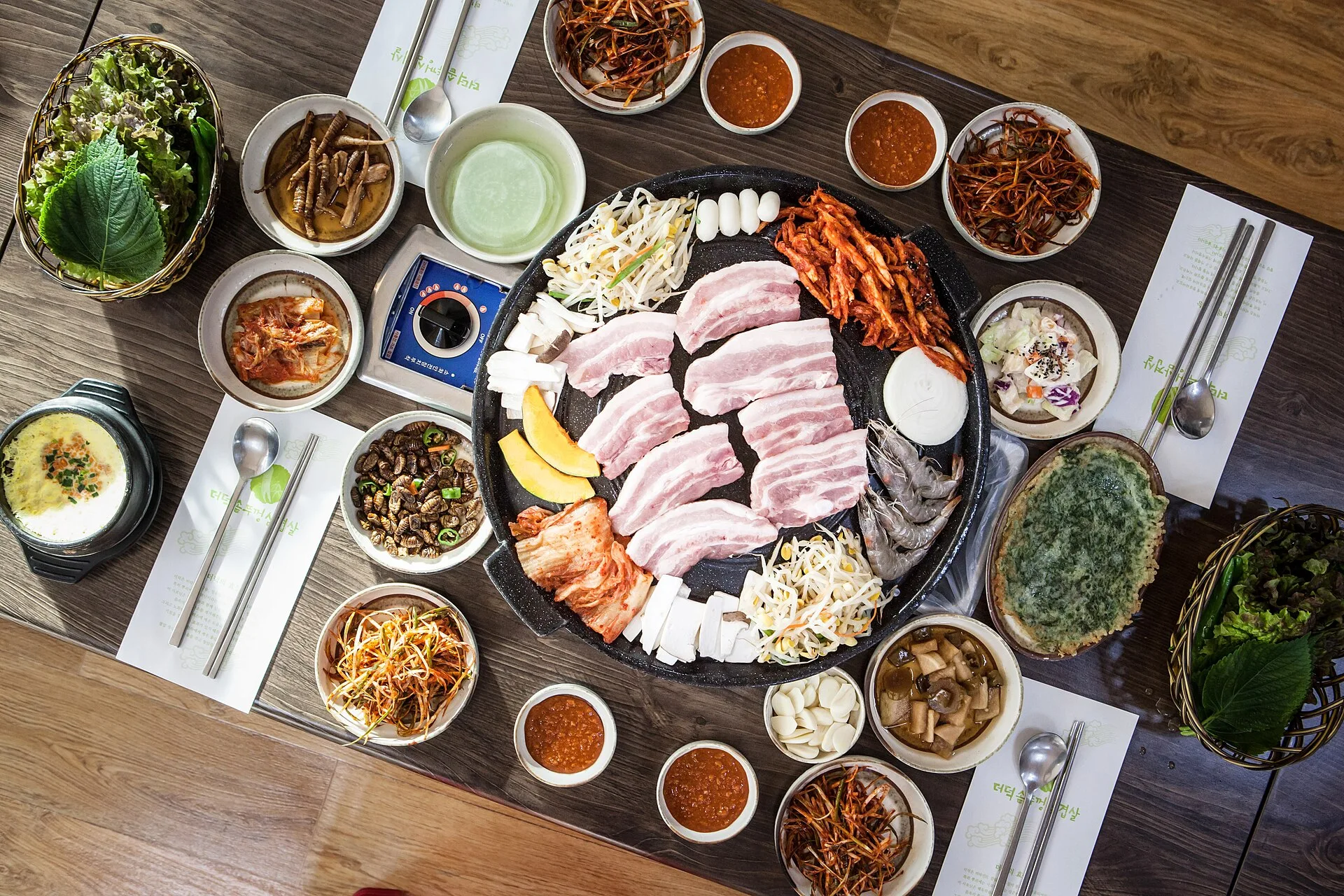
Eating it is simple. The Korean Food Promotion Institute describes samgyeopsal as grilled without marinade, dipped in salt or ssamjang and sometimes wrapped in vegetables; its official English name is “Samgyeopsal (Grilled Pork Belly)”. VisitKorea calls belly fatty and tender, one of Koreans’ favourite pork cuts and a common pick for company dinners, and suggests sesame oil with salt as an alternative dip, with garlic on the side. The National Folk Museum’s encyclopedia describes the classic wrap: grilled belly on lettuce with garlic, hot green chili and ssamjang.
There is even an official grilling tip. The Rural Development Administration’s animal science institute advises cooking samgyeopsal and moksal in a pan heated to about 250 °C and turning the meat as few times as possible so that less juice escapes. The trade-off is fat. In the Rural Development Administration’s food composition database, 100 g of raw pork belly has 372 kcal and 33.31 g of fat, roughly twice the 16.36 g of raw pork neck. That richness is the point of samgyeopsal, but it can feel heavy if you prefer leaner meat.
Moksal: pork neck, leaner and chewier
What menus call moksal appears as 목심 (moksim) in the official cut standard and the food composition database. The standard defines pork moksim as the neck and upper-back muscles from the first neck vertebra to the fourth or fifth thoracic vertebra, with a single retail cut. I could not find an official page that says outright that moksal and moksim are the same cut, but the Rural Development Administration’s pork-grilling guide uses both words for this cut, and the Korean Food Promotion Institute and VisitKorea both call the dish moksal-gui. Beef has a 목심 cut too, but the moksal-gui both bodies describe is pork.
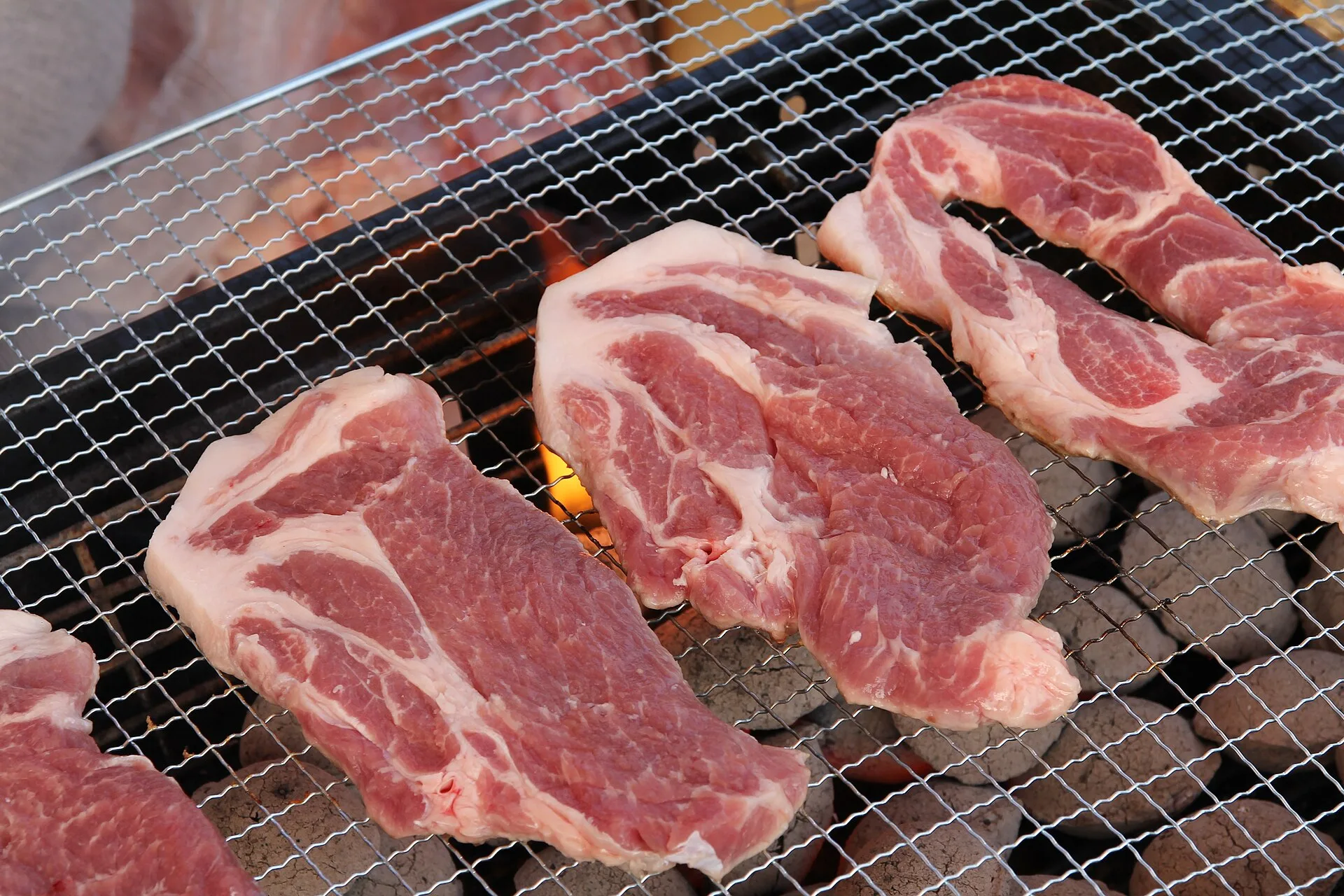
VisitKorea says moksal has less fat than belly but a richer taste, with slightly firmer, chewier meat, and ranks it with belly as the most popular pork cut. It is grilled over charcoal with coarse salt or eaten with sesame oil and salt. The Korean Food Promotion Institute describes moksal-gui as neck meat seasoned with salt and pepper and grilled on a hot plate, and says it goes well with a soybean-paste sauce and vegetables. The database puts raw pork neck at 227 kcal and 16.36 g of fat per 100 g.
Watch the English name. The Korean Food Promotion Institute’s official translation is “Moksalgui (Grilled Pork Neck)”, but VisitKorea’s food guide calls the same dish “Grilled Pork Shoulder”, and uses “pork neck” for hangjeongsal (항정살), a different cut that the official standard places in the front-leg primal, not in moksim. If an English menu says pork neck or pork shoulder, look at the Korean next to it: 목살 is moksal, 항정살 is hangjeongsal.
Moksal suits anyone who wants Korean grilled pork without the full richness of belly. As VisitKorea’s description suggests, it is firmer and chewier, so if you are expecting the fatty tenderness of belly, it may feel different. Grill it the same way as samgyeopsal.
Galbi: beef or pork, marinated or plain
Galbi simply means ribs, and it is the broadest of the three words. In the official standard, the pork rib primal covers ribs one to four or five, sold as galbi, boneless galbisal and maguri. Beef ribs are split by position into bon-galbi (ribs 1–5), kkot-galbi (6–8) and cham-galbi (9–13), plus boneless galbisal, maguri and, for classification purposes, three more cuts: tosisal, anchangsal and jebichuri. The National Folk Museum’s encyclopedia says kkot-galbi is well marbled and suits grilling, while cham-galbi has little meat and mostly goes into galbitang, the rib soup.
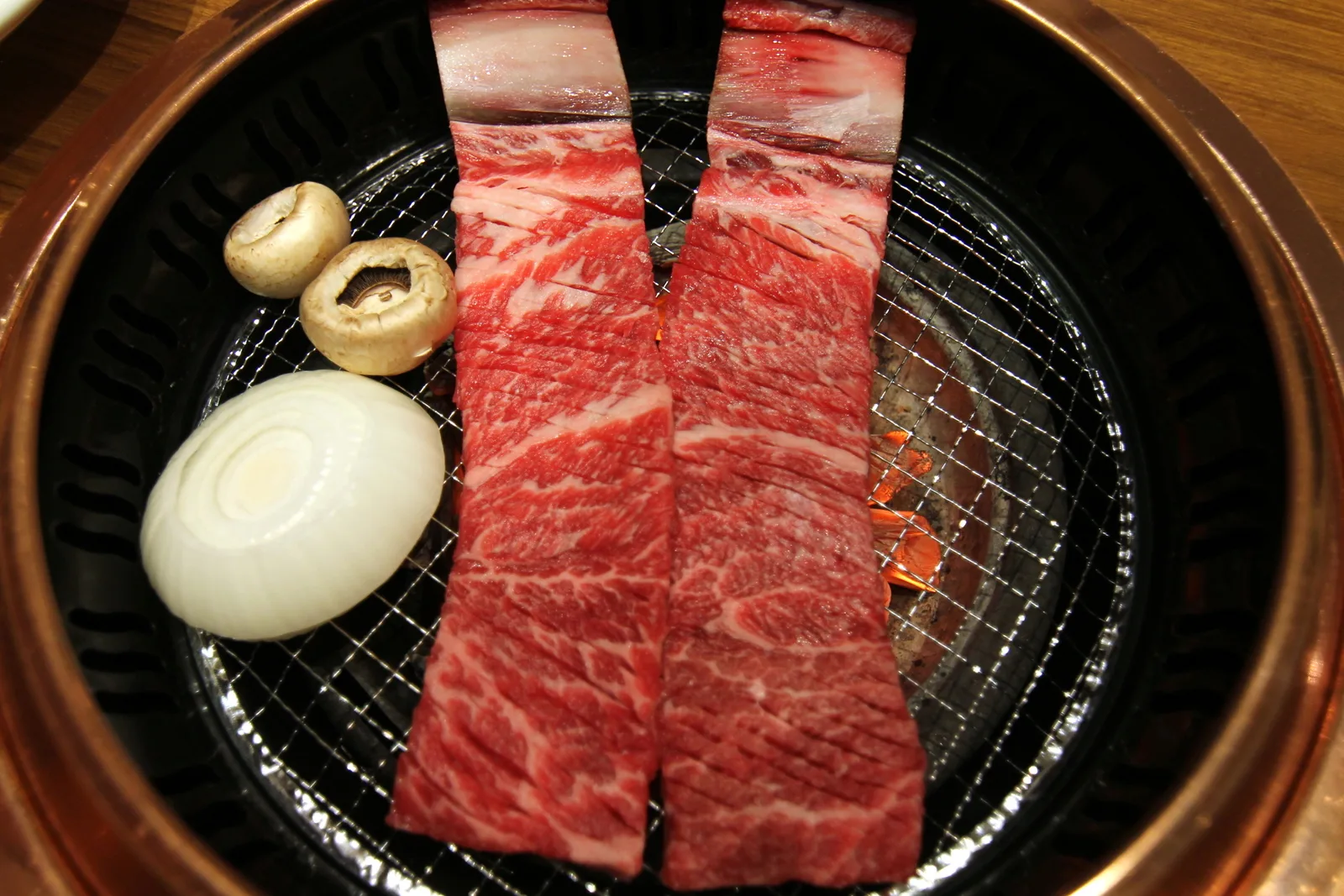
Restaurant galbi is usually marinated. The Korean Food Promotion Institute describes ribs opened out thin, marinated and grilled under two official names: “Sogalbigui (Grilled Beef Ribs)” and “Dwaejigalbigui (Grilled Spareribs)”. Its entries differ on the pork version: one says beef galbi is generally soy-marinated and pork galbi uses red chili paste; another describes pork galbi in a soy-based marinade that chili powder or chili paste can make spicy. VisitKorea also says pork galbi is marinated with soy sauce or red chili paste, so ask if heat matters to you. VisitKorea describes the beef marinade as soy sauce, sugar, garlic and more, balancing sweet and salty, and calls pork galbi more affordable and more tender than beef ribs.
Plain galbi exists too. According to the folk encyclopedia, the big galbi restaurants of the 1980s mostly served marinated galbi, and tastes shifted towards unmarinated saeng-galbi after the 1988 Seoul Olympics. Once grilled, galbi is cut into bite-size pieces and eaten as is or wrapped in lettuce or perilla with garlic or ssamjang, VisitKorea says. You may also see LA galbi, ribs cut across the bone so that small bone pieces sit between the meat; its official English name is “La Galbi (Marinated Grilled Ribs)”. The Encyclopedia of Korean Culture lists several theories for the name; the one it rates most likely is that the cut caught on among early Korean immigrants in Los Angeles and was later introduced in Korea as LA galbi.
Grilled galbi has a long history as eating-out food. The folk encyclopedia says Seoul taverns and popular restaurants were already selling it by the mid-1920s, and that in the mid-1950s restaurants in Mapo, Seoul, began grilling pork galbi on drums once used by the US military. Suwon, south of Seoul, has its own style seasoned with salt instead of soy sauce. The Encyclopedia of Korean Culture traces it to Hwachunok, opened at Yeongdong Market in 1945, which began selling grilled galbi in 1956; the long 10–13 cm rib pieces go into a salt-based marinade with salt and sugar at six to one. VisitKorea says the pieces still run over 10 cm, which is why “wang”, meaning jumbo, is part of the name wanggalbi.
Fat varies by animal and grade. The food composition database gives raw pork ribs 236 kcal and 17.06 g of fat per 100 g of edible meat, close to pork neck, while raw Hanwoo beef ribs range from 24.41 g of fat (grade 2) to 36.93 g (grade 1++). All of these are raw, unmarinated values, from analyses dated 2014 to 2020.
A simple plan for your first table
No official body tells you which cut to order first, so what follows is an editor’s suggestion built on the official descriptions above. If you want to taste the meat itself, start with plain samgyeopsal: switching between salt, ssamjang and leaf wraps is the easiest way into Korean barbecue. If fatty meat is not for you, moksal gives you the same ritual with about half the fat. If you want a sweet-and-salty marinade, or beef, go for galbi, but first check whether the menu says 소 or 돼지, and 양념 or 생.
In a group, ordering samgyeopsal and moksal together is an easy way to compare fat and texture. With beef galbi, the origin label tells you whether it is Hanwoo, other domestic beef or imported, and from which country, which helps you make sense of the menu. VisitKorea also notes that tipping is not expected in Korea and that asking for more water or side dishes costs nothing extra.
Related on Rank Three: for noodles, see Pyongyang vs Hamheung naengmyeon vs Busan milmyeon: which Korean cold noodles to order?; for something to drink, Three ways into Korean drinks: makgeolli, yakju and distilled soju; and for a day in Suwon, the home of Suwon galbi, Suwon Hwaseong vs DMZ tour vs Nami Island: which day trip from Seoul?.
Our three picks
- Samgyeopsal: three layers of pork bellySamgyeopsal
The baseline Korean barbecue: unmarinated belly grilled at the table, dipped in salt or ssamjang and wrapped in lettuce or perilla. Official English name: Samgyeopsal (Grilled Pork Belly). Expect richness: 33.31 g of fat per 100 g raw, about twice pork neck.
- Moksal: pork neck, leaner and chewierMoksal
Seasoned with salt and pepper and grilled the same way, but with about half the fat of belly (16.36 g per 100 g raw) and a firmer, chewier bite. English menus call it pork neck or pork shoulder, so look for 목살 in Korean.
- Galbi: beef or pork, marinated or plainGalbi
Ribs, usually marinated: beef (Grilled Beef Ribs) in a soy-based sauce, pork (Grilled Spareribs) in soy or chili paste. VisitKorea calls pork galbi more affordable and more tender than beef. Check 소 or 돼지, 양념 or 생, and the origin label first.
Side by side
| Item | Samgyeopsal | Moksal | Galbi |
|---|---|---|---|
| Official cut (MFDS standard) | Pork belly: from the 5th or 6th rib back to the hind leg | Pork neck (목심): first neck vertebra to the 4th or 5th thoracic vertebra | Pork ribs 1 to 4 or 5 / beef bon-galbi (1–5), kkot-galbi (6–8), cham-galbi (9–13) |
| Official English menu name | Samgyeopsal (Grilled Pork Belly) | Moksalgui (Grilled Pork Neck) | Sogalbigui (Grilled Beef Ribs), Dwaejigalbigui (Grilled Spareribs) |
| Usual seasoning | None; dip in salt or ssamjang | Salt and pepper; coarse salt or sesame oil with salt | Usually marinated (beef soy-based, pork soy or chili paste); plain saeng-galbi exists |
| Texture (official descriptions) | Three layers of lean and fat; rich and tender | Less fat than belly; firmer and chewier | Meat on the bone; kkot-galbi well marbled; pork galbi more tender than beef |
| Fat per 100 g raw (Rural Development Administration database) | 33.31 g (372 kcal) | 16.36 g (227 kcal) | Pork 17.06 g (236 kcal); Hanwoo beef 24.41–36.93 g by grade |
| How it is eaten | Grilled, then wrapped in lettuce or perilla with garlic, chili and ssamjang | Same as samgyeopsal | Cut into bite-size pieces; eaten as is or wrapped |
| Check on the menu | Origin of the pork (국내산 = domestic) | English names vary (pork neck or shoulder); not the same as 항정살 | 소 or 돼지, 양념 or 생; for beef, Hanwoo, other domestic beef or imported |
| Good for | A first taste of Korean barbecue | People who find fatty meat heavy | A marinade or beef |
What I would order first
For a first Korean barbecue I would order samgyeopsal. Plain grilled pork dipped in salt or ssamjang and wrapped in lettuce or perilla is the basic pattern of the whole meal, and VisitKorea counts belly among Koreans’ favourite pork cuts. If fatty meat is not for you, moksal gives you the same experience with about half the fat. If a marinade or beef appeals, choose galbi, but check whether it is beef or pork, marinated or plain, and where it comes from. Whichever you pick, reading the Korean name and the origin label next to it makes ordering much easier.


