Order fried chicken in Korea and the first choice is the flavour. This guide compares three styles: plain fried (huraideu), yangnyeom with its sweet-spicy glaze, and soy garlic (ganjang). All three start from the same fried chicken, but the sauce, the heat and the way you eat them differ, and a few ordering words such as banban and sunsal make the menu easier. It is built from the Encyclopedia of Korean Culture, the Korea Tourism Organization’s VISITKOREA food guides and columns, the Korean Food Promotion Institute’s official menu translations and magazine, the National Institute of Korean Language’s dictionaries, the Ministry of Food and Drug Safety’s food nutrition database, Korea’s Youth Protection Act and the Daegu Chimac Festival’s official site, all checked on 20 October 2026 (21 October in Korea). It is a research piece, not a tasting report, and it does not rank brands or quote prices.
Reading the menu: huraideu, banban and sunsal
In everyday Korean, chikin (치킨) means fried chicken. The Encyclopedia of Korean Culture defines it as pieces of seasoned chicken fried in oil, and an essay by Dr Jeong Eun-jeong published by the Korean Food Promotion Institute (KFPI) says that in Korea “chikin” simply means fried chicken. The same essay notes that until the 1980s people more often said tongdak, “whole chicken”.
The menu word huraideu (후라이드) is a spelling of “fried”. The Standard Korean Language Dictionary lists the standard form, 프라이드치킨 (peuraideu chikin), as a synonym of dak-twigim, fried chicken, and the National Institute of Korean Language’s Urimalsaem dictionary records 후라이드치킨 but notes that the normative spelling is 프라이드치킨. This guide uses huraideu, as menus do.
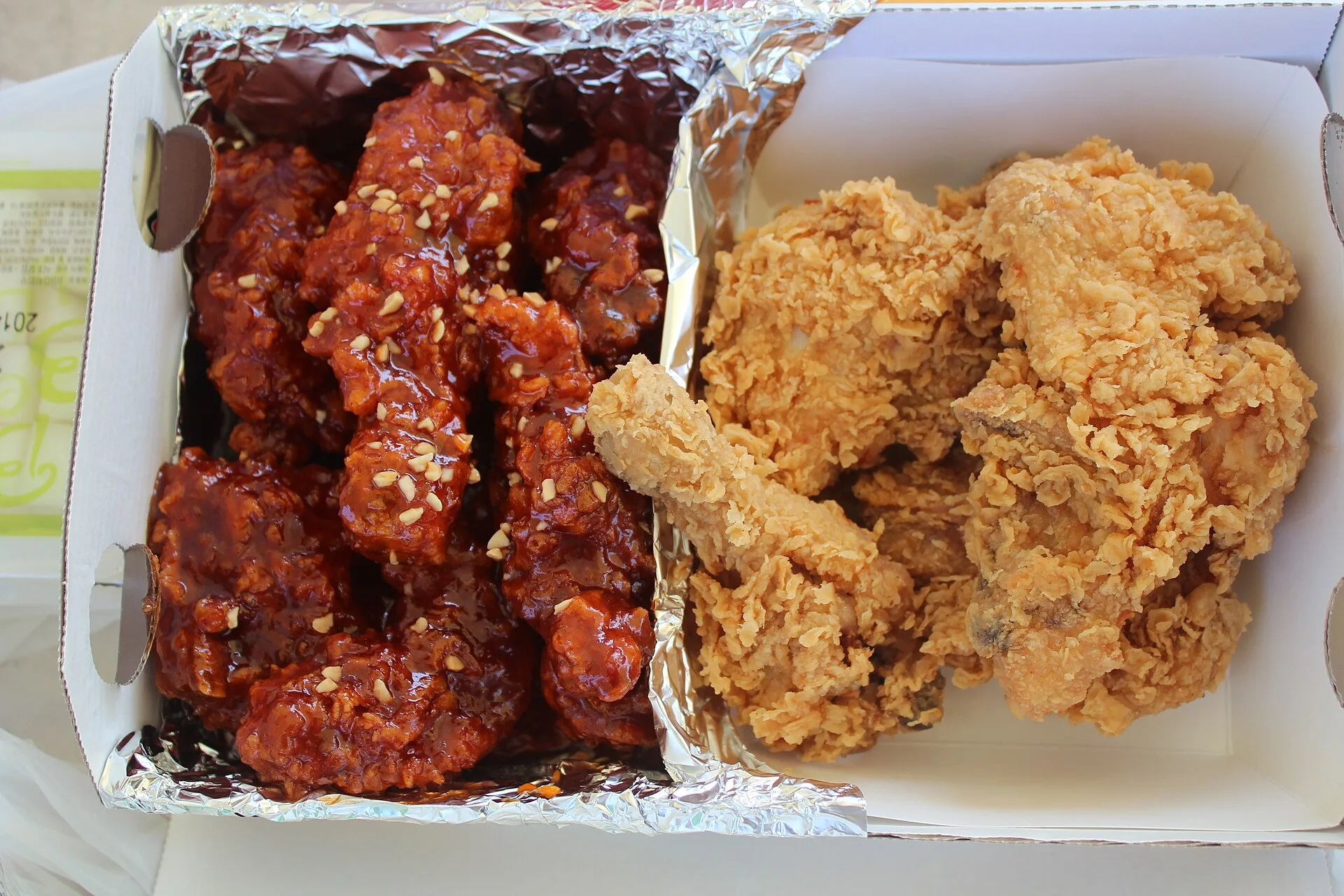
A few ordering words help. Banban (반반, “half and half”) gets you two flavours, half and half, in one order: Urimalsaem defines banban chikin as chicken sold half and half, usually half fried and half yangnyeom, and a column published by the Korea Tourism Organization says the word appeared as yangnyeom chicken spread. Sunsal (순살) means boneless meat, and Urimalsaem also has separate entries for boneless yangnyeom chicken and boneless fried chicken (순살양념치킨, 순살후라이드치킨). According to the KFPI essay, boneless chicken can be eaten with a fork, but chicken still usually comes on the bone and is eaten by hand. Han mari (한 마리) means one whole bird, mari being the counter for animals, and the essay notes that, although more people now eat one alone, a whole chicken is a lot for one person and is best shared.
Two names catch visitors out. Dakhanmari (닭한마리), which KFPI translates as “Whole Chicken Stew”, is a boiled whole-chicken dish, not an order of “one fried chicken”. Dakgangjeong (닭강정), which KFPI translates as “Deep-fried and Braised Chicken”, is also a separate dish from yangnyeom chicken. In fact, KFPI’s official guide to 800 Korean menu names has only one entry for “chikin”, yangnyeom chicken; plain fried and soy chicken have no official KFPI translation.
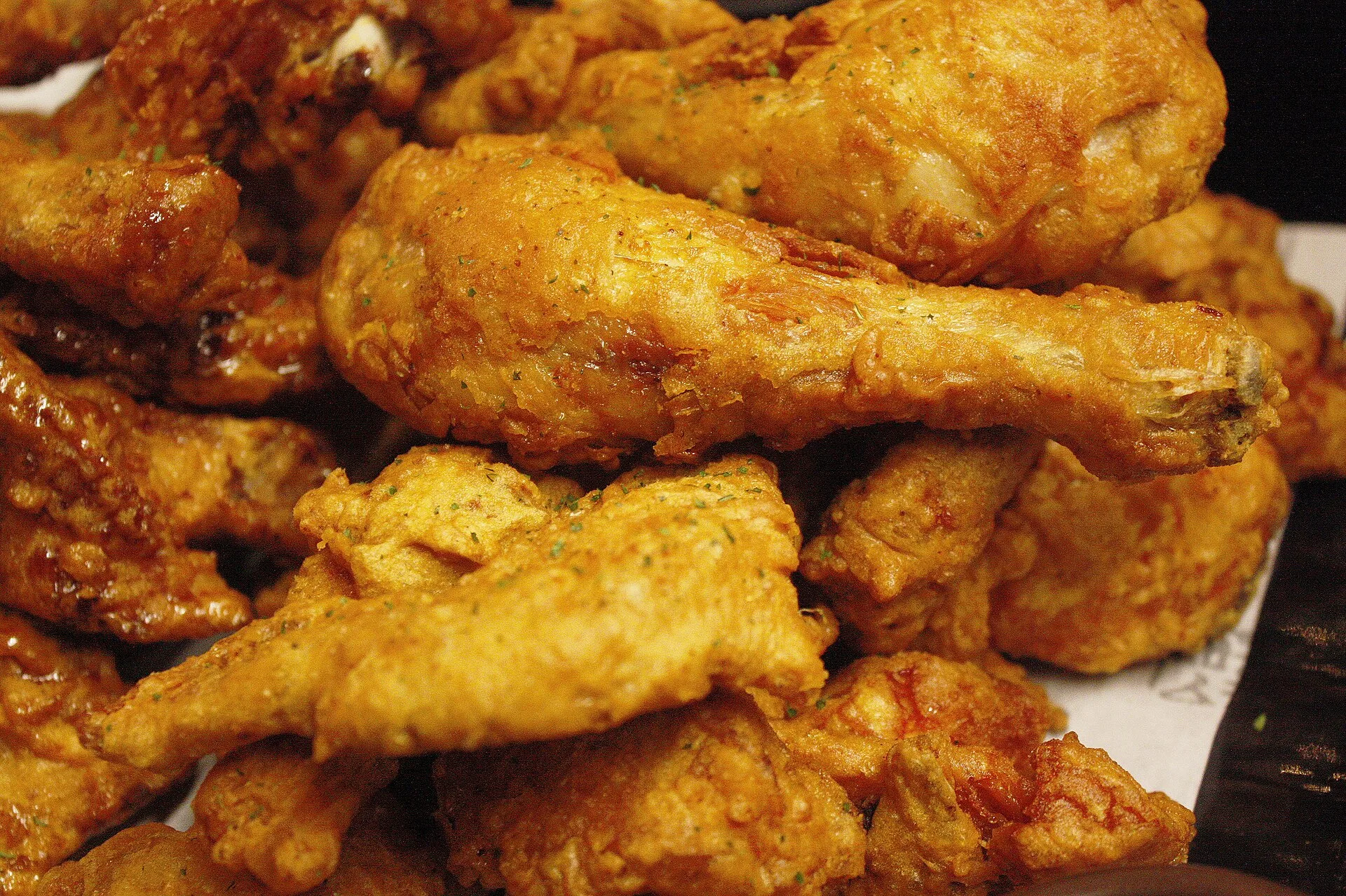
Fried (huraideu): no sauce, just the batter and the brine
Huraideu is the plain style, with no sauce tossed on. The Standard Korean Language Dictionary defines it as chicken coated with flour, mustard powder, salt, pepper and the like and fried in oil. The Encyclopedia of Korean Culture adds what specialist shops do: they cut the chicken, cure it in seasoning (yeomji, 염지), coat it and fry it in a pressure fryer, and it calls the curing step essential. The coating is a starch-based premix seasoned with spices and mixed with water so it fries crisp.
Not all huraideu is alike, and the batter is the difference. The Korea Tourism Organization (VISITKOREA) says the real divide in Korean fried chicken is between thick-battered “crispy” chicken and thinly coated “embo” chicken. Embo chicken is a small whole bird, the size used for samgyetang, lightly coated and fried whole, then cut up and eaten with salt or a sauce on the side. The encyclopedia says the three-step crispy coating (powder, batter, powder) does not go soggy, while smooth wet-batter “minmunui” chicken can turn soggy if it is not eaten straight away.
Chicken in pieces only took hold in the late 1970s. The encyclopedia says electric-rotisserie whole chickens, typified by the Yeongyang Center in Seoul’s Myeongdong, were a big trend from the early 1960s to the mid-1970s. VISITKOREA links the start of whole fried chicken to the launch of soybean cooking oil in 1971, and says Lim’s Chicken, which opened in 1977 in the basement of the Shinsegae department store, started the shift to frying pieces instead of whole birds; the encyclopedia also names Lim’s Chicken, incorporated in 1977, as the start of franchise fried chicken in Korea. Whole fried birds are still sold as “yennal tongdak” (old-style) or “sijang tongdak” (market chicken), the KFPI essay says.
Some guides say Korean fried chicken is double-fried. None of the official sources checked for this guide says so; the encyclopedia points instead to curing, the coating and pressure frying, while VISITKOREA distinguishes styles by the type of batter. As a choice, huraideu shows off the batter and the seasoning, but with no sauce there is nothing to offset the greasiness the KFPI essay mentions; that is the job of the sweet-sour pickled radish on the side, the essay says. In the Ministry of Food and Drug Safety’s food nutrition database, the representative entry for fried chicken (닭튀김) has 301 kcal, 16.57 g of fat, 0.50 g of sugars and 415 mg of sodium per 100 g, the sodium being 20.75% of an adult’s daily reference value.
Yangnyeom: a sweet-spicy glaze built on gochujang
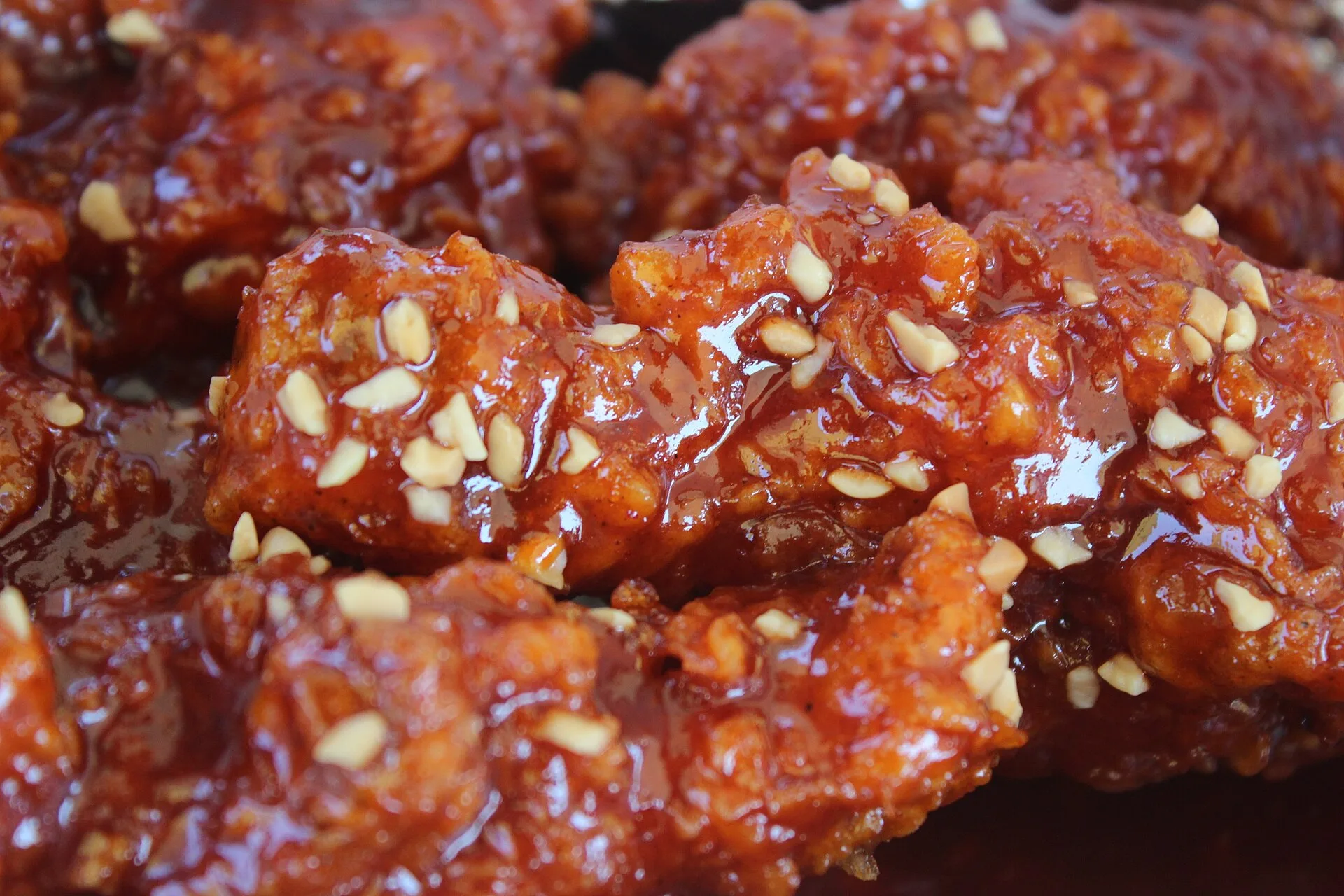
Yangnyeom chicken is fried chicken tossed in a red sauce. The Encyclopedia of Korean Culture describes the sauce as based on gochujang (chili paste), brewed soy sauce and mul-yeot (starch syrup), among others, and Urimalsaem as gochujang, garlic, sugar and the like. KFPI’s official names are “Yangnyeom Chicken” (romanized) and “Seasoned Fried Chicken” (English); it describes seasoned chicken cut into pieces, deep-fried and mixed with soy sauce, gochujang or other sauces, with a “mild yet spicy” taste. These official ingredient lists are only examples (each ends with “and the like” or “other sauces”), so if tomato or ketchup matters to you, ask the shop.
When it began depends on whom you ask. A VISITKOREA feature says Pelicana popularised seasoned fried chicken in 1981; a column published by the Korea Tourism Organization says, with an “it is said”, that Pelicana first offered it after starting in Daejeon in 1982; and the encyclopedia and the KFPI essay date its spread to the mid-1980s. Either way, it is a 1980s taste, and the encyclopedia says it is credited with remaking fried chicken, which can taste greasy, in a Korean way.
Even the official sources disagree about which batter suits the sauce. VISITKOREA says the thick crispy batter is commonly used for yangnyeom and soy chicken because it stays crunchy under a liquid glaze, while the encyclopedia says smooth minmunui chicken is best for yangnyeom because crispy chicken absorbs the sauce poorly. In practice, it varies by shop.
Expect sticky fingers: the KFPI essay notes that yangnyeom sauce ends up on your hands when you eat it the usual way. In the food safety ministry’s database, seasoned fried chicken (닭튀김_양념) has 276 kcal, 13.40 g of fat, 6.25 g of sugars and 403 mg of sodium per 100 g, so far more sugar than the plain fried entry (0.50 g). The two entries have different data dates (2015 for the seasoned entry, 2017 for plain fried) and are per 100 g, so they do not tell you which style is healthier.
Soy garlic (ganjang): sweet, salty and usually not spicy
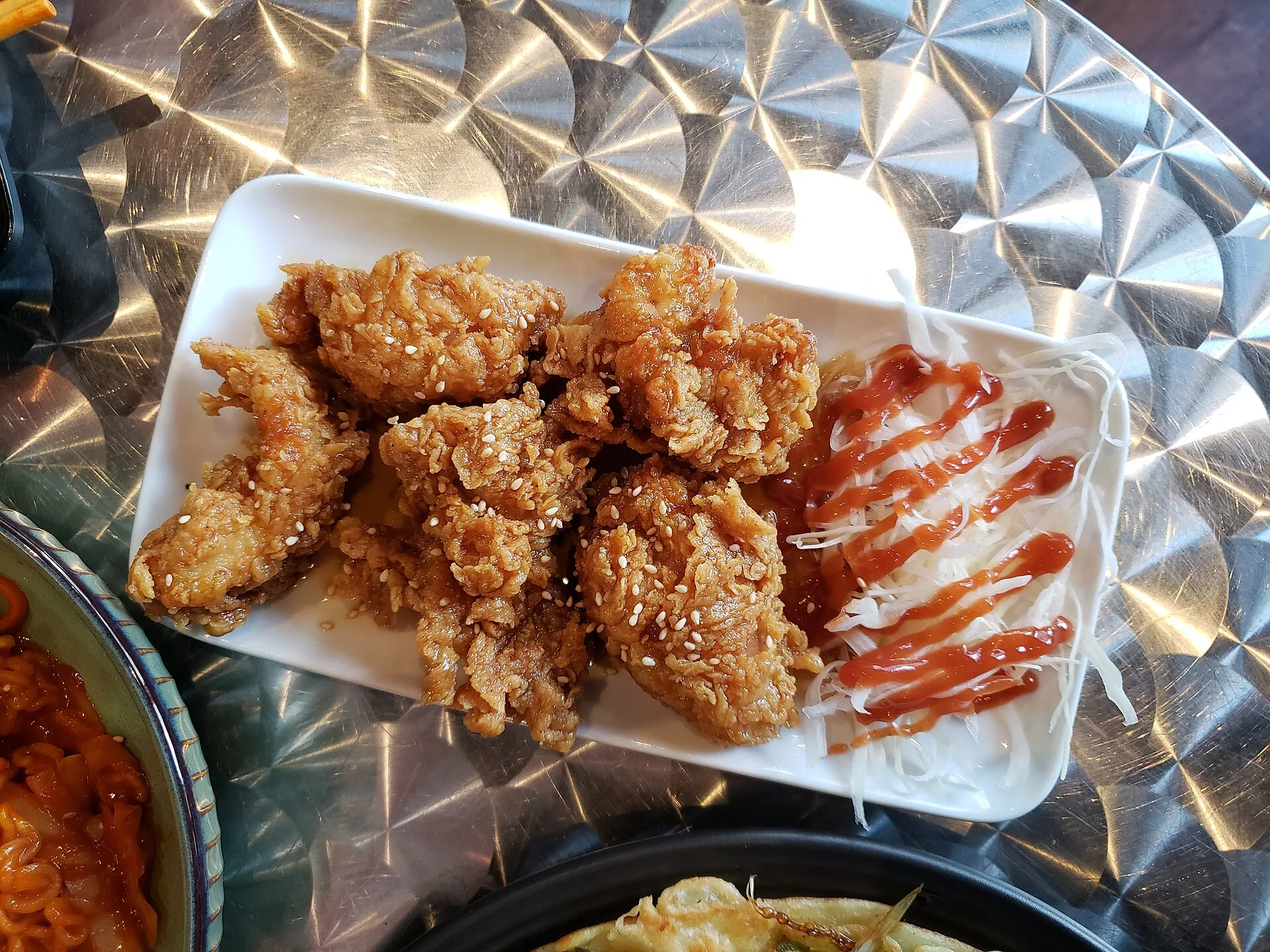
Soy chicken, ganjang chikin (간장치킨), is fried chicken brushed with or tossed in a soy-sauce glaze, as Urimalsaem defines it. VISITKOREA calls it Soy Sauce Seasoned Fried Chicken (간장 양념치킨): soy sauce is applied to crispy fried chicken, which is then stir-fried again, and despite the name it is not simply salty, because the savoury chicken comes with a sweet-and-salty sauce. VISITKOREA lists Garlic Fried Chicken (마늘치킨) separately: fried chicken topped or tossed with a garlic sauce made of soy sauce, sugar and syrup, sweet and savoury rather than spicy. This guide treats the two together as the soy-garlic style.
Unlike yangnyeom, it is usually not spicy, which makes it the sauced option for anyone who avoids chili. Menu names vary from shop to shop, such as ganjang, ganjang-maneul (soy garlic) or maneul (garlic), so it is worth asking whether it is spicy. KFPI’s 800-dish guide has no entry for it, so there is no official KFPI English name; VISITKOREA’s “Soy Sauce Seasoned Fried Chicken” is the official-source name to use. I found no origin story for soy chicken that is confirmed by more than one official source, so this guide leaves its history out.
Nutrition is harder to compare. Search the food safety ministry’s database for 간장치킨 and every dish entry carries a company name, so the closest generic entry is home-style soy fried drumsticks (간장 닭다리튀김): 323 kcal, 19.60 g of fat, 3.71 g of sugars and 410 mg of sodium per 100 g. That is not the same dish as a chicken shop’s soy chicken, so treat it as a rough guide.
If you do not like sweet glazes, the sweetness may be the catch: its base, as VISITKOREA describes it, is a sweet-and-salty sauce, so plain huraideu is the better choice for you. Since it is glazed, expect sticky fingers here too.
Chimaek and the sides: pickled radish, beer and the drinking age
Fried chicken in Korea comes with chikin-mu, pickled radish. Urimalsaem defines it as cubed radish pickled in vinegar, sugar and so on, eaten with chicken, and the KFPI essay says this crunchy, sweet-sour side cuts the greasiness and makes Korean chicken feel Korean. The same essay offers a handy order for when you want both fried and yangnyeom: “Banban, mu mani juseyo!” (half and half, and plenty of radish, please).
Add beer and you have chimaek, a blend of chikin and maekju (beer), as Urimalsaem explains. The Encyclopedia of Korean Culture says the word took off after a TV-drama scene in which the main character drinks beer with fried chicken became famous; it does not name the drama. According to a column published by the Korea Tourism Organization, fried chicken pieces spread quickly from the late 1970s and draft-beer chains also served them, which made fried chicken the byword for a beer snack, and around the 1986 Asian Games and the 1988 Olympics, ordering chicken delivery to watch sports on TV became routine. The same column notes that children have chicken with cola, which Koreans call chikol.
Daegu usually holds the Daegu Chimac Festival around Duryu Park in July (the 2023 edition ran from 30 August to 3 September, and the 2020 and 2021 editions were cancelled because of COVID-19). According to the official site, the 2026 edition, officially the 14th (the count includes the cancelled 2020 and 2021 editions), ran from 1 to 5 July from 6 p.m., and the first was held from 18 to 21 July 2013; 2027 dates were not yet on the site on 20 October 2026. The festival spells it “Chimac”, while VISITKOREA uses “chimaek”, which matches Korea’s official romanization.
If you plan to drink, know the age rule. Korea’s Youth Protection Act treats people under 19 as minors, except anyone who has reached 1 January of the year they turn 19. In practice, you can buy alcohol from 1 January of the year you turn 19, and sellers must check age and identity (Article 28), so carry ID. If you have allergies, ask about the sauce and toppings: the allergen list in Korea’s food labelling rules, as quoted by the Ministry of Food and Drug Safety, includes soybean, wheat, peanut, chicken and tomato, but it is a labelling rule for packaged food, and I could not confirm that it applies to chicken-shop menus.
Related on Rank Three: to order by delivery, see Baemin vs Yogiyo vs Coupang Eats: compare the final bill; for something other than beer, Three ways into Korean drinks: makgeolli, yakju and distilled soju; and for a first Korean barbecue, Samgyeopsal vs moksal vs galbi: which Korean BBQ cut to order first?.
Our three picks
- Fried (huraideu): no sauce, just the batter and the brineFried (huraideu)
The baseline: no sauce, just brined chicken and the batter. The standard Korean spelling is 프라이드치킨, but menus say 후라이드. The food safety ministry’s database lists 301 kcal and 415 mg of sodium per 100 g. Pickled radish on the side cuts the richness.
- Yangnyeom: a sweet-spicy glaze built on gochujangYangnyeom chicken
Tossed in a sweet-spicy sauce built on gochujang, starch syrup or sugar, and garlic. KFPI’s official names are Yangnyeom Chicken and Seasoned Fried Chicken, “mild yet spicy”. Expect sticky fingers and more sugar: 6.25 g per 100 g against 0.50 g for plain fried.
- Soy garlic (ganjang): sweet, salty and usually not spicySoy garlic (ganjang) chicken
Brushed or tossed with a soy-sauce glaze; the garlic version’s sauce is soy sauce, sugar and syrup. Usually sweet and salty rather than spicy, so it suits anyone who wants a sauce without the chili. VISITKOREA calls it Soy Sauce Seasoned Fried Chicken.
Side by side
| Item | Fried (huraideu) | Yangnyeom | Soy garlic (ganjang) |
|---|---|---|---|
| Names | Standard spelling 프라이드치킨; menus say 후라이드; also dak-twigim | 양념치킨 (KFPI: Yangnyeom Chicken / Seasoned Fried Chicken) | 간장치킨 (VISITKOREA: Soy Sauce Seasoned Fried Chicken); garlic version listed separately |
| What it is | Coated in flour and spices and deep-fried; shops brine it first and use pressure fryers | Fried chicken tossed in a red sauce | Fried chicken brushed with or tossed in a soy-sauce glaze |
| Sauce base | None; salt or a sauce on the side | Gochujang, starch syrup or sugar, garlic; sometimes soy sauce | Soy sauce; garlic version: soy sauce, sugar and syrup |
| Flavour (official descriptions) | Savoury; can taste greasy, hence the pickled radish | Sweet-spicy (KTO column); “mild yet spicy” (KFPI) | Sweet and salty; usually not spicy |
| Coating | Thin embo or thick crispy batter; wet batter turns soggy if left | Crispy commonly used (VISITKOREA); smooth batter best (encyclopedia) | Soy applied to crispy chicken, then stir-fried again (VISITKOREA) |
| Eating | By hand when bone-in; boneless can be eaten with a fork | Sauce on your fingers | Likely sticky too (editor’s inference) |
| Per 100 g (MFDS database) | 301 kcal; fat 16.57 g; sugars 0.50 g; sodium 415 mg | 276 kcal; fat 13.40 g; sugars 6.25 g; sodium 403 mg | No generic entry (home-style soy drumsticks: 323 kcal; fat 19.60 g; sugars 3.71 g; sodium 410 mg) |
| How to order | “Huraideu han mari” (one whole bird); “sunsal” for boneless | “Yangnyeom”, or “banban” (usually half fried, half yangnyeom) | “Ganjang” or the shop’s name for it; ask if it is spicy |
| Good for | A first taste of the batter itself | A sweet, spicy glaze | A sauced chicken without the chili |
What I would order first
For a first order I would get banban. One bird gives you plain huraideu and sweet-spicy yangnyeom side by side, and the KFPI essay’s line “Banban, mu mani juseyo!” is all the Korean you need. If chili worries you, choose soy garlic instead of yangnyeom; shops differ in which halves they will combine, so ask. And if beer is part of the plan, check that you have reached 1 January of the year you turn 19 and carry ID; if you have allergies, ask about the sauce first.


